

Stocking up: Savers can front load 2026 money contributions
Stocking up: Savers can front load 2026 money contributions
Popular tax-advantaged accounts have deposit limits — and timing can matter
Stocking up: Savers can front load 2026 money contributions
Popular tax-advantaged accounts have deposit limits — and timing can matter

01.06.2026

Listen
·Stocking up: Savers can front load 2026 money contributions
Key takeaways
For health spending, HSA and FSA rules differ, including eligibility, timing, and the reimbursement process.
IRA contributions allow some flexibility in which plan year you assign it to.
401(k) match timing needs a closer look into whether the plan offers a true-up.
Front-loading tax-advantaged accounts can extend time in the market, but IRS limits, reimbursement rules, and employer match timing may affect the decision-making.
For some financial accounts like savings, checking, or certificates of deposit, there’s no limit to how much people can deposit. For others that offer tax advantages, the IRS has rules around maximums people can contribute.
Funding these accounts can help lower overall tax liability and give savings a longer time horizon to build potential growth. Having a variety of places for your money also builds diversity across your net worth: Almost one in five Americans say they actively spread their efforts across multiple wealth-building strategies, according to an Empower study.
People who want to maximize their savings may consider making their contributions earlier in the year: enter “front loading.”
Health savings accounts
Known for their “triple tax advantage,” health savings accounts (HSAs) offer tax-deferred contributions and tax-free withdrawals for medical spending — and may have the option to front-load contributions in a given plan year depending on the account setup. HSAs are tied to high-deductible health plans (HDHPs), and the IRS has requirements about which plans qualify.1 For 2026, people with individual coverage can set aside $4,400 into a health savings account, and the limit rises to $8,750 for those with family coverage.
High-deductible health care plans (HDHPs) can be more financially attractive to younger, healthier adults with lower monthly premiums and the potential for health savings accounts to complement the plan. Young adults make up 44% of the U.S. population, but drive only 21% of overall health spending. Funds in an HSA do not have to be used right away, and there’s no time limit on when reimbursements can be taken. Since HSAs offer investment choices for the money within the account, they can be treated similarly to a brokerage account in terms of asset allocation.
After age 65, HSA funds can be withdrawn and used for any purpose without penalty, but they will be subject to the owner’s ordinary income tax rate if not used for qualified medical expenses. Also, state income taxes may still apply.
Read more: This savings account has tax advantages for life
Flexible spending accounts
Among the benefits that employers can offer are two types of flexible spending accounts (FSAs): medical and dependent-care costs. These plans allow workers to defer a certain amount of their paycheck — pre-tax and up to IRS limits — and the money can be used to spend directly or for reimbursement for eligible expenses.
Contributions are made from your income and deducted from your wages on a pre-tax basis. However, you’re only allowed to access the money by using it for eligible expenses.
The timing for when those funds land in the account and can be used is more complicated, however.
Medical FSA timing
The amount you elect for the year through your employer’s medical FSA program is available for use on Jan. 1. For example, if at the end of 2025 you decided on $500 for a medical FSA for 2026, that $500 amount would be available on Jan. 1, 2026. Starting then, you could make eligible medical purchases or get eligible services up to that amount and submit the expenses for reimbursement. If approved, you’d then be reimbursed based on the $500 amount, even if you may not have deferred that much yet. Throughout the rest of the calendar year, pre-tax deferrals would be taken from your paycheck and put into the FSA until the $500 amount is met.
Dependent care FSA timing
Dependent care FSAs are more of a “pay as you go” system. The amount reimbursed at a given time can only meet or be less than the amount you’ve put into the FSA already. For example, you can submit a $1,000 monthly bill for your dependent’s daycare on Feb. 1, 2026, though the plan can reimburse you only what you’ve already had deferred from your paycheck since Jan. 1, 2026. If the full amount of your eligible bill is not available, it is called a partial reimbursement.2
Regardless of when you can get reimbursed for medical or dependent care expenses through these accounts, the smartest strategy for savers is to keep diligent records. As you accumulate eligible expenses, make sure you have a receipt with the provider/company name, eligible amount, and description of the goods/services.
2026 limits on flexible spending accounts
Given the tax benefits of both accounts, the IRS sets limits on how much people can defer pre-tax. For 2026, the amounts are:3
Medical FSA: $3,400 maximum, with up to $680 eligible to carry over into 2027 (if your employer allows)
Dependent care FSA: $7,500 maximum for single filers and married couples filing jointly; $3,750 maximum for married people filing separately
Retirement savings: IRAs and workplace accounts
More than a third (36%) of Americans prioritized their financial future in 2025 by contributing to their retirement savings, according to Empower research. The start of the calendar year can be a mental milestone to take more action, though some savers have a bit of flexibility to maximize contribution amounts.
For individual retirement accounts (IRAs), people can also use the start of 2026 to still fund 2025 contributions, if they haven’t maxed out already. The IRS gives IRA savers until the federal tax filing deadline of the following year to make contributions (without extensions). That means 2025’s maximum of $7,000 ($8,000 if 50 or older) would need to be deposited by April 15, 2026, and any 2026 tax year contributions — $7,500 maximum, $8,600 if 50 or older — are due by April 15, 2027. Just make sure that you’re selecting the correct year at your financial institution when making each contribution.
Read more: Can I contribute to a 401(k) and an IRA?
Meanwhile, retirement plans set up through employers have their IRS-mandated contribution limits reset at the start of the calendar year. In 2026, you can contribute up to $24,500 to a 401(k), 403(b), and 457 plan, a boost of $1,000 from 2025. Older savers can contribute an additional $8,000 (ages 50 and older) or $11,250 (ages 60-63) on top of the deferral limit.4
If it’s within your budget and leaves enough cash flow for your lifestyle, you can adjust your contribution rate in your employer retirement account to take more money out of your early 2026 paychecks to get closer to the IRS limit earlier in the year. This gives the funds more time for potential growth, using the power of compounding.
How front-loading contributions affects employer match
Over half of all retirement plans offer an up to 5% of compensation match cap, according to the 2025 Empowering America’s Financial Journey 4th Edition report. Often, what triggers an employer match is the worker’s own paycheck deferrals. So, for example, if you contributed the full $24,500 to your plan account in the month of January, the 5% match cap would be based on your compensation through January and not your full-year compensation.
Before taking action, check with your employer on how their plan is set up. Companies may offer to “true up” their employer match if your contributions are uneven during the plan year. However, the timing of the true-up could be different, perhaps quarterly or at the end of the full plan year. You’ll need to consider the trade-off of payroll deductions happening sooner but perhaps the employer match comes later. Also take vesting schedules into account if you’re not fully contributing up to the employer match.
Read more: 401(k) matching example: Potential growth over time
Other timeline considerations
Although savers may want to be as proactive as possible, there are some specific details to remember when it comes to funding tax-advantaged accounts.
Roth IRAs have a five-year clock to avoid taxation or penalties on investment earnings. This means five years must pass before account owners can make a qualified withdrawal of earnings, along with other distribution requirements. However, Roth IRA contributions are made with after-tax dollars and can be withdrawn anytime.
Your job tenure is another consideration when it comes to front-loading. Should you leave a job during a plan year, you’ll need to arrange with your next employer about how to continue with contributions made earlier in the year. The IRS limits for workplace retirement plans are tied to the individual, not the company you’re working for. Keeping a copy of periodic account statements can help you track how close you’re getting to the annual maximums. Consulting with a tax professional before filing could also help to avoid any possible overages or adjustments.
On the clock to contribute
As the beginning of the year can push people toward taking action, it’s important to think about how front-loading accounts could help you meet financial goals sooner. Enlisting a financial advisor may bring more clarity to what’s at stake and what growth could look like.
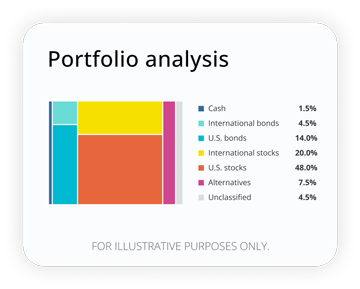
How well are your investments performing?
Analyze your portfolio in minutes and receive a target allocation for your goals.
1 IRS, “IRS releases tax inflation adjustments for tax year 2026, including amendments from the One, Big, Beautiful Bill,” October 2025.
2 WageWorks, “Dependent Care FSA FAQs,” accessed December 2025.
3 MedCost, “2026 Flexible Spending Accounts and Dependent Care Assistance Program Updates,” October 2025.
4 IRS, “401(k) limit increases to $24,500 for 2026, IRA limit increases to $7,500,” November 2025.
RO5087916-1225
 Get The Currency newsletter



The Currency editors
Staff contributors
The CurrencyTM writers and editors cover the latest financial news and insights shaping how we live, work, and play. The team provides accurate, data-driven, and timely content aimed at empowering financial freedom for all.
The content contained in this blog post is intended for general informational purposes only and is not meant to constitute legal, tax, accounting or investment advice. You should consult a qualified legal or tax professional regarding your specific situation. No part of this blog, nor the links contained therein is a solicitation or offer to sell securities. Compensation for freelance contributions not to exceed $1,250. Third-party data is obtained from sources believed to be reliable; however, Empower cannot guarantee the accuracy, timeliness, completeness or fitness of this data for any particular purpose. Third-party links are provided solely as a convenience and do not imply an affiliation, endorsement or approval by Empower of the contents on such third-party websites. This article is based on current events, research, and developments at the time of publication, which may change over time.
Certain sections of this blog may contain forward-looking statements that are based on our reasonable expectations, estimates, projections and assumptions. Past performance is not a guarantee of future return, nor is it indicative of future performance. Investing involves risk. The value of your investment will fluctuate and you may lose money.
Certified Financial Planner Board of Standards Inc. (CFP Board) owns the certification marks CFP®, CERTIFIED FINANCIAL PLANNER™, CFP® (with plaque design), and CFP® (with flame design) in the U.S., which it authorizes use of by individuals who successfully complete CFP Board's initial and ongoing certification requirements.