

How much should I have saved by 40? Get a Sense Check
How much should I have saved by 40? Get a Sense Check
Empower's Lindsey Shinners discusses retirement savings benchmarks, competing financial priorities, and how to know if you're on track in your 40s
How much should I have saved by 40? Get a Sense Check
Empower's Lindsey Shinners discusses retirement savings benchmarks, competing financial priorities, and how to know if you're on track in your 40s

11.18.2026
Key takeaways
- Saving three times your annual salary for retirement by age 40 is a common benchmark, but your personal goals and circumstances matter more than a specific number.
- Saving 15%-20% of income for retirement, maintaining an emergency fund, and taking advantage of an employer match can help strengthen your financial foundation.
- Your 40s can be a good time to stress-test your retirement plan, manage high-interest debt, and make sure lifestyle creep isn't undermining your progress.
Your 40s can feel like a financial balancing act. You may be earning more than ever, but you also may be carrying a mortgage, raising kids, saving for college, and possibly caring for aging parents. And you're supposed to be saving for retirement somewhere in the middle of it all.
So, how much should you have saved by 40 — and what if you're nowhere close? Here are some ways to assess where you stand and make the most of this decade.
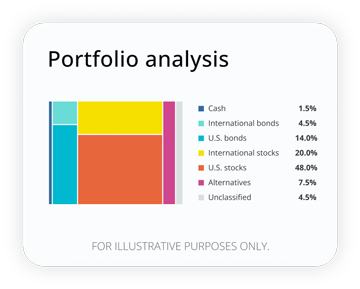
How well are your investments performing?
Analyze your portfolio in minutes and receive a target allocation for your goals.
How much should I have saved by 40?
A commonly used benchmark is to have three times your annual salary saved for retirement by age 40 — so if you're earning $100,000, the savings target would be $300,000. That can be a good gut check, but you shouldn’t panic if you’ve saved less. By the same token, you shouldn’t automatically assume you're all set if you’re ahead of the benchmark.
Salary is a starting point, but it’s only a piece of the overall picture. Considerations like when you want to retire, the lifestyle you envision, and whether you'll have a pension, Social Security income, or another income stream all factor into what retirement may actually look like for you. Your financial picture may be dramatically different if your dream is to hang out in the backyard versus travel the world.
When calculating how much you've saved, focus primarily on assets that are intended to fund your retirement. That includes 401(k)s, IRAs, 403(b)s, any health savings accounts (HSAs) you don't plan to touch until retirement, as well as taxable investment accounts earmarked for retirement. Assets such as home equity generally aren’t included in this calculation, unless you have a plan to access it during retirement.
Read more: The average 401(k) balance by age
How aggressive should my investments be at 40?
Your time horizon, not age alone, should drive your investment risk. If you're 40 and planning to retire at 65, you still have 25 years to save and invest. But if you're hoping to retire at 50, that's a very different conversation. Your ability to take on risk changes significantly when you're working with 10 years ahead of you instead of 25.
Remember, you're not just investing to get to retirement. You need that money to last through retirement, too. That means your investment strategy should account for both when you'll need the money and how long you'll need it to last.
Just as at age 30, in your 40s it can help to think about your money in buckets. For short-term goals, such as an emergency fund, vacation, or home project, you may not want to take on much investment risk if you’ll need the money within the next few years. A high-yield savings account, money market fund, or other cash alternatives may be more appropriate, depending on your liquidity needs and tolerance for risk.
For midterm goals that are five or more years away but before retirement, you may be able to take on moderate risk, depending on the timing.
You may have the most time to invest more aggressively with money that’s specifically earmarked for the long term — depending on your overall financial situation and risk tolerance. At 40 it may still be decades before you retire, so time can potentially be one of your greatest advantages and allow you to be flexible.
How should I prioritize savings in my 40s?
It can be helpful to think about financial priorities in three stages. The first is protection — which means having appropriate insurance coverage, as well as an emergency fund and cash for immediate needs and essentials like housing, groceries, and utilities. A good target can be to set aside enough to cover six months of nondiscretionary expenses for a single-income household and three months for a dual-income household.
Next, take advantage of any employer contributions to your retirement savings. If you don’t contribute enough to receive the full match, you're essentially leaving “free money” on the table.
Then focus on retirement savings. One common guideline is to aim to save 15%-20% of your income for retirement, although the appropriate amount depends on your individual circumstances and goals. You’ll have more flexibility if you've run the numbers and know you're saving enough to make your retirement plan. Depending on your goals, this could mean anything from saving more so that you can retire earlier, to taking a family vacation or tackling a home renovation. It's about balancing return on investment with return on life.
Read more: How do I know if I’m ready to retire? Get a Sense Check
How does debt affect savings targets at 40?
With so many competing needs, it’s not unusual to have debt in your 40s. But not all debt is created equal. Debt from an affordable mortgage at age 40 is not the same as carrying credit card debt at 20% interest or more — while also trying to invest and save.
Consider directing additional money toward paying down high-interest debt once you've established an emergency fund and are contributing enough to receive your full employer match. This can help reduce the amount you're spending on interest while continuing to build your retirement savings.
There are a few different approaches to paying down that debt. Some people prefer to start with the smaller balance debt because emotionally it can feel good to pay it off sooner. But it can potentially make better financial sense to start making a dent in the highest-interest debt first while making minimum payments on everything else. The ultimate goal is pay off the debt, so whatever approach you can stick with is the one that's going to work best.
Read more: 6 ways to balance your saving, debt payoff, and investing goals
What if I'm 40 and behind on retirement savings?
While it’s never too late to save, 40 is a good point to stop saying you'll catch up later—especially if you discover you’re behind on your goals.
The first step is figuring out the gap. Ask yourself: How much have you saved? What income do you expect in retirement? How much do you plan to spend, and when do you want to retire? Once you put those numbers together, you can determine how much you need to save going forward.
It’s important not to delay just because you’re behind. While the number may feel daunting, waiting further likely will end up being even more overwhelming. If you can’t hit your target savings number for the year, then save what you can to start narrowing that gap.
How can I avoid lifestyle creep as my income grows?
When you’re earning more, it can be tempting to spend more — but lifestyle creep can be a lot more expensive at 40 than it is at 30. The standard of living at this stage of life could very well become the lifestyle you want to maintain in retirement. If you start spending an additional $1,000 a month, that’s not just $12,000 more a year from now — it’s also potentially creating the expectation that your retirement plan will need to support another $12,000 annually too.
Extra income can instead be an opportunity to accelerate your savings. You might consider automatically allocating half of every raise toward retirement. That way, you still enjoy making more money while investing in your future.
Read more: What is lifestyle creep, and how can you control it?
How can I balance retirement with other financial priorities?
Your 40s can be a sandwich-generation decade, when financial responsibilities to children and aging parents can compete with your own long-term goals. With so many demands on your money, deciding how much to allocate toward each priority can be challenging.
One principle worth remembering is that you can borrow for college, but you can't borrow for retirement. If helping your children pay for their education is a priority, it's important to understand what it will take to make that happen and how it fits into your overall financial plan. Maybe it means increasing your savings, adjusting other spending priorities, or even working a couple of extra years.
Ultimately, it's about making intentional choices. There isn't a one-size-fits-all approach to balancing competing financial goals, but understanding the trade-offs can help you support the people and priorities that matter most without losing sight of your own retirement.
Read more: Is a 529 plan worth it? Pros, cons, and when it makes sense
How do I know if I'm actually on track for retirement?
By 40, it's time to go beyond simply monitoring your net worth and take a closer look at whether your savings and investments are on track to support your retirement goals.
While salary multiples are a useful gut check and your net worth shows progress, they're not a substitute for an actual retirement plan. This can be a good time to start using retirement projections and stress-test your financial plan — what you're spending, when you plan to retire, what Social Security or pension income you may receive, and what health care costs might look like, especially if you're retiring before Medicare eligibility at 65.
It can also be easy to fall into the trap of comparing yourself to your neighbors at this stage of life. But remember you have no idea what their net worth is, how much debt they're carrying, or whether they have anything saved in their 401(k). The best measure of how you’re doing is you — and whether you’re making progress toward your goals and the retirement you want.
Read more: How much do I need to retire? Why one number isn’t the whole story
Is it okay to dip into savings in my 40s?
The question of whether to use your savings comes down to which savings you’re talking about and why. Every dollar has a job. Using your emergency fund or a sinking fund to pay for a leaky roof is what the money is there for, but tapping your 401(k) to renovate your kitchen is a different story — especially when taxes, potential penalties, and lost investment growth may be involved.
Ultimately, the goal isn't simply to accumulate as much money as possible. Money is a tool that we’re meant to use — to build financial security while still having the flexibility to enjoy the life you're living now. After all, you can't put everything off until retirement.
Looking ahead: What should I aim for by 50?
As you approach 50, the goal is to have a consistent savings rate and a clearer picture of what retirement will look like, including when you plan to retire and how much you'll need to support your lifestyle. Other milestones to work toward include eliminating high-interest debt, maintaining an appropriate emergency reserve, and ensuring your investments remain diversified.
To help stay on track, it can make sense to review your financial plan at least annually and whenever something meaningful changes in your life. This can help you assess your progress, revisit your investment strategy, and rebalance your portfolio when appropriate.
Your 30s are about building a financial foundation and establishing good habits. At 40, it's about pressure-testing those habits to see if they're actually pointing toward the life you want. By 50, you want a clearer answer to what retirement looks like for you — and whether the decisions you're making today will get you there.
Read more: How much should I have saved by 30? Get a Sense Check
Investing involves risk, including possible loss of principal.
Past performance is not indicative of future results.
RO6121345-1126
 Get The Currency newsletter



The content contained in this blog post is intended for general informational purposes only and is not meant to constitute legal, tax, accounting or investment advice. You should consult a qualified legal or tax professional regarding your specific situation. No part of this blog, nor the links contained therein is a solicitation or offer to sell securities. Compensation for freelance contributions not to exceed $1,250. Third-party data is obtained from sources believed to be reliable; however, Empower cannot guarantee the accuracy, timeliness, completeness or fitness of this data for any particular purpose. Third-party links are provided solely as a convenience and do not imply an affiliation, endorsement or approval by Empower of the contents on such third-party websites. This article is based on current events, research, and developments at the time of publication, which may change over time.
Certain sections of this blog may contain forward-looking statements that are based on our reasonable expectations, estimates, projections and assumptions. Past performance is not a guarantee of future return, nor is it indicative of future performance. Investing involves risk. The value of your investment will fluctuate and you may lose money.
Certified Financial Planner Board of Standards Inc. (CFP Board) owns the certification marks CFP®, CERTIFIED FINANCIAL PLANNER™, CFP® (with plaque design), and CFP® (with flame design) in the U.S., which it authorizes use of by individuals who successfully complete CFP Board's initial and ongoing certification requirements.