

IRA vs 401(k): Key differences
IRA vs 401(k): Key differences
IRAs and 401(k)s are tax-advantaged retirement accounts that can help you save for post-work years. Learn how they differ in benefits, rules, and eligibility
IRA vs 401(k): Key differences
IRAs and 401(k)s are tax-advantaged retirement accounts that can help you save for post-work years. Learn how they differ in benefits, rules, and eligibility

07.10.2026
Key takeaways
- You can open an IRA independently, while a 401(k) is offered through your employer. This can make IRAs a more accessible option when saving for retirement.
- 401(k)s usually offer higher contribution limits and may include employer matching, while IRAs typically offer more investment choice and control.
- Many savers contribute to both an IRA and a 401(k), allowing them to take advantage of the benefits of each account.
IRAs and 401(k)s are tax-advantaged retirement accounts that can help support financial security during retirement. As two of the most popular retirement savings accounts, IRAs and 401(k)s can offer valuable tax advantages through traditional or Roth contributions.
However, IRAs and 401(k)s differ in eligibility requirements, contribution and withdrawal rules, and features such as employer matching and investment flexibility. Taking a closer look at how these accounts compare can help you decide whether an IRA, a 401(k), or both may fit into your retirement strategy.
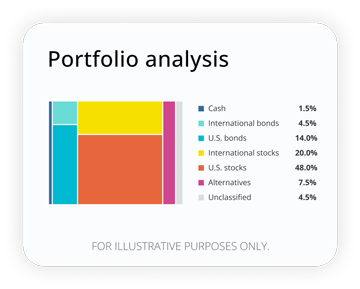
How well are your investments performing?
Analyze your portfolio in minutes and receive a target allocation for your goals.
What is an IRA?
An individual retirement account, or IRA, is a type of tax-advantaged account that can help build your retirement savings by offering potential tax savings and investment opportunities. An IRA is typically self-initiated, unlike a 401(k) plan, which is offered through an employer and funded with payroll deductions.
You can open an IRA directly with a financial services provider and make direct contributions either periodically or as a lump sum each year, up to annual contribution limits.
Whether used alongside a 401(k) plan or in the absence of one, an IRAs’ potential tax savings and investment opportunities can be an important piece of your retirement strategy.
Benefits of an IRA
- Tax advantages: You may receive an upfront tax break or tax-free qualified withdrawals during retirement, depending on whether you choose a traditional or Roth IRA.
- Account ownership: An IRA is owned and controlled by the individual and is not tied to a specific employer. This means you can continue contributing to and managing the account regardless of changes in employment.
- Investment opportunities: IRAs may offer a wider range of investment options than employer-sponsored retirement plans as they are not limited to those selected by your employer.
Individual retirement accounts are valuable tools when it comes to saving for retirement. Roth IRAs alone account for 32.3% of Gen Z’s retirement savings and 25.3% of Millennials’ as of March 2026. Spousal IRAs also provide a unique opportunity for nonworking spouses to contribute to their own IRA based on their working spouse’s income.
Read more: 5 IRA benefits for retirement planning
What is a 401(k)?
A 401(k) is an employer-sponsored retirement plan that allows eligible employees to contribute a portion of their wages to save and invest for retirement. 401(k)s provide higher contribution limits than IRAs, allowing you to save more for retirement each year. Many employers also offer matching contributions, adding money to your 401(k) based on how much you contribute.
Read more: Types of 401(k) plans
Benefits of a 401(k)
- Tax advantages: You may receive an upfront tax break or tax-free qualified withdrawals during retirement, depending on whether you choose to contribute to a traditional pre-tax or Roth 401(k) account.
- Employer matching: Your company may contribute funds to your 401(k) account, matching a percentage of your own contributions. Employer matches do not count toward your individual contribution limit.
- Higher contribution limits: You can contribute up to $24,500 ($32,500 if ages 50 to 59 or over 63, and $35,750 if ages 60 - 63) to your 401(k) in 2026. This is substantially higher than the IRA contribution limit of $7,500 ($8,600 if age 50 or older) across all IRAs.
Read more: Top benefits of a 401(k) plan
IRA vs 401(k): Differences in benefits, rules, & eligibility
There are several major differences between IRAs and 401(k)s as outlined in the table below:
| IRA | 401(k) |
Eligibility | Must have taxable compensation; income cap on Roth contributions | Only available through an employer |
Employer matching | No employer matching | Employer matching is common, but not required |
Contribution limits in 2026 | $7,500 across all IRAs; $8,600 if age 50 or older | $24,500; $32,500 if age 50 or older; $35,750 if age 60 to 63 |
Investment options | Flexible, determined by the investment firm or provider | Varies between employers |
Withdrawals | Can begin at age 59 ½ to avoid early withdrawal tax penalty. | Same as IRA, with the exception of the Rule of 55 |
Loans | Loans not allowed | Varies, if allowed, may generally be up to 50% of your vested balance and capped at $50,000 |
Required minimum distributions (RMDs) | Beginning at age 73; only apply to traditional IRAs; can withdraw the combined RMD total from one IRA or split it across several | Beginning at age 73; only apply to traditional pre-tax 401(k)s; can take RMDs for each account separately
|
Eligibility
401(k)s are employer-sponsored retirement plans, meaning they are only available when offered by a participating employer. However, IRAs are available to almost anyone with taxable income. Roth IRAs do have additional income limits, based on filing status and Modified Adjusted Gross Income (MAGI), which may affect your eligibility.
Employer matching
Many 401(k) plans offer employer matching, while IRAs do not. This means that your employer can contribute a certain amount to your 401(k) based on the amount you contribute. Employer matching contributions don’t count toward your annual contribution limit, but there is a limit for you and your employer contributions combined: In 2026, the limit is either 100% of your salary or $72,000 ($80,000 including catch-up contributions or up to $83,250 if you’re age 60 to 63), whichever comes first.
Contributions made by employers to your 401(k) may be subject to a vesting period. Vesting is the process by which employees gain ownership of employer contributions made to their account over time. While employees always retain ownership of their own 401(k) contributions, employer matches often follow a vesting schedule. For example, you may become fully vested in employer matching contributions after three years, or your plan may use gradual vesting, where your ownership increases incrementally over time.
Contribution limits in 2026
A significant benefit of 401(k)s is their high contribution limits — up to $24,500 to a 401(k) in 2026, plus an additional $8,000 if you are age 50 or older. There’s also an additional $3,750 (on top of the $8,000) catch-up contribution available if you’re age 60 to 63. As 401(k) plans are subject to IRS non-discrimination rules, annual contribution limits may be lower for certain highly compensated employees.
IRAs have significantly lower contribution limits than 401(k)s. You can contribute up to $7,500 across all IRA(s) in 2026, or 100% of your earned income, whichever is less. If you’re age 50 or older, you can make a catch-up contribution of $1,100, bringing the total contribution limit to $8,600 for 2026.
Roth IRAs, unlike Roth 401(k)s, have an additional income limit that can lower the amount you’re able to contribute. Based on your filing status and your Modified Adjusted Gross Income (MAGI), you may be able to contribute the maximum amount, a reduced amount, or nothing at all.1 However, you may still be able to use a backdoor Roth conversion to contribute indirectly.
Investment options
IRAs typically offer a wider range of investment options than 401(k)s as they are not limited to the selections offered by your employer. Typically, when you contribute to a retirement account, you have the option to invest this money into securities and funds. With IRAs, your IRA investment options depend on the financial institution where you open the account. You can shop around until you find the option that fits your needs, offering greater flexibility in how you invest your contributions.
In most plans, you can also invest your 401(k) contributions, though you will need to choose from the investment options provided by your employer. Mutual funds are a popular type of investment offered in 401(k)s and can give you access to dozens or even hundreds of underlying securities.
Read more: Roth IRA investments: A tool to help grow retirement wealth
Withdrawals
In general, you can take tax and penalty free withdrawals from your 401(k) or IRA beginning at age 59 ½. Early withdrawals from pre-tax accounts are typically subject to ordinary income taxes as well as a 10% early withdrawal penalty.
There is, however, an exception known as the Rule of 55. If you leave your job during or after the year you turn age 55, you may begin taking 401(k) withdrawals without paying the IRS 10% early withdrawal penalty, although you’ll pay ordinary income taxes on your withdrawals. The Rule of 55 doesn’t apply to IRAs as funds are intended to remain in the account until at least age 59 ½. Traditional IRA distributions at this time will be subject to income taxes. For Roth IRAs, original contributions can be withdrawn at any time tax- and penalty-free. Roth 401(k)s do not have the same contribution withdrawal rules; distributions are generally subject to plan restrictions, and nonqualified distributions include both contributions and earnings on a proportional basis.
Loans
You cannot borrow money from your IRA, but you may be eligible to take a loan from your 401(k). Often referred to as a retirement plan loan, 401(k) loans allow you to borrow from the balance you’ve built up in your retirement account. Generally, if allowed by the plan, you may borrow up to 50% of your vested balance, for a maximum loan amount of $50,000.
The IRS does offer a few exceptions that allow you to withdraw money from your IRA early without facing a 10% penalty. Outside of these IRS exceptions, taking money from your IRA will generally be considered a withdrawal and will be taxed as such. The consequences of that will depend on the type of IRA you have.2
Read more: 401(k) loans: What they are and how they work
Required minimum distributions (RMDs)
Both 401(k)s and traditional IRAs are subject to required minimum distributions (RMDs), but they differ in how distributions can be taken. RMDs are mandatory withdrawals from tax-deferred retirement accounts beginning at age 73.
With traditional IRAs, you generally need to calculate the RMD for each account separately, but you can withdraw the combined RMD total from one account or split it across several. Alternatively, with 401(k)s, you must generally calculate and take RMDs for each account separately. Some 401(k) holders can also delay taking RMDs if they are working beyond age 73 and do not own more than 5% of the company they work for.
Tools like Empower’s RMD calculator can give you a better idea of what your required minimum distributions could look like in retirement.
Can you contribute to an IRA and a 401(k)?
Contributing to both an IRA and a 401(k) can be a great way to boost your retirement savings and put even more of your money to work in tax-advantaged accounts. For eligible low- and moderate-income savers, contributions to an IRA, 401(k), or both may also qualify for the Saver’s Credit, which can add to the tax benefits of saving for retirement. If you have access to a 401(k) plan at work, you may not be eligible to deduct contributions made to a traditional IRA.
If your employer offers a 401(k) match, consider contributing enough to receive the full match before funding an IRA. Once you’ve taken full advantage of any employer matches, the choice whether to contribute to your IRA or 401(k), or both, comes down to differences in income limits, taxes, and investment options.
Read more: Can I contribute to a 401(k) & an IRA?
The bottom line
IRAs and 401(k)s both offer unique benefits when financially preparing for retirement. A 401(k) may offer employer matching and higher contribution limits through work, while an IRA may offer more control over where you invest. If you’ve recently left a job and no longer want to keep your 401(k) funds in the account, then you may be able to roll those savings into another eligible retirement account, such as a new employer plan or IRA, depending on plan rules, taxes, and timing requirements.
If you’re eligible to contribute to both types of retirement accounts, doing so can help you make the most of any employer matching, max out both 401(k) and IRA contribution limits, and build a diverse investment portfolio along the way.
** This calculator is for information purposes only and is not intended to provide investment, legal, tax or accounting advice, nor is it intended to indicate the performance, availability or applicability of any product or service.
1 Investopedia, “Modified Adjusted Gross Income (MAGI): Calculating and Using It,” May 2026.
2 IRS, “Retirement topics - Exceptions to tax on early distributions,” December 2025.
RO 5722381-0726
 Get The Currency newsletter



The Currency editors
Staff contributors
The CurrencyTM writers and editors cover the latest financial news and insights shaping how we live, work, and play. The team provides accurate, data-driven, and timely content aimed at empowering financial freedom for all.
The content contained in this blog post is intended for general informational purposes only and is not meant to constitute legal, tax, accounting or investment advice. You should consult a qualified legal or tax professional regarding your specific situation. No part of this blog, nor the links contained therein is a solicitation or offer to sell securities. Compensation for freelance contributions not to exceed $1,250. Third-party data is obtained from sources believed to be reliable; however, Empower cannot guarantee the accuracy, timeliness, completeness or fitness of this data for any particular purpose. Third-party links are provided solely as a convenience and do not imply an affiliation, endorsement or approval by Empower of the contents on such third-party websites. This article is based on current events, research, and developments at the time of publication, which may change over time.
Certain sections of this blog may contain forward-looking statements that are based on our reasonable expectations, estimates, projections and assumptions. Past performance is not a guarantee of future return, nor is it indicative of future performance. Investing involves risk. The value of your investment will fluctuate and you may lose money.
Certified Financial Planner Board of Standards Inc. (CFP Board) owns the certification marks CFP®, CERTIFIED FINANCIAL PLANNER™, CFP® (with plaque design), and CFP® (with flame design) in the U.S., which it authorizes use of by individuals who successfully complete CFP Board's initial and ongoing certification requirements.