

What is a 529 plan? How it works, potential benefits, & key rules
What is a 529 plan? How it works, potential benefits, & key rules
Learn what a 529 plan is, potential tax benefits, financial aid rules, and how to use one for education expenses
What is a 529 plan? How it works, potential benefits, & key rules
Learn what a 529 plan is, potential tax benefits, financial aid rules, and how to use one for education expenses

05.15.2026
Key takeaways
- A 529 plan offers tax-advantaged savings for education, with tax-free withdrawals for qualified expenses.
- You can open, fund, and invest a 529 account over time to cover a range of education costs.
- Funds are generally used for education, since non-qualified withdrawals may trigger taxes and penalties.
A 529 plan is a tax-advantaged account designed to help pay for education expenses. Savers make contributions with after-tax dollars, invest the funds for potential growth, and can make tax-free withdrawals for qualified education costs. Those expenses can include college, certain K–12 tuition, apprenticeships, student loan repayment, and professional credential programs, depending on current federal and state rules.1
Using a 529 plan is generally straightforward: a U.S. adult opens an account, names a beneficiary, contributes and invests over time, keeps records of qualified expenses, and then withdraws funds in the same tax year those costs are incurred. To estimate how much you might need to save, try Empower’s 529 College Savings Calculator.*
What is a 529 plan?
A 529 plan, also known as a qualified tuition program (QTP), is a state-sponsored account that lets an account owner save and invest for a beneficiary’s future education expenses. These plans are typically sponsored by states, state agencies, or educational institutions, and the account owner generally controls contributions, investment choices, beneficiary changes, and withdrawals. Funds are intended for qualified education expenses as defined under federal tax rules.2
Here are a few key terms to know:
Key term | Definition |
Account owner | Person who opens and controls the 529 account. |
Beneficiary | Person whose education expenses the account is meant to pay for. This could be the same person as the account owner if over age 18. |
Qualified expenses | Education costs that can be paid with 529 funds without federal tax on earnings. |
Nonqualified withdrawal | A withdrawal not used for qualified education expenses, generally triggering taxes and a 10% penalty on earnings |
How does a 529 plan work?
A 529 plan can be opened by any eligible adult for a beneficiary, such as a child, or for their own education expenses. Here’s how opening a 529 and using the funds generally works in practice:
- Choose a plan: Compare 529 plans offered by states, state agencies, and financial institutions based on potential state tax benefits, fees, investment options, performance, and any residency rules. You’re generally not limited to your own state’s plan, so it can be worth shopping around.3
- Open the account: To open a 529 account, you will need to provide the name, date of birth, and Social Security Number (SSN) or other tax identification number for both the account owner and the beneficiary. Many 529 plan providers allow you to open an account online, though requirements and steps can vary by plan.
- Contribute money: Contributions are usually made after-tax and can come from parents, grandparents, relatives, or friends. A 529 calculator can help you determine a monthly contribution amount to meet your savings goal, though contributions can generally be made in almost any amount and at any time.
- Invest the money: 529 plans typically offer portfolios consisting of mutual funds or exchange-traded funds (ETFs), which can potentially grow tax-deferred to pay for qualified education expenses. Investments may be generally managed through age-based portfolios — which automatically shift from aggressive to conservative as the beneficiary nears college age — or static portfolios that maintain a fixed risk level.4
- Use the money for qualified expenses: As the beneficiary incurs qualified expenses, you can either pay bills first and then reimburse yourself from the 529 account, or withdraw money from the 529 account first and then use it to pay bills. Just be sure to keep all documentation to demonstrate the costs were qualified and that reimbursement was made in the same tax year.5
- Adjust if plans change: If plans change, you have flexibility in how you use the 529 plan. If the beneficiary doesn’t go to college or doesn’t use all the funds in the account, options include changing beneficiaries, leaving the funds invested, using funds for qualified non-college education expenses, or considering a 529-to-Roth IRA rollover.
What can a 529 plan be used for?
529 plan funds can be used for a range of education expenses, but the details depend on how the money is spent and current federal and state rules. Current qualified expenses include:
Qualified use | What to know |
College tuition and fees | Covers eligible colleges, universities, vocational schools, and other postsecondary institutions. |
Room and board | Typically requires at least half-time enrollment and is limited to the school’s cost of attendance. |
Books, supplies, and equipment | Must be required for enrollment or attendance. |
Computers, software, and internet | Covered if the student uses it mostly for school while they’re enrolled. |
Apprenticeship programs | Must be part of an IRS-recognized program. |
Student loan repayments | Allowed up to a lifetime limit of $10,000 per individual. 6 |
K–12 tuition | Annual limits apply; eligible expenses may vary by state and current rules. |
Professional and continuing education | Coverage depends on current rules and program eligibility. |
The table above covers the most common uses, but not every eligible expense. For a more complete breakdown, see our full guide to qualified 529 expenses.
529 tax benefits
A 529 plan offers several potential tax advantages that can help families build education savings more efficiently over time.
Tax-deferred potential growth and tax-free qualified withdrawals
One of the primary benefits is federal tax-deferred potential growth, meaning any investment earnings within the account are not taxed if they accumulate. When funds are used for qualified education expenses — such as tuition, fees, room and board, and certain required supplies — withdrawals are generally federal income tax-free. This structure can make a 529 plan more efficient than saving in a taxable investment account for education-specific goals.
State tax deductions and credits
In addition to federal benefits, many states offer income tax deductions or credits for contributions to a 529 plan.7 These incentives vary by state and which plan you choose, and in some cases may only apply to state residents. State tax treatment varies, and some states may recapture prior deductions or credits if money is rolled over or withdrawn for expenses the state does not recognize.
Contribution rules and income limits
529 plans do not have a federal income limit, meaning anyone can open or contribute to an account regardless of earnings. There is also no strict federal annual 529 contribution limit. However, contributions are subject to gift tax rules.8
Gift tax considerations for 529 contributions
For 2026, the annual gift federal tax exclusion allows individuals to contribute up to $19,000 per recipient (or $38,000 for married couples filing jointly) without triggering gift tax reporting requirements.9 Some contributors may choose to “superfund” a 529 plan by making 5 years of gifts at once, totaling $95,000 per person or $190,000 for married couples.10
What happens if you don’t use all the 529 money?
A common misconception is that 529 funds are inaccessible if the beneficiary doesn’t use all the money or chooses not to go to college. A key benefit of 529 plans is that there is no use-it-or-lose-it policy. There are a variety of ways to use excess 529 funds, including:
- Leave the funds invested: You can keep the money in the account to use for future education expenses, such as graduate school or other qualified programs.
- Changing the beneficiary: You can typically change a 529 plan beneficiary online or via a form from your plan provider. The new beneficiary must be a qualifying family member of the original to avoid taxes and 10% penalties.11
- Use the funds for other qualified expenses: Depending on current rules, 529 funds may be used for expenses beyond traditional college, such as certain apprenticeship programs, student loan repayments, or other eligible education costs.
- Complete a 529-to-Roth IRA rollover: In some cases, you may be able to roll up to $35,000 of 529 funds into a Roth IRA. This can turn unused education savings into a powerful retirement boost — and potentially tax-free if certain conditions are met. Carefully consider all your options, including tax implications, fees, and expenses, before moving money between accounts. Assess all features of current accounts before moving money.
- Making a non-qualified withdrawal: You can withdraw funds for non-education expenses, but earnings on those withdrawals are generally subject to income tax and a 10% penalty.
Read more: 529 plan myths: 6 facts that could change how you save
Is a 529 plan worth it?
A 529 plan is generally considered a powerful savings tool for future education expenses because it offers tax-free potential growth and tax-free withdrawals on qualified expenses.
A 529 may make sense if... | A 529 may be less ideal if... |
You want tax-advantaged education savings. | You need unrestricted access to the money for non-education goals. |
You have time to invest before education bills arrive. | Investment values can rise or fall with the market, especially over shorter time horizons. |
Your state offers a meaningful tax benefit. | You haven’t built an emergency fund or your retirement savings are underfunded. |
You want family members to contribute to a specific education goal. | You’re unsure whether the beneficiary will use the funds for qualified education expenses |
529 plan Frequently Asked Questions
How much can I contribute to a 529 plan?
529 plans do not have a strict federal annual contribution limit, but contributions may be subject to gift tax rules. Each plan also sets an overall account balance limit, which can vary by state. For a deeper breakdown of contribution rules and limits, see our guide to 529 contribution limits.
Who can open a 529 plan?
A 529 plan can typically be opened by any U.S. citizen or resident alien over 18 with a social security number or tax identification number, either for themselves or for a designated beneficiary. Contributions are not limited to the account owner — family members and friends can also add funds. There are no federal income limits that restrict who can open or contribute to a 529 plan.
Do 529 plans affect financial aid?
The impact of 529 plans on financial aid generally depends on the owner of the account. Assets reported on the Free Application for Federal Student Aid (FAFSA) are assessed at different rates, with parent assets typically assessed at up to about 5.64%, compared to up to 20% for student assets.12 However, 529 plans for dependent students are generally treated as parent assets regardless of whether the account is owned by the parent or the student.13
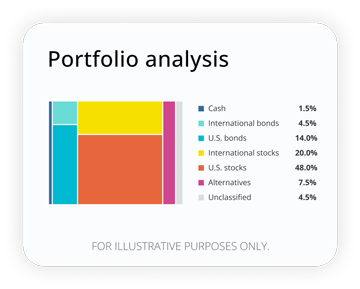
How well are your investments performing?
Analyze your portfolio in minutes and receive a target allocation for your goals.
*This calculator is for information purposes only and is not intended to provide investment, legal, tax or accounting advice, nor is it intended to indicate the performance, availability or applicability of any product or service.
Exchange-traded funds (ETFs) are a type of exchange-traded investment product that must register as either an open-end investment company (generally known as “funds”) or a unit investment trust. ETFs are not mutual funds.
Unlike with mutual funds, individual shares of ETFs are not redeemable directly with the issuer. ETF shares are a collection of securities bought and sold at market price, which may be higher or lower than the net asset value. Investment returns will vary based on market conditions and volatility, so an investor’s shares, when redeemed or sold, may be worth more or less than their original cost. ETFs are subject to risks, including those of their underlying securities.
1 IRS, “529 Plans: Questions and answers,” January 2026.
2 IRS, “Topic no. 313, Qualified tuition programs (QTPs),” February 2026.
3 IRS, “529 Plans: Questions and answers,” January 2026.
4 Investor.gov, “An Introduction to 529 Plans,” January 2026.
5 IRS, “Publication 970 (2025), Tax Benefits for Education,” April 2026.
6 IRS, “Topic no. 313, Qualified tuition programs (QTPs),” February 2026.
7 Ibid.
8 IRS, “529 Plans: Questions and answers,” January 2026.
9 IRS, “Frequently asked questions on gift taxes,” December 2025.
10 IRS, “Publication 970 (2025), Tax Benefits for Education,” April 2026.
11 IRS, “529 Plans: Questions and answers,” January 2026.
12 Finaid.org, “Account Ownership: In Whose Name to Save?” May 2026.
13 FAFSA, “Filling Out the FAFSA Form,” May 2026.
RO5480558-0526
 Be current.



The Currency editors
Staff contributors
The CurrencyTM writers and editors cover the latest financial news and insights shaping how we live, work, and play. The team provides accurate, data-driven, and timely content aimed at empowering financial freedom for all.
The content contained in this blog post is intended for general informational purposes only and is not meant to constitute legal, tax, accounting or investment advice. You should consult a qualified legal or tax professional regarding your specific situation. No part of this blog, nor the links contained therein is a solicitation or offer to sell securities. Compensation for freelance contributions not to exceed $1,250. Third-party data is obtained from sources believed to be reliable; however, Empower cannot guarantee the accuracy, timeliness, completeness or fitness of this data for any particular purpose. Third-party links are provided solely as a convenience and do not imply an affiliation, endorsement or approval by Empower of the contents on such third-party websites. This article is based on current events, research, and developments at the time of publication, which may change over time.
Certain sections of this blog may contain forward-looking statements that are based on our reasonable expectations, estimates, projections and assumptions. Past performance is not a guarantee of future return, nor is it indicative of future performance. Investing involves risk. The value of your investment will fluctuate and you may lose money.
Certified Financial Planner Board of Standards Inc. (CFP Board) owns the certification marks CFP®, CERTIFIED FINANCIAL PLANNER™, CFP® (with plaque design), and CFP® (with flame design) in the U.S., which it authorizes use of by individuals who successfully complete CFP Board's initial and ongoing certification requirements.