

6 ways to balance your saving, debt payoff, and investing goals
6 ways to balance your saving, debt payoff, and investing goals
How an “order of operations” approach can help you prioritize your competing financial demands with purpose
6 ways to balance your saving, debt payoff, and investing goals
How an “order of operations” approach can help you prioritize your competing financial demands with purpose

05.28.2026
Key takeaways
- Securing your full employer 401(k) match can be one of the simplest and most effective ways to boost long-term savings.
- Building emergency savings and paying down high-interest debt can help create financial stability before ramping up investing goals.
- Once foundational goals are in place, additional dollars can go toward future milestones like buying a home, saving for college, and accumulating long-term wealth.
As your paycheck grows, your financial priorities often grow with it. Balancing goals like saving, paying down debt, and investing can feel overwhelming — especially if you’re just getting started. Each objective — between building an emergency fund, paying off debt, saving for a home, investing for retirement, and maybe even planning for a child’s education — can feel equally urgent. It can be hard to know what should come first.
The good news: You don’t have to do everything at once, and there’s no single rule for what should come first. What matters most is building a strategy that fits your goals and your budget.
One way to get started is with an “order of operations” or “financial waterfall” approach — a step-by-step framework that helps you decide where your dollars should go first. Instead of trying to optimize every goal at the same time, this strategy can help you prioritize the steps that build a stronger financial foundation.
This practical roadmap may help you balance savings, debt, and investing goals without spreading yourself too thin.
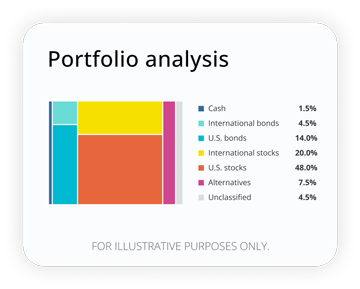
How well are your investments performing?
Analyze your portfolio in minutes and receive a target allocation for your goals.
1. Secure your employer retirement match
If your employer offers a 401(k) match, this can be an easy and effective place to start. An employer match can help grow your retirement savings just by contributing to your plan, which can be a financial win for you over time.
Skipping the match can mean leaving part of your compensation on the table. For example, if your employer matches contributions up to 3% of your salary, contributing enough to get the full match could instantly double that portion of your savings. A worker earning $75,000 annually could receive an extra $2,250 per year from their employer just by meeting the match threshold.
Even with competing financial priorities, contributing enough to secure the full match can provide an immediate return on contributions that’s difficult to replicate elsewhere. Since 401(k) contributions typically are deducted automatically from each paycheck, capturing the match can also be one of the simplest ways to help you build long-term savings consistently.
Read more: 401(k) matching example: Potential growth over time
2. Start building your emergency cushion
Creating an emergency cushion for unexpected costs like car repairs, medical bills, or job loss can help keep your financial progress on track. The median emergency savings in the U.S. is $500, and one in three Americans have no emergency savings set aside at all.
Conventional wisdom suggests saving enough to cover three to six months of essential expenses. This may feel like an overwhelming goal for some — but it shouldn’t deter you from getting started. Even a small emergency fund can help cover unexpected costs and potentially reduce the need to take on debt.
The goal at this stage isn’t to fully fund every possible emergency. It’s to create enough breathing room to reduce financial stress as you continue to make progress in other areas.
Read more: How to build an emergency fund
3. Tackle high-interest debt
Once a starter emergency fund is in place, consider turning your attention to any high-interest debt you may hold — especially credit cards.
Credit card debt hit a record $1.28 trillion at the start of 2026, and the average interest rate on accounts carrying a balance sits at 21.52%. High borrowing costs can make it harder for your investments to outpace the savings you gain by paying off expensive debt.
There are two main strategies. The avalanche method prioritizes paying off balances with the highest interest rates first, which can be a good option if your goal is saving money. The snowball method focuses on paying off the smallest balances first, which can help build momentum by giving you quick wins. Ultimately, the best option can depend on whichever one you’re able to stick to consistently.
Read more: How do I pay off credit card debt? Get a Sense Check
4. Build sinking funds and expand emergency savings
After high-interest debt becomes more manageable, it can be a good time to focus on strengthening your financial foundation.
This stage includes growing emergency savings toward three to six months of essential expenses and creating “sinking funds,” which serve a different purpose. Unlike emergency savings, sinking funds are meant for expected expenses that don’t happen every month, like vacations, holiday spending, and routine home upkeep or car repairs. Setting aside money gradually for these predictable bills can help reduce the need to take on new debt or interrupt investing goals later.
Together, larger emergency reserves and establishing sinking funds can provide greater financial flexibility and stability to help protect long-term investments during periods of uncertainty. These assets should be kept liquid in a high yield cash account, money market account, or similar vehicle so you can access them when needed.
Read more: What is a sinking fund? How to help keep budgets afloat without touching emergency savings
5. Increase retirement investing
Once your short-term finances feel more stable, you may be ready to focus more on long-term retirement investing and the potential benefits of compound growth. According to Empower Personal Dashboard data, the average retirement savings balance stands at $547,840 as of March 31, 2026, with people aged 60 and older having the highest totals.
While retirement goals vary, one common guideline is to save about 25 times your annual expenses. Depending on income and goals, some people work toward increasing retirement contributions beyond their employer match by:
- Raising 401(k) contribution percentages
- Funding a Roth IRA
- Taking advantage of catch-up contributions from age 50 and on
Using a retirement planning tool can help with targeting realistic and sustainable savings goals.
Read more: 5 IRA benefits for retirement planning
Step 6: Invest for future milestones and long-term wealth
Once your retirement contributions, emergency savings, and debt goals are on track, additional dollars can go toward broader life goals and wealth-building priorities.
This may include:
- Saving for a home down payment
- Contributing to a 529 college savings plan
- Investing through taxable brokerage accounts
- Paying down lower-interest debt faster
- Building wealth for future financial independence
Goals like buying a home or building taxable investments can create flexibility and help support long-term financial security outside of retirement accounts. And starting 529 plan savings early — even with modest contributions — may help families benefit from years of potential compound growth before college costs arrive.
The big picture
Financial priorities aren’t static. The best order to tackle yours likely will vary depending on your income, age, family needs, and personal goals. The key is having a plan and staying flexible. Having a clear framework potentially can help make competing financial priorities feel more manageable and less overwhelming. And making adjustments along the way may help you continue to make steady progress as your circumstances evolve.
RO5527291-0526
 Get The Currency newsletter



The Currency editors
Staff contributors
The CurrencyTM writers and editors cover the latest financial news and insights shaping how we live, work, and play. The team provides accurate, data-driven, and timely content aimed at empowering financial freedom for all.
The content contained in this blog post is intended for general informational purposes only and is not meant to constitute legal, tax, accounting or investment advice. You should consult a qualified legal or tax professional regarding your specific situation. No part of this blog, nor the links contained therein is a solicitation or offer to sell securities. Compensation for freelance contributions not to exceed $1,250. Third-party data is obtained from sources believed to be reliable; however, Empower cannot guarantee the accuracy, timeliness, completeness or fitness of this data for any particular purpose. Third-party links are provided solely as a convenience and do not imply an affiliation, endorsement or approval by Empower of the contents on such third-party websites. This article is based on current events, research, and developments at the time of publication, which may change over time.
Certain sections of this blog may contain forward-looking statements that are based on our reasonable expectations, estimates, projections and assumptions. Past performance is not a guarantee of future return, nor is it indicative of future performance. Investing involves risk. The value of your investment will fluctuate and you may lose money.
Certified Financial Planner Board of Standards Inc. (CFP Board) owns the certification marks CFP®, CERTIFIED FINANCIAL PLANNER™, CFP® (with plaque design), and CFP® (with flame design) in the U.S., which it authorizes use of by individuals who successfully complete CFP Board's initial and ongoing certification requirements.