

Rollover IRA taxes and the 60-day rule
Rollover IRA taxes and the 60-day rule
Gain an understanding of the 60-day rollover rule, what distinguishes direct and indirect rollovers, plus the possible tax implications of both
Rollover IRA taxes and the 60-day rule
Gain an understanding of the 60-day rollover rule, what distinguishes direct and indirect rollovers, plus the possible tax implications of both

12.17.2025
Key takeaways
Moving retirement savings into a rollover IRA can help consolidate accounts but the timing matters
Indirect rollovers require depositing the full amount within 60 days to remain tax-deferred
Direct rollovers avoid the 60-day deadline and mandatory tax withholding
Retirement funds can be paid directly to an individual, though they must be deposited into another eligible account within 60 days to preserve tax-advantaged status. Missing that deadline can create a taxable distribution and potential penalties.
Having money in strategic accounts is key when saving for retirement. Individual retirement accounts (IRAs) can be a great tax-advantaged way to potentially grow your nest egg — though certain guidelines with rollover IRAs must be followed to protect your wealth.
Moving around retirement money shouldn’t cost a fortune in taxes. A common mistake — like missing a deadline by one day — could mean a big tax bill and a bite into retirement savings. Understanding the “60-day rule” along with the difference between direct and indirect rollovers can keep your savings tax-deferred.
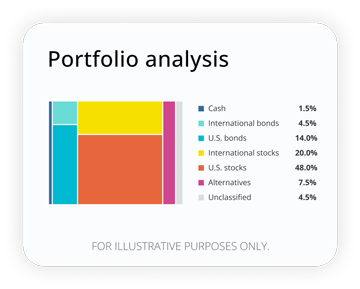
How well are your investments performing?
Analyze your portfolio in minutes and receive a target allocation for your goals.
What is the 60-day rollover rule?
Americans believe they need $1.06 million to retire, according to Empower research, and savings can be spread out among multiple accounts. Some 70% of people contribute to a retirement plan like a 401(k) or 403(b). With workers switching jobs frequently, people must decide how to handle their workplace retirement savings when they leave. One option is to transfer the accumulated funds into a rollover IRA, which is tied to an individual and not an employer.
To “roll over” the money, money must be moved between the existing plan provider and the institution where the rollover IRA is held. One of several ways to make this move is to get the distribution paid directly to you, but this means you need to take the next step quickly. The 60-day rollover rule means you have exactly 60 days from the day you receive a distribution of retirement money to deposit it into another eligible retirement account like a rollover IRA.1
For instance, if you leave a job on Jan. 1 and request a distribution from your old 401(k), and receive the distribution on Jan. 10: The 60-day clock begins Jan. 10 to have that money deposited into the other retirement account in order to preserve the money’s tax-advantaged status (and avoid paying taxes and penalties). Note that the time frame starts when you receive the distribution, not the day you leave your employer.
Direct vs. indirect rollovers: Why it matters
Remembering to watch a clock could be stressful, so it’s important to understand how rollovers work. There are two types of rollovers when dealing with previous retirement savings:
Direct rollover: Also referred to as a trustee-to-trustee transfer, this type of rollover is not made to the investor themself; instead, the money is paid directly to the new financial institution. An example would be the plan administrator of an old 401(k) making the rollover check payable to the institution where you’ve opened a rollover IRA. The 60-day rollover rule does not apply in this case, and taxes are not withheld.
Indirect rollover: Money from a tax-advantaged retirement plan is paid directly to the investor, who then has the responsibility to transfer that money within 60 days into another eligible retirement account, like a rollover IRA.
Read more: What to know about 401(k) rollover options
Indirect rollovers also have two other important aspects for people to remember to not have to pay additional taxes and penalties:
Taxes are withheld in an indirect rollover: Distributions from a retirement plan made out to you (rather than another financial institution) reflect a mandatory withholding of 20%, regardless of whether you intend to roll over the money.
You’ll need to cover the difference in withholding: The 20% amount that is withheld from the distribution will have to be funded from another source because the full amount of the distribution must be deposited into the next retirement account completely, or it could be considered taxable. For example, if the distribution was $20,000 (with $4,000 withheld) and you want to roll over the full amount of any eligible rollover distribution you receive — the amount received plus the 20% withheld — you’ll have to come up with $4,000 to fund the difference.
Read more: Rollover IRA vs. IRA contributions: How do they differ?
Tax implications of missing the 60-day deadline
When funding a retirement, people want to make every minute count: Empower findings show that 43% of people wish they could go back in time to start saving sooner.
The 60-day rollover rule is relevant to ensure that every dollar counts, too. Being even one day past the deadline could impact your retirement savings. Here’s what can happen if you take an indirect rollover and miss the 60-day deadline:
Income tax: The entire amount of the distribution would be added to your taxable income for the year.
Early withdrawal penalty: If you’re under age 59 ½, you may be subject to a 10% additional “early withdrawal” tax.
Lose out on tax-advantaged savings: If the distribution is classified as an early withdrawal, it’s effectively now ordinary income for you and can no longer grow tax-deferred.
Another IRS rule around IRA rollovers
The IRS has an additional requirement around timing when it comes to rolling over retirement savings: Since 2015, people are allowed to make only one rollover from an IRA to another (or the same) IRA in a given 12-month period.2
Note that this cap does not apply to direct (trustee-to-trustee) rollovers or Roth conversions (moving money from a traditional IRA into a Roth IRA).
Rollovers and Roth conversions
The question “Do you pay taxes on a rollover IRA?” can get tricky when a Roth account is involved. Roth IRAs differ from traditional IRAs because they use after-tax (rather than pre-tax) dollars for contributions. This distinction can make rolling over retirement funds more complex, though it can still be a smart money move depending on your situation — and if you abide by the rules.
While the 60-day rollover rule does not apply to transferring money from a traditional IRA to a Roth IRA, that move is still always a taxable event. You will need to pay income taxes on the amount converted, and once finalized, those funds are treated slightly differently than other money in the Roth account. The money from the Roth conversion is subject to a five-year rule — in which funds that are held in the account for at least five years would be eligible for a tax-free withdrawal. Should you take a withdrawal of some or all of the converted money, you’d face a 10% penalty.3
Read more: Roth vs. traditional IRAs: Which should I choose?
Waivers: Exceptions to the 60-day rollover rule
In some cases, the 60-day rollover rule may not apply, or people are able to request a waiver for the resulting taxes and penalties.
The IRS outlines some exceptions to the rollover rule, often when the situation is out of the person’s control, such as if the deposit was not made due to an error on the part of an involved financial institution.4 If people think they qualify for a waiver, they are able to write a letter — providing information based on the IRS requirements (under “Certification for Late Rollover Contribution”) — and self-certify that a waiver be issued.5
Deciding on a rollover strategy
More than half of Americans already or plan to rely on personal savings like IRAs for retirement income, according to an Empower study. Given the complexity of the 60-day rollover rule on indirect rollovers, making direct rollovers could be a more streamlined option for people looking to consolidate their accounts. Consulting with a tax professional or financial advisor before moving money can give more insight to how best to follow the rules and ensure your retirement savings stay on track.
Frequently asked questions about IRA rollovers
Do you pay taxes on a rollover IRA?
A direct rollover does not create a taxable event. In an indirect rollover, the full distribution must be deposited within 60 days to stay tax-deferred. Roth conversions are always taxable because funds move from a pre-tax account to a Roth account.
Does the 60-day rule apply to 401(k)s?
Yes. When a 401(k) distribution is paid directly to an individual, the 60-day rule applies. The funds must be deposited into another eligible retirement account within 60 days to maintain tax-advantaged status.
Does the 60-day rule apply to direct rollovers?
No. In a direct rollover, funds are paid directly from one financial institution to another without receipt of the money by the individual. Because the individual never receives the funds, the 60-day rule and the mandatory 20% withholding do not apply.
1 IRS, “Rollovers of retirement plan and IRA distributions,” accessed December 2025.
2 IRS, “Rollovers of retirement plan and IRA distributions,” accessed December 2025.
3 IRS, “Publication 590-B (2024), Distributions from Individual Retirement Arrangements (IRAs),” accessed December 2025.
4 IRS, “Retirement plans FAQs relating to waivers of the 60-day rollover requirement,” accessed December 2025.
5 IRS, “Waiver of 60-Day Rollover Requirement, Rev. Proc. 2016-47,” accessed December 2025.
RO5063944-1225
 Get The Currency newsletter



The Currency editors
Staff contributors
The CurrencyTM writers and editors cover the latest financial news and insights shaping how we live, work, and play. The team provides accurate, data-driven, and timely content aimed at empowering financial freedom for all.
The content contained in this blog post is intended for general informational purposes only and is not meant to constitute legal, tax, accounting or investment advice. You should consult a qualified legal or tax professional regarding your specific situation. No part of this blog, nor the links contained therein is a solicitation or offer to sell securities. Compensation for freelance contributions not to exceed $1,250. Third-party data is obtained from sources believed to be reliable; however, Empower cannot guarantee the accuracy, timeliness, completeness or fitness of this data for any particular purpose. Third-party links are provided solely as a convenience and do not imply an affiliation, endorsement or approval by Empower of the contents on such third-party websites. This article is based on current events, research, and developments at the time of publication, which may change over time.
Certain sections of this blog may contain forward-looking statements that are based on our reasonable expectations, estimates, projections and assumptions. Past performance is not a guarantee of future return, nor is it indicative of future performance. Investing involves risk. The value of your investment will fluctuate and you may lose money.
Certified Financial Planner Board of Standards Inc. (CFP Board) owns the certification marks CFP®, CERTIFIED FINANCIAL PLANNER™, CFP® (with plaque design), and CFP® (with flame design) in the U.S., which it authorizes use of by individuals who successfully complete CFP Board's initial and ongoing certification requirements.