

What is a traditional IRA and how does it work?
What is a traditional IRA and how does it work?
Learn what a traditional IRA is and how it works — including eligibility, withdrawal rules, 2026 contribution and deduction limits, and comparisons with other retirement accounts.
What is a traditional IRA and how does it work?
Learn what a traditional IRA is and how it works — including eligibility, withdrawal rules, 2026 contribution and deduction limits, and comparisons with other retirement accounts.

06.16.2026
Key takeaways
- A traditional IRA is an individual retirement account that may offer a tax deduction on eligible contributions while allowing investments to potentially grow on a tax-deferred basis.
- Anyone with earned income can contribute to a traditional IRA, but the ability to deduct contributions depends on income and workplace plan participation.
- Traditional IRA withdrawals are taxed as ordinary income in retirement, and early distributions may incur IRS penalties.
A traditional IRA is an individual retirement account that enables you to save and invest for retirement. Some or all the money contributed to the account may be tax-deductible, depending on your income and whether you have a retirement plan at work.
Traditional IRAs can provide a straightforward, tax-efficient way to build retirement savings. The combination of potential tax deductions, tax-deferred growth, and broad investment options offers flexibility at various life stages. Understanding these mechanics and how they compare with Roth IRAs and 401(k)s can help savers choose the right mix of retirement tools for their financial goals.
What is a traditional IRA?
A traditional IRA is an individual retirement account that can offer a tax deduction on eligible contributions. Unlike a workplace plan, you open and control the account yourself, which can mean broader choice over providers and investments. Savers who think their tax rates may fall in retirement, or who prefer to lower their current taxable income, might consider how traditional IRAs could play a role in their long-term financial strategy.
What are traditional IRAs often used for?
Traditional IRAs support long-term savings goals for individuals seeking an immediate tax benefit or for those who want to supplement workplace retirement plans. They also serve as a flexible home for assets accumulated across multiple jobs, especially when used to consolidate old 401(k) balances. Their tax structure, accessibility, and broad investment range have made them a consistent component of retirement planning for decades.
What can be invested inside a traditional IRA?
Traditional IRAs provide broad investment flexibility. Most accounts allow access across multiple asset categories:
- Mutual funds
- Exchange-traded funds (ETFs)
- Individual stocks
- Corporate or government bonds
- Certificates of deposit (CDs)
- Target date retirement funds
This range typically exceeds the investment menus available through many workplace plans, which may limit selections based on price and provider agreements. The flexibility of traditional IRAs can support a tailored investment approach that evolves over time. IRS rules do restrict certain types of holdings, such as collectibles and other prohibited assets, but most mainstream investment options remain accessible.1
How does a traditional IRA work?
A traditional IRA works by allowing you to contribute money, invest it for long-term potential growth, and defer taxes on earnings until you take withdrawals. If the contribution is deductible, it may reduce your taxable income in the year you make it, while later withdrawals are generally taxed as ordinary income.
The traditional IRA’s tax-deferred structure can enhance the compounding power of long-term investing. With no annual taxes pulled from the account, the full balance has an opportunity to grow over decades, which may result in larger balances compared with taxable accounts that incur annual taxes on gains.
What are the traditional IRA withdrawal rules?
Traditional IRAs are subject to specific withdrawal rules. Distributions are taxed as ordinary income and most withdrawals taken before age 59½ may be subject to a 10% early distribution penalty, since the account is funded with tax-deferred funds. IRS rules include specific exceptions that may allow for early withdrawals without the additional penalty, so long as certain conditions are satisfied.2
The IRS requires traditional IRA owners to begin taking required minimum distributions (RMDs) once they reach a certain age, depending on current tax law. These mandated withdrawals ensure that deferred taxes are eventually paid.
Read more: What is 401(k) matching and how does it work?
What are the traditional IRA contribution limits?
Federal law sets annual contribution limits for traditional IRAs. Individuals may contribute up to $7,500 in 2026, with an additional $1,100 catch-up contribution available for those age 50 or above.3 Contributions cannot exceed earned income for the year, although spousal IRAs allow contributions on behalf of a partner with little or no earned income if the household meets certain criteria.4
IRA balances have the potential to compound over time, so contributing the maximum amount can be beneficial when possible. For context, average balances rise from $88,291 for savers in their 30s to $215,206 in the 40s — and more than double again by the 50s.
Who is eligible to contribute to a traditional IRA?
Anyone with earned income is eligible to contribute to a traditional IRA, including non-working individuals whose spouses have taxable income, as long as they are filing jointly. However, their ability to deduct their contributions depends on income and whether they’re covered by a workplace retirement plan, such as a 401(k).5
Eligibility to contribute and eligibility to deduct are separate rules, and individuals may still contribute even when income limits reduce (or eliminate) deductions. The IRS sets annual income-based phase-out ranges that determine whether contributions are fully deductible, partially deductible, or non-deductible, depending on filing status and workplace plan participation.6
How are traditional IRAs taxed?
Traditional IRAs operate under a tax-deferred structure. Deductible contributions are subject to ordinary income tax at the time they are withdrawn and have the potential to reduce your current taxable income. Non-deductible contributions, which are taxed at the time of contribution, do not lower your taxable income but are also not subject to income tax when withdrawn.7 Regardless of the contribution type, any investment growth accumulates without current taxation because gains are deferred until withdrawal. This structure can benefit individuals who expect to be in a lower tax bracket in retirement than during their higher-earning years.
How do traditional IRAs compare to other retirement accounts?
Roth IRA vs. traditional IRA: Key differences
Traditional and Roth IRAs reflect two fundamentally different tax strategies for retirement saving, depending on when taxation occurs and how income might change. Aside from their differing tax opportunities, these retirement accounts have distinct income limits and distribution requirements.
Key differences between Roth IRAs and traditional IRAs include:8
- Taxation: Traditional IRA contributions may be tax-deductible, with taxes applied later at withdrawal. Roth IRA contributions are made with after-tax dollars, and qualified withdrawals are tax-free. Traditional IRAs require RMDs; Roth IRAs do not during the account owner’s lifetime.
- Income limits: Roth IRAs impose income restrictions on who can contribute directly. Traditional IRA contributions are allowed at any income level, though deductibility may be limited or eliminated for those participating in workplace retirement plans.
- RMDs: Traditional IRAs require distributions beginning at the IRS-mandated age. Roth IRAs do not require RMDs during the original owner’s lifetime, giving savers more flexibility and control over the timing of withdrawals.
Read more: Roth vs. traditional IRAs: Which should I choose?
Traditional IRA vs. 401(k): Key differences
Traditional IRAs and employer-sponsored 401(k) plans differ in contribution limits, investment options, fees, and withdrawal rules. While both offer tax-deferred growth potential, several structural differences influence how each account is used.
Key differences between traditional IRAs and 401(k)s include:
- Contribution limits: 401(k) plans allow significantly higher annual contributions than IRAs, enabling workers to save more through workplace plans when eligible. Matching contributions from employers can help boost savings further, when available.
Investment options: The array of investment options available under a 401(k) plan are determined by employers or plan administrators. Traditional IRA investments are chosen by the account owner, and generally provide a broad selection of investments that include individual stocks, bonds, CDs, mutual funds, and target-date funds.
Fees: Some 401(k) plans carry administrative fees or plan costs that don't typically apply to many IRA accounts, though fees vary by provider and investment choice across both account types.
Withdrawal rules: Both account types impose penalties for early withdrawals and require RMDs in retirement. However, 401(k)s may allow loans or hardship withdrawals, which are not available with IRAs.
Rollovers: Traditional IRAs often serve as rollover destinations when workers leave an employer. A rollover moves money from a 401(k) or similar workplace plan into an IRA. Using a direct rollover helps keep the funds tax-deferred while avoiding the 20% withholding, which helps preserve the full account balance in one place while consolidating retirement savings.
Read more: Can I contribute to a 401(k) & an IRA?
Other common types of IRAs
Several IRA variants support different employment and income situations:
- SEP IRAs: Allow higher employer-funded contributions; common among self-employed individuals and small business owners.
- SIMPLE IRAs: Designed for small employers; involve both employer and employee contributions under streamlined rules.
- Spousal IRAs: Allow contributions on behalf of a non-earning or lower-earning spouse as long as the household meets income requirements.
- 530A (Trump) accounts: Custodial-style accounts owned by a child. Parents or guardians are authorized to act on the child’s behalf until they turn 18.
Traditional IRA FAQs
Are traditional IRA contributions tax-deductible?
Traditional IRA contributions may be fully deductible, partially deductible, or non-deductible. The deduction depends on your income, filing status, and whether you or your spouse is covered by a workplace retirement plan.
When do required minimum distributions begin?
Required minimum distributions generally start for the year you turn age 73. Your first RMD is usually due by April 1 of the following year, while subsequent RMDs are generally due by December 31 each year. Missing a required RMD can trigger a 25% excise tax which can be reduced to 10% if corrected within two years.9
Can traditional IRA funds be accessed early?
Yes, but traditional IRA withdrawals before age 59½ are generally subject to ordinary income tax and a 10% penalty. Certain exceptions apply, including qualified first-time homebuyer expenses, certain higher-education expenses, certain medical expenses, and health insurance premiums during unemployment.10
Can a traditional IRA receive rollovers from a 401(k)?
Yes. Pre-tax assets from employer-sponsored plans, including 401(k)s, can be rolled into a traditional IRA. Direct rollovers help preserve tax-deferred status and avoid mandatory withholding.
What is the contribution deadline for a traditional IRA?
Contributions for a tax year may be made until the federal tax filing deadline the following year, usually mid-April.
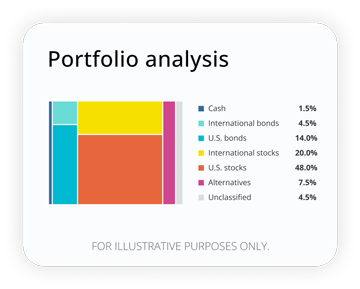
How well are your investments performing?
Analyze your portfolio in minutes and receive a target allocation for your goals.
1 Internal Revenue Service, “Publication 590-A (2025), Contributions to Individual Retirement Arrangements (IRAs),” April 2026
2 Internal Revenue Service, “Retirement topics - Exceptions to tax on early distributions,” December 2025
3 Internal Revenue Service, “Retirement topics - IRA contribution limits,” March 2026
4 Internal Revenue Service, “Publication 590-A (2025), Contributions to Individual Retirement Arrangements (IRAs),” April 2026
5 Internal Revenue Service, “Retirement topics - IRA contribution limits,” March 2026
6 Ibid.
7 Internal Revenue Service, “IRA deduction limits,” August 2025
8 Internal Revenue Service, “Roth comparison chart,” September 2025
9 Internal Revenue Service, “Retirement plan and IRA required minimum distributions FAQs,” January 2026
10 Internal Revenue Service, “Topic no. 557, Additional tax on early distributions from traditional and Roth IRAs,” December 2025
RO5580727-0626
 Get The Currency newsletter



The Currency editors
Staff contributors
The CurrencyTM writers and editors cover the latest financial news and insights shaping how we live, work, and play. The team provides accurate, data-driven, and timely content aimed at empowering financial freedom for all.
The content contained in this blog post is intended for general informational purposes only and is not meant to constitute legal, tax, accounting or investment advice. You should consult a qualified legal or tax professional regarding your specific situation. No part of this blog, nor the links contained therein is a solicitation or offer to sell securities. Compensation for freelance contributions not to exceed $1,250. Third-party data is obtained from sources believed to be reliable; however, Empower cannot guarantee the accuracy, timeliness, completeness or fitness of this data for any particular purpose. Third-party links are provided solely as a convenience and do not imply an affiliation, endorsement or approval by Empower of the contents on such third-party websites. This article is based on current events, research, and developments at the time of publication, which may change over time.
Certain sections of this blog may contain forward-looking statements that are based on our reasonable expectations, estimates, projections and assumptions. Past performance is not a guarantee of future return, nor is it indicative of future performance. Investing involves risk. The value of your investment will fluctuate and you may lose money.
Certified Financial Planner Board of Standards Inc. (CFP Board) owns the certification marks CFP®, CERTIFIED FINANCIAL PLANNER™, CFP® (with plaque design), and CFP® (with flame design) in the U.S., which it authorizes use of by individuals who successfully complete CFP Board's initial and ongoing certification requirements.
The content contained in this blog post is intended for general informational purposes only and is not meant to constitute legal, tax, accounting or investment advice. You should consult a qualified legal or tax professional regarding your specific situation. No part of this blog, nor the links contained therein is a solicitation or offer to sell securities. Compensation for freelance contributions not to exceed $1,250. Third-party data is obtained from sources believed to be reliable; however, Empower cannot guarantee the accuracy, timeliness, completeness or fitness of this data for any particular purpose. Third-party links are provided solely as a convenience and do not imply an affiliation, endorsement or approval by Empower of the contents on such third-party websites. This article is based on current events, research, and developments at the time of publication, which may change over time.
Certain sections of this blog may contain forward-looking statements that are based on our reasonable expectations, estimates, projections and assumptions. Past performance is not a guarantee of future return, nor is it indicative of future performance. Investing involves risk. The value of your investment will fluctuate and you may lose money.
Certified Financial Planner Board of Standards Inc. (CFP Board) owns the certification marks CFP®, CERTIFIED FINANCIAL PLANNER™, CFP® (with plaque design), and CFP® (with flame design) in the U.S., which it authorizes use of by individuals who successfully complete CFP Board's initial and ongoing certification requirements.