

Spousal IRA: What it is and how it works
Spousal IRA: What it is and how it works
A spousal IRA allows a working spouse to contribute to an IRA on behalf of a spouse who has little or no earned income, as long as they file a joint tax return
Spousal IRA: What it is and how it works
A spousal IRA allows a working spouse to contribute to an IRA on behalf of a spouse who has little or no earned income, as long as they file a joint tax return

06.25.2026
Key takeaways
- A spousal IRA allows a nonworking spouse to save for retirement based on their spouse’s taxable compensation
- Couples must file a joint tax return to qualify for spousal IRA contributions
- The 2026 contribution limit is $7,500 per spouse, or $8,600 if age 50+
Tax-advantaged retirement accounts can be a good way to save for retirement, but they’re generally only available to people with taxable compensation. A stay-at-home parent or someone who works in the home in some other capacity doesn’t have access to an employer’s 401(k) plan.
A spousal IRA offers a way for married couples with one taxable compensation earner to increase their retirement savings. By filing jointly, the spouse without taxable compensation can contribute to an IRA in their own name, expanding the household’s tax-advantaged savings opportunities.
Spousal IRAs can be an excellent way for stay-at-home parents, homemakers, and other spouses who do not earn taxable compensation to prepare for retirement without having to rely solely on their spouse’s retirement accounts.
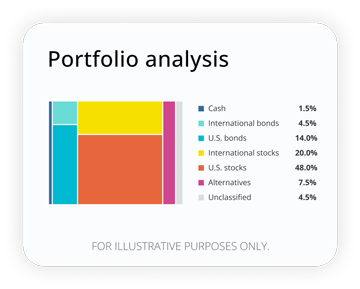
How well are your investments performing?
Analyze your portfolio in minutes and receive a target allocation for your goals.
What is a spousal IRA?
A spousal IRA is an individual retirement account (IRA) that allows married individuals to save for retirement based on their spouse’s taxable compensation rather than their own. Functionally, a spousal IRA is no different than any other IRA — the only difference is whose income the contributions are based on.1 Like other IRAs, they can help build retirement savings regardless of access to workplace retirement plans, such as 401(k)s or 403(b)s.
Spouses not earning taxable compensation can choose between a traditional IRA and a Roth IRA — or use a combination of the two. Here’s how those work:
- Traditional IRA: Contributions are pre-tax, which may lower your taxable income for the current year. Any investment earnings are tax-deferred, but withdrawals are taxable.
- Roth IRA: Contributions are after-tax, meaning there’s no upfront tax benefit. However, any investment earnings and qualified withdrawals are both tax-free. A withdrawal from a Roth account is not subject to federal taxation as long as it is qualified as defined under IRS regulations. However, state and local taxes may still apply.
It’s important to note that both traditional and Roth IRAs have income limits. In the case of a traditional IRA, if your spouse has access to an employer-sponsored retirement plan, your ability to deduct your contributions may be limited if their income is above a certain threshold.2 And in the case of Roth IRAs, you may be prohibited from contributing if your spouse’s income is too high.
When you’re deciding between a traditional and a Roth IRA, it’s important to consider you and your spouse’s overall financial situation and goals. The traditional IRA offers an upfront tax advantage, while the Roth IRA offers a tax advantage during retirement.
If your family currently has a high household income and wants to reduce its tax burden, a traditional IRA may help you do that (as long as your spouse’s income isn’t too high for deductible contributions). On the other hand, your family may want to opt for a Roth IRA if they meet the income threshold and prefer tax-free qualified distributions during retirement.
Finally, know that you don’t have to choose between the two. You can contribute to both a traditional and a Roth IRA as long as your household income allows it.
Read more: Roth vs. traditional IRAs: Which should I choose?
Benefits of spousal IRAs
Spousal IRAs have some major advantages. If you don’t work outside the home but your spouse has earned income, here are some reasons to consider a spousal IRA:
- Double the contributions: Opening and contributing to a spousal IRA essentially allows you and your spouse to double your IRA contributions each year. Rather than being able to save $7,500, which is the 2026 contribution limit, you can save $15,000. That increases to $8,600 for you and $8,600 for your spouse, for a total of $17,200 in 2026, if you are both age 50 or older. And that’s on top of any contributions the taxable compensation-earning spouse makes to a workplace retirement plan.
- Tax benefits: Both traditional and Roth IRAs can have significant tax benefits. Contributions to traditional IRAs may be tax-deductible in the year you make them, but withdrawals are generally taxed as ordinary income in retirement. With Roth IRAs, contributions are made with after-tax dollars, with the potential for tax-free investment growth.
- Saver's Credit: Contributing to a spousal IRA may enable you to take advantage of a tax credit called the Retirement Savings Contribution Credit — or simply the Saver’s Credit. The Saver’s Credit is available to individuals who are age 18 or older, aren’t a student, and aren’t a dependent on someone else’s tax return.
- Account ownership: As a non-working spouse, you have ownership over your spousal IRA. Contributions made to your account can be invested and withdrawn as you see fit, provided you stick to the contribution limits.
Spousal IRA rules
Before you open and contribute to a spousal IRA, make sure you’re familiar with the eligibility requirements, contribution limits, and withdrawal rules.
Eligibility criteria
To be eligible to contribute to a spousal IRA, you and your spouse must meet the following criteria:
- Taxable compensation: Either you or your spouse must have taxable compensation. The total amount contributed to your spousal IRA(s) must not exceed the working spouse’s taxable compensation for the year. In the case of Roth IRAs, an income cap restricts who can contribute at all.
- Married filing jointly: You and your spouse file a joint tax return. If you are married but file separately, you aren’t eligible to contribute to a spousal IRA.
- IRA ownership: Unlike taxable brokerage accounts, IRAs are always individually owned. In the case of a spousal IRA, even though eligibility is based on the working spouse’s compensation, the account is owned entirely by the non-working spouse.
Spousal IRA contribution limits and rules
The IRS limits how much someone can contribute to an IRA each year. In 2026, the contribution limit is $7,500 per year, up from $7,000 in 2025. Additionally, workers who are 50 or older can make a catch-up contribution of $1,100 in 2026, up from $1,000 in 2025.
One important note about IRA contributions is that they are limited by your earned income. You cannot contribute more than 100% of your taxable compensation during any given year. In the case of married individuals using the spousal IRA rules, both spouses’ combined contributions generally can’t exceed the couple's combined taxable compensation.
In most cases, you and your spouse can each contribute $7,500 to an IRA in 2026, for total contributions of $15,000. But if the working spouse earns less than $15,000, then contributions will be limited by the actual amount of taxable compensation.3
Consequence of exceeding contribution limits
If you contribute more than your maximum contribution limit to a spousal IRA, you’ll have the chance to fix your mistake. The IRS gives you until the deadline for filing your taxes to withdraw any excess contributions. However, if you fail to withdraw your excess contributions, they’ll be taxed at 6% per year that they remain in the account.4
Age restrictions and withdrawal rules
Non-working spouses contributing to IRAs are subject to the same age and withdrawal restrictions as working spouses. Although there are no age restrictions on contributing to an IRA, there is an age restriction on withdrawals.
With traditional IRAs, unqualified withdrawals made before age 59 ½ will be subject to an early withdrawal penalty on top of any income taxes owed.5 Alternatively, Roth IRA contributions can be withdrawn at any time, tax-free and penalty-free. Investment earnings on Roth IRAs can be withdrawn without taxation and penalties as long as they meet certain requirements.
Traditional IRAs, unlike Roth IRAs, are also subject to required minimum distributions (RMDs). Starting at age 73, you must start taking taxable withdrawals from your IRA.
How to open a spousal IRA
The process of opening a spousal IRA is usually identical to opening any other IRA. The account should be opened in the nonworking spouse’s name, even if the working spouse is funding the account.
Here’s a step-by-step guide:
- Choose a financial institution or brokerage firm: Many different financial institutions and brokerage firms offer IRAs. When choosing the right provider, consider the fees they charge and the investments they offer. You may decide to open your IRA with the same provider as any other household investments you have to keep things simple.
- Complete the necessary paperwork or documentation: When you apply for your spousal IRA, you’ll have to provide personal identifying information, such as your name, photo identification, and Social Security number. You may also have to provide information about your household income to ensure your contributions fall within the rules.
- Set up an account beneficiary: It’s important to ensure you’ve set up a beneficiary on both your spousal IRA and your spouse’s retirement accounts. Doing so can ensure one spouse’s account asset seamlessly transfers to the other beneficiary in case one spouse passes away.
- Fund your IRA: Once your spousal IRA is open, you can typically fund the account by connecting a bank account. You can deposit your full annual contribution at once or set up monthly contributions. Just make sure your contributions don’t exceed your household income or the contribution limits set by the IRS.
- Direct your investments: Funding a spousal IRA is only the first step. To potentially grow your savings, you'll need to choose investments for the account. You can typically choose from a wide variety of investments, including individual stocks and bonds or diversified investments like mutual funds and exchange-traded funds (ETFs).
Managing a spousal IRA
Once your account is open and you’ve started contributing, you’ll also have to manage the account and its investments on an ongoing basis. This can be done using financial tools or consulting a financial professional.
Financial planning tools
Free tools, like Empower’s Retirement Planner, can help you estimate your retirement expenses and plan your contributions accordingly. IRAs are often one aspect of a household retirement plan, and certain tools can make it easier to view them in conjunction with your other investments and retirement accounts.
Managing your investments
There’s no one-size-fits-all approach to investing. However, it’s generally important to build a diversified portfolio that fits your financial goals and risk tolerance. As you get closer to retirement, you may find it beneficial to adjust your investments to correspond with your time horizon and retirement goals. You can do this on your own using financial tools, or consulting with a financial advisor or other financial professional with experience in retirement investing.
The bottom line
A spousal IRA can be an excellent way to save for retirement if you don’t work outside the home, but your spouse does. Before opening a spousal IRA, make sure you fully understand the eligibility requirements and contribution rules. Finally, consider how your spousal IRA fits into your family’s overall investment and retirement plan and what investments are best suited to your unique situation and goals.
FAQs about spousal IRAs
How much can you contribute to a spousal IRA in 2026?
Up to $7,500 per spouse, or $8,600 for those age 50 and older.
Do spousal IRAs follow Roth and traditional IRA rules?
Yes. Deduction and income limits for traditional IRAs and contribution limits for Roth IRAs still apply.
Who owns the spousal IRA?
The nonworking spouse is the sole account owner, even though contributions are based on, and may be funded by, their partner’s income.
Can both spouses contribute if one has a workplace 401(k)?
Yes, but traditional IRA deductibility or Roth eligibility may phase out at higher incomes.
Exchange-traded funds (ETFs) are a type of exchange-traded investment product that must register as either an open-end investment company (generally known as “funds”) or a unit investment trust. ETFs are not mutual funds.
Unlike with mutual funds, individual shares of ETFs are not redeemable directly with the issuer. ETF shares are a collection of securities bought and sold at market price, which may be higher or lower than the net asset value. Investment returns will vary based on market conditions and volatility, so an investor’s shares, when redeemed or sold, may be worth more or less than their original cost. ETFs are subject to risks, including those of their underlying securities.
Asset allocation and balanced investment options and models are subject to the risks of their underlying investments.
1 IRS, “401(k) limit increases to $24,500 for 2026, IRA limit increases to $7,500,” November 13, 2025.
2 IRS, “IRA Deduction Limits,” August 2025.
3 IRS, “Retirement plans FAQs regarding IRAs,” November 16, 2025.
4 IRS, “Retirement Topics — IRA Contribution Limits,” August 2025.
5 IRS, “Hardships, early withdrawals, and loans,” August 26, 2025.
RO5635214-0626
 Get The Currency newsletter



The Currency editors
Staff contributors
The CurrencyTM writers and editors cover the latest financial news and insights shaping how we live, work, and play. The team provides accurate, data-driven, and timely content aimed at empowering financial freedom for all.
The content contained in this blog post is intended for general informational purposes only and is not meant to constitute legal, tax, accounting or investment advice. You should consult a qualified legal or tax professional regarding your specific situation. No part of this blog, nor the links contained therein is a solicitation or offer to sell securities. Compensation for freelance contributions not to exceed $1,250. Third-party data is obtained from sources believed to be reliable; however, Empower cannot guarantee the accuracy, timeliness, completeness or fitness of this data for any particular purpose. Third-party links are provided solely as a convenience and do not imply an affiliation, endorsement or approval by Empower of the contents on such third-party websites. This article is based on current events, research, and developments at the time of publication, which may change over time.
Certain sections of this blog may contain forward-looking statements that are based on our reasonable expectations, estimates, projections and assumptions. Past performance is not a guarantee of future return, nor is it indicative of future performance. Investing involves risk. The value of your investment will fluctuate and you may lose money.
Certified Financial Planner Board of Standards Inc. (CFP Board) owns the certification marks CFP®, CERTIFIED FINANCIAL PLANNER™, CFP® (with plaque design), and CFP® (with flame design) in the U.S., which it authorizes use of by individuals who successfully complete CFP Board's initial and ongoing certification requirements.