

What is a Roth 401(k)?
What is a Roth 401(k)?
A Roth 401(k) lets workers save after-tax dollars for qualified tax-free withdrawals in retirement, with the IRS standard contribution limit rising to $24,500 in 2026
What is a Roth 401(k)?
A Roth 401(k) lets workers save after-tax dollars for qualified tax-free withdrawals in retirement, with the IRS standard contribution limit rising to $24,500 in 2026

06.24.2026
Key takeaways
- Roth 401(k) contributions are made using after-tax money, but qualified withdrawals in retirement are generally tax-free if certain requirements are met.
- Beyond the standard IRS threshold, additional catch-up contributions are available for savers 50 and older.
- Unlike Roth IRAs, Roth 401(k)s have no income limits.
A Roth 401(k) is a retirement savings option that lets eligible employees make after-tax contributions to their workplace retirement plan. The contributions do not reduce taxable income that year, but qualified withdrawals in retirement — of both contributions and any earnings — can be tax-free.
Americans have saved an average of $340,364 in 401(k) plans, according to Empower Personal DashboardTM data. Whether you’re starting a new job or reevaluating how to save for retirement, a Roth 401(k) account can be a helpful way to boost your savings goals.
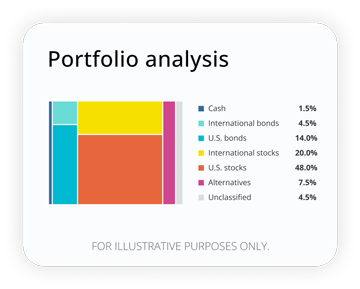
How well are your investments performing?
Analyze your portfolio in minutes and receive a target allocation for your goals.
How does a Roth 401(k) work?
When workers get their paycheck, they may notice a line item for contributions to their employer’s 401(k) retirement plan. Before this happens, the employee elects how much of their pay they want to contribute, subject to IRS limits.
With a Roth 401(k), the contributions are made with after-tax dollars, so those funds are subject to ordinary income taxes before being contributed to the account.
Before the contributions start, the worker can select investment options within the 401(k) account. Like other workplace retirement plans, investing in your Roth 401(k) commonly includes options like equity funds, bond funds, and asset allocation funds such as target-date funds. Your employer plan may also offer a chance to buy shares of company stock. Depending on your goals, this could be attractive addition or complement to any equity compensation you may be receiving.
Potential earnings grow tax-deferred within the Roth 401(k) account and qualified withdrawals are tax-free, as long as IRS requirements are fulfilled. The account owner must be at least age 59½ and have held the account for at least five years, among other IRS requirements.1 Earnings withdrawn before those conditions are met may be subject to taxes and penalties. Tax laws are subject to change. State and local taxes may still apply.
Roth 401(k) savings also have flexibility, depending on how employers have set up their plans. Some companies allow workers to take out a loan using their Roth 401(k) money, and employees may start saving immediately or have their contribution rate increased regularly using automatic enrollment.
Read more: Tips for understanding your 401(k) plan
Roth 401(k) contribution limits for 2026
Unlike a Roth IRA, a Roth 401(k) has no income-based restrictions for participation. However, savers still need to follow limits around annual contributions. Roth 401(k) contribution limits are much higher than those for Roth IRAs. The IRS adjusts the thresholds each year based on cost-of-living increases. The following limits apply for 2026.2
2026 IRS limit | Amount | Description |
|---|---|---|
Employee elective deferral limit | $24,500 | Limit applies to all 401(k) contributions across pre-tax and Roth accounts |
Catch-up contribution limit for those 50+ | $8,000 | Participants age 50 and older can contribute up to $32,500 in 2026. |
“Super” catch-up limit for those 60-63 | $11,250 | Savers turning 60, 61, 62 or 63 during the calendar year have an even higher catch-up contribution ceiling. |
Workers approaching retirement should be aware that Roth 401(k) rules on catch-up contributions have been modified in recent years under the Secure 2.0 Act. In addition to the standard higher catch-up contributions for those age 50 and older, workers age 60-63 may be eligible to make enhanced catch-up contributions that would allow them to save even more for retirement.
Read more: Roth 401(k) catch up: New rule for age 50 and up
Roth vs. traditional 401(k)
Saving for retirement in a 401(k) doesn’t have to be a choice between a Roth 401(k) or traditional 401(k) plan. Workers can defer their savings into one or both types of accounts, depending on what their plan offers.
Taxes are the key factor in how a Roth 401(k) and traditional 401(k) differ:
Account question | Roth 401(k) | Traditional 401(k) |
|---|---|---|
How are contributions taxed? | After-tax contributions from employee | Pre-tax contributions from employee |
How do contributions affect my current-year taxable income? | Doesn’t reduce current taxable income | Reduces current taxable income |
How are qualified withdrawals taxed? | When requirements are met, both contributions and earnings are federal income tax-free | Withdrawals are subject to federal and possibly state income taxes |
How does employer matching work? | Employers can match based on your Roth contributions; however, the match dollars are typically put into a pre-tax account3 |
Keep in mind that annual contribution limits apply across all your 401(k) retirement plans, not separately to Roth and traditional accounts. If you also defer money into a traditional 401(k), you’ll need to account for those pre-tax contributions when determining if you are close to approaching the limit and maxing out your 401(k).
Read more: Roth 401(k) vs. Roth IRA: Key differences
Workers also have the option to transfer existing traditional 401(k) money into a Roth 401(k) account, through an in-plan Roth conversion. Because traditional 401(k) contributions generally have not been taxed, the amount converted is typically subject to ordinary income tax in the year of the conversion. In return, those assets may be eligible for tax-free growth and tax-free qualified withdrawals in the future, provided IRS requirements are met.
Benefits of a Roth 401(k) — and considerations
Not paying taxes on qualified withdrawals is among the advantages of Roth 401(k) plans. You pay taxes upfront on paycheck contributions, rather than when taking qualified withdrawals. A Roth 401(k) may be attractive if you’re currently in a lower tax bracket or expect to be in a higher tax bracket when you start taking 401(k) distributions but will depend on your individual circumstances and tax situation.
Another potential advantage of Roth 401(k)s is that the account owners don’t need to take required minimum distributions during their lifetime.4 This may provide a longer time horizon of potential growth for the owner’s retirement savings. Roth 401(k)s are also helpful as part of a wider estate plan because RMD rules take effect for a spouse or other beneficiary only once the accounts are inherited.
Read more: Taxes on inheritance and how to avoid them
However, workers who want to prioritize immediate tax benefits may be more attracted to traditional 401(k) contributions, which avoids paying income tax upfront. Those unsure of what tax bracket they’ll end up in later in life may also choose to go this route.
How does a Roth 401(k) fit into retirement savings?
Saving for retirement should be part of an investor’s year-round tax strategy, and the tax advantages of a Roth 401(k) can make it an essential financial tool. Beyond the potential benefits of compounded growth, these accounts can impact how taxes are paid throughout your lifetime.
Frequently asked questions on Roth 401(k)s
Does a Roth 401(k) have income limits?
No, a Roth 401(k) does not have income-based eligibility restrictions. If an employer offers a Roth 401(k), employees can contribute regardless of income level, subject to annual IRS contribution limits.
Do you pay taxes on Roth 401(k) gains?
Qualified withdrawals of Roth 401(k) contributions and investment earnings are generally federally tax-free. For a distribution to be qualified, the account must have been open for at least five years, and the withdrawal must occur after age 59½, death, or disability. Earnings withdrawn before those conditions are met may be subject to taxes and penalties. Tax laws are subject to change. State and local taxes may still apply.
Does employer match happen in a Roth 401(k)?
Yes, employers could match contributions made to a Roth 401(k) if they choose. However, employer-matching contributions are generally deposited into a separate pre-tax account within the 401(k), which means that those funds and any associated earnings are typically taxable under a qualified withdrawal.
Can you roll over a 401(k) into a Roth IRA?
Yes. Funds from a Roth 401(k) can generally be rolled into a Roth IRA without triggering taxes, as long as the rollover requirements are followed. Pre-tax 401(k) money can also be converted to a Roth IRA, but the converted amount is generally subject to ordinary income tax in the year of the conversion.
Does a Roth 401(k) have RMDs?
No, Roth 401(k) accounts are no longer subject to required minimum distributions during the original account owner's lifetime. This change took effect in 2024 under the SECURE 2.0 Act, aligning Roth 401(k) rules more closely with Roth IRA rules.
1 IRS, “Roth account in your retirement plan,” accessed June 2026.
2 IRS, “COLA increases for dollar limitations on benefits and contributions,” accessed June 2026.
3 IRS, “Retirement plans FAQs on designated Roth accounts,” accessed June 2026.
4 IRS, “Retirement plan and IRA required minimum distributions FAQs,” accessed June 2026.
RO5581025-0626
 Get The Currency newsletter



The Currency editors
Staff contributors
The CurrencyTM writers and editors cover the latest financial news and insights shaping how we live, work, and play. The team provides accurate, data-driven, and timely content aimed at empowering financial freedom for all.
The content contained in this blog post is intended for general informational purposes only and is not meant to constitute legal, tax, accounting or investment advice. You should consult a qualified legal or tax professional regarding your specific situation. No part of this blog, nor the links contained therein is a solicitation or offer to sell securities. Compensation for freelance contributions not to exceed $1,250. Third-party data is obtained from sources believed to be reliable; however, Empower cannot guarantee the accuracy, timeliness, completeness or fitness of this data for any particular purpose. Third-party links are provided solely as a convenience and do not imply an affiliation, endorsement or approval by Empower of the contents on such third-party websites. This article is based on current events, research, and developments at the time of publication, which may change over time.
Certain sections of this blog may contain forward-looking statements that are based on our reasonable expectations, estimates, projections and assumptions. Past performance is not a guarantee of future return, nor is it indicative of future performance. Investing involves risk. The value of your investment will fluctuate and you may lose money.
Certified Financial Planner Board of Standards Inc. (CFP Board) owns the certification marks CFP®, CERTIFIED FINANCIAL PLANNER™, CFP® (with plaque design), and CFP® (with flame design) in the U.S., which it authorizes use of by individuals who successfully complete CFP Board's initial and ongoing certification requirements.