

Roth vs. traditional IRAs: Which should I choose?
Roth vs. traditional IRAs: Which should I choose?
Determine whether Roth or traditional IRAs match your retirement planning strategy based on tax benefits, eligibility, and income and deduction limits
Roth vs. traditional IRAs: Which should I choose?
Determine whether Roth or traditional IRAs match your retirement planning strategy based on tax benefits, eligibility, and income and deduction limits

05.29.2026
Key takeaways
- A key difference between Roth and traditional IRAs comes down to timing: Roth IRAs trade today’s tax break for tax-free qualified withdrawals in retirement.
- Traditional IRAs, unlike Roth IRAs, are subject to required minimum distributions (RMDs) once you reach age 73.
Roth IRAs may be best suited to workers early in their career, while traditional IRAs could appeal to those expecting their income to decline in retirement.
Roth and traditional IRAs are powerful tax savings tools that can be used alone or with an employer-sponsored retirement plan. Both types of IRAs have similar contribution limits, but differ when it comes to their tax treatment, income limits, and eligibility.
Traditional IRAs may give you a tax deduction upfront but are generally taxed when you withdraw the money. Roth IRAs are funded with after-tax dollars but can provide tax-free qualified withdrawals in retirement.
Keep reading to learn more about Roth and traditional IRAs and which plan may be best for you.
Outside of workplace retirement plans, IRAs can help further boost retirement savings. Keep in mind their contribution limits and tax rules, since those differ from a 401(k).
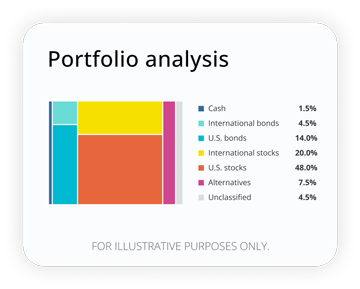
How well are your investments performing?
Analyze your portfolio in minutes and receive a target allocation for your goals.
What are IRAs?
Individual retirement accounts, or IRAs, are a type of tax-advantaged retirement account. Two of the most common options, Roth IRAs and traditional IRAs, are often used to supplement retirement savings beyond employer-sponsored plans. Both options differ from a 401(k) plan, in which an individual enrolls through their employer and defers a specific percentage from each paycheck. An IRA is typically self-initiated, meaning you can open your own account directly with a financial services provider. In many cases, an IRA is relatively simple to open, maintain, and access.
Empower research shows that the biggest growth in IRA balances happens between your 30s and 50s, when earnings and contributions typically peak. By starting as soon as possible, traditional and Roth IRAs can play an important role in your retirement strategy.
Roth vs. traditional IRA: How they compare
The key difference between a Roth IRA and a traditional IRA is when you will receive a tax break. Both retirement accounts have similar contribution limits and broad investment flexibility, yet differ in their tax treatment, withdrawal rules, and income and deduction limits.
The table below provides a brief comparison of Roth and traditional IRAs:
Feature | Roth IRA | Traditional IRA |
Tax treatment | Contributions are after-tax and not deductible; qualified withdrawals can be tax-free | Contributions may be able to be deducted from your taxable income; withdrawals of deductible contributions and earnings are generally taxable |
Eligibility | Must have taxable compensation; direct contribution eligibility depends on MAGI and filing status | Must have taxable compensation; no income cap to contribute |
Income and deduction limits | Contribution amount phases out at higher income levels | Contribution allowed regardless of income, but the deduction may phase out if you or your spouse is covered by a workplace plan |
Annual contribution limits | Combined 2026 limit across all Roth and traditional IRAs is $7,500, or $8,600 if age 50 or older | Same combined limit as Roth IRA |
Withdrawal rules | Contributions can be withdrawn anytime; earnings generally require a qualified distribution for tax-free treatment | Withdrawals are generally taxable; before age 59 ½, a 10% additional tax may apply unless an exception applies |
RMDs | None for the original owner | Generally begin at age 73 |
Investment options | Same types available in both Roth and traditional IRAs | Same types available in both Roth and traditional IRAs |
Tax treatment
The biggest difference between Roth and traditional IRA accounts is when you receive a tax benefit:
- Traditional IRAs: Contributions may be deductible in the year you make them, which can reduce your current taxable income. From there, your investments can grow tax-deferred, and withdrawals of deductible contributions and earnings are generally taxed as ordinary income in retirement.
- Roth IRAs: Tax benefits are delayed until retirement. Contributions enjoy federal tax-free investment growth potential and qualified withdrawals of earnings will be tax-free.
Eligibility
You must receive taxable compensation to contribute to a Roth or traditional IRA. This generally includes income from wages, salary, commissions, bonuses, or self-employment income. There’s no age limit on contributing to either account. Married couples filing jointly may also be able to contribute to separate IRAs through a spousal IRA if the working spouse has enough taxable compensation to cover both contributions.1
2026 income and deduction limits
Income and deduction limits play different roles across Roth and traditional IRAs. The income cap for Roth IRAs limits who can contribute. If your income exceeds the limits set by the IRS, you won’t be able to contribute to a Roth IRA at all. For traditional IRAs, income limits dictate who can deduct their contributions from their taxable income. If your income exceeds these limits, then you may not be able to deduct part or all of your contributions.
Roth IRA income limits for 2026
As mentioned, Roth IRAs have income limits that determine whether you can make a full contribution, a reduced contribution, or no direct contribution at all. Your modified adjusted gross income (MAGI), along with your filing status, determines how much you’re allowed to contribute.
The table below shows the income limits for 2026:
Filing status | Modified AGI | Allowed contribution |
Married filing jointly, qualifying widower | < $242,000 | $7,500 ($8,600 if 50 or older) |
Married filing jointly, qualifying widower | ≥ $242,000 but < $252,000 | Partial contribution |
Married filing jointly, qualifying widower | ≥ $252,000 | Not eligible |
Married filing separately | > $10,000 | Partial contribution |
Married filing separately | ≥ $10,000 | Not eligible |
Single or head of household | > $153,000 | $7,500 ($8,600 if 50 or older) |
Single or head of household | ≥ $153,000 to $168,000 | Partial contribution |
Single or head of household | ≥ $168,000 or more | Not eligible |
If you want to utilize a Roth IRA and your income is above the limits, you may still be able to achieve the benefits using what’s called a backdoor Roth IRA. However, this approach can have tax implications — particularly for individuals who already hold pre-tax assets in traditional, SEP, or SIMPLE IRAs due to IRS pro-rata rules. Consider consulting a tax professional before proceeding.
Traditional IRA deduction limits for 2026
Unlike with a Roth IRA, there's no income limit for those who can contribute to a traditional IRA. But your income (as well as your spouse's) affects whether you can deduct your traditional IRA contributions from your taxable income for the year. If you don’t have an employer-sponsored retirement plan, there are no income limits on tax deductions. However, if you do have a retirement plan through your workplace, you’ll be subject to the following income limits for deductions for 2026:2
Filing status | Modified AGI | Allowed deduction |
Married filing jointly, qualifying widower | ≤ $129,000 | Full deduction |
Married filing jointly, qualifying widower | > $129,000 but < $149,000 | Partial deduction |
Married filing jointly, qualifying widower | ≥ $149,000 | No deduction |
Married filing separately | < $10,000 | Partial deduction |
Married filing separately | ≥ $10,000 | No deduction |
Single or head of household | ≤ $81,000 or less | Full deduction |
Single or head of household | > $81,000 but < $91,000 | Partial deduction |
Single or head of household | ≥ $91,000 | No deduction |
Annual contribution limits
The IRS allows you to contribute up to $7,500 in 2026 — an increase from $7,000 in 2025 — or 100% of your earned income, whichever is less. The IRS also allows for a catch-up contribution for workers 50 and older. The catch-up contribution in 2026 is $1,100, which brings the total contribution limit for those individuals to $8,600.3
It’s important to note that the contribution limit for Roth and traditional IRAs applies to both together. If you choose to put $7,500 into a Roth IRA, you couldn’t also put $7,500 into a traditional IRA (though you could split the contribution amount between the two accounts).
Investment options
Roth and traditional IRAs offer the same investment options, which are determined by the investment firm or provider you choose. Popular investment options include individual stocks and bonds, mutual funds, and exchange-traded funds.
Withdrawal rules
Both traditional and Roth IRAs are retirement accounts, and the funds are intended to remain in the account until at least age 59 ½. However, the two accounts have different withdrawal rules.
- Traditional IRA: You can access the money in your traditional IRA at any time, paying income taxes on your withdrawals. However, because a traditional IRA is intended to be used for retirement, distributions before age 59 ½ will also be subject to a 10% early withdrawal tax (unless an exception applies).4
- Roth IRA: Roth IRA rules vary between contributions and earnings. Contributions can be withdrawn at any time tax-free and penalty-free. As with traditional IRAs, any earnings distributed before age 59 ½ may be subject to both income taxes and the 10% early withdrawal penalty. However, to withdraw any investment earnings tax-free and penalty-free, you must wait at least five years after the year you first contributed to the account and meet the age or disability requirements.
Required minimum distributions (RMDs)
Traditional IRAs, unlike Roth IRAs, are subject to required minimum distributions (RMDs). Once you reach age 73, you’ll have to start taking distributions from your retirement account. You’ll also have to pay any income taxes associated with those distributions.
Should I choose a Roth or traditional IRA?
When choosing between a traditional and a Roth IRA, one of the most valuable questions you can ask is: When would a tax break be most valuable to me?
Because of their deferred tax advantage, Roth IRAs may be best suited to workers early in their career or those earning relatively low incomes compared to what they expect to earn later when the upfront tax advantage might be more important. In that case, a Roth IRA can be a powerful way to pay your taxes today at a low rate and enjoy tax-free withdrawals later.
A traditional IRA might be more appealing if you currently have a high income that puts you in an upper tax bracket. In this situation, you may be more interested in the tax break today, especially if you expect your tax rate to be lower during retirement.
If you’re unsure which tax advantage is better for you, consider using an online calculator like the Empower Pre-tax vs. Roth Analyzer to help decide. Can I contribute to both a Roth IRA and a traditional IRA?
It is possible to own and contribute to multiple IRAs, including Roth and traditional IRAs. This can allow you to combine the tax benefits of both retirement accounts.
Suppose you decide to split your contributions between both types of IRA. You contribute $3,750 to your traditional IRA, which allows you to reduce your taxable income by the same amount using a tax deduction. You also decide to contribute $3,750 to your Roth IRA. You’ll first pay taxes on those dollars, but then you can enjoy tax-free growth. And as an added bonus, you can access that $3,750 in the Roth account when you need to.
If you decide to use both IRAs in your retirement strategy, just make sure to pay attention to your contribution limits to ensure you aren’t over-contributing.
The bottom line
Both Roth and traditional IRAs are excellent ways to save for retirement, either alongside a workplace retirement plan or on their own. These accounts have some key similarities. Both are self-directed and have the same contribution limits. However, they have important tax differences and are best suited to different types of investors.
If you aren’t sure which type of IRA is best for your situation, consider speaking with a financial professional who can analyze your situation and help you determine the best approach at this point in your life.
1 IRS, “Retirement topics - IRA contribution limits,” March 2026.
2 IRS, “401(k) limit increases to $24,500 for 2026, IRA limit increases to $7,500,” November 2025.
3 Ibid.
4 IRS, “Publication 590-B (2024), Distributions from Individual Retirement Arrangements (IRAs),” March 2026.
Roth withdrawals are federally tax-free if they are qualified distributions as defined by the IRS. For a distribution to be qualified, the account must have been open for at least five years, and the withdrawal must occur after age 59½, death, or disability. Contributions may be withdrawn at any time without penalty. Earnings withdrawn before those conditions are met may be subject to taxes and penalties. Tax laws are subject to change. State and local taxes may still apply.
Calculators are for informational purposes only and are not intended to provide investment, legal, tax or accounting advice, nor are they intended to indicate the performance, availability or applicability of any product or service.
RO5517138-0526
 Get The Currency newsletter



The Currency editors
Staff contributors
The CurrencyTM writers and editors cover the latest financial news and insights shaping how we live, work, and play. The team provides accurate, data-driven, and timely content aimed at empowering financial freedom for all.
The content contained in this blog post is intended for general informational purposes only and is not meant to constitute legal, tax, accounting or investment advice. You should consult a qualified legal or tax professional regarding your specific situation. No part of this blog, nor the links contained therein is a solicitation or offer to sell securities. Compensation for freelance contributions not to exceed $1,250. Third-party data is obtained from sources believed to be reliable; however, Empower cannot guarantee the accuracy, timeliness, completeness or fitness of this data for any particular purpose. Third-party links are provided solely as a convenience and do not imply an affiliation, endorsement or approval by Empower of the contents on such third-party websites. This article is based on current events, research, and developments at the time of publication, which may change over time.
Certain sections of this blog may contain forward-looking statements that are based on our reasonable expectations, estimates, projections and assumptions. Past performance is not a guarantee of future return, nor is it indicative of future performance. Investing involves risk. The value of your investment will fluctuate and you may lose money.
Certified Financial Planner Board of Standards Inc. (CFP Board) owns the certification marks CFP®, CERTIFIED FINANCIAL PLANNER™, CFP® (with plaque design), and CFP® (with flame design) in the U.S., which it authorizes use of by individuals who successfully complete CFP Board's initial and ongoing certification requirements.