

Average IRA balances by age: Traditional & Roth
Average IRA balances by age: Traditional & Roth
The average individual retirement account (IRA) balance is $281,280, while Roth IRA balances average $106,073
Average IRA balances by age: Traditional & Roth
The average individual retirement account (IRA) balance is $281,280, while Roth IRA balances average $106,073

05.19.2026
Key takeaways
- IRA balances grow significantly with age, rising from about $46K in your 20s to over $700K in your 60s.
- The biggest balance growth happens between your 30s and 50s, when earnings and contributions typically peak.
- Traditional IRA balances are typically higher than Roth IRAs, largely due to rollovers from employer plans like 401(k)s.
The average individual retirement account (IRA) balance varies widely by age, with savers in their 20s holding an average of $46,107 compared to an average of $716,661 for those in their 60s. These figures reflect individual retirement accounts, including traditional IRAs, Roth IRAs, and rollover IRAs, based on anonymized Empower Personal Dashboard™ data as of March 2026.
Looking at average and median IRA balances by age can help you understand how your savings compare — especially since balances can differ significantly depending on contribution habits, investment growth, and account type.
Average IRA balance by age (latest data)
Traditional IRA balances increase significantly with age. The below table shows Americans’ average IRA balance by decade, according to Empower Personal DashboardTM as of March 2026.*
Age | Average IRA balance | Median IRA balance |
20s | $46,107 | $7,893 |
30s | $88,291 | $15,451 |
40s | $215,206 | $42,427 |
50s | $483,451 | $140,597 |
60s | $716,661 | $262,614 |
70s | $712,572 | $271,107 |
80s | $593,911 | $232,477 |
All Americans | $281,280 | $41,084 |
Across all age groups, Americans’ average IRA balance is $281,280, while the median is $41,084. IRA balances tend to grow significantly over time, with the largest increases occurring during peak earning years. For example, average balances rise from $88,291 for savers in their 30s to $215,206 in the 40s — and more than double again by the 50s.
This growth reflects the combined impact of consistent contributions, investment returns, and time in the market. Over multiple decades, compounding can help turn relatively modest balances into substantially larger retirement savings.
Average Roth IRA balance by age
Roth IRA balances follow a different pattern, reflecting how these accounts are typically funded and used over time.
Age | Average Roth IRA balance | Median Roth IRA balance |
20s | $45,637 | $19,311 |
30s | $74,695 | $29,085 |
40s | $118,663 | $40,749 |
50s | $167,423 | $50,820 |
60s | $213,130 | $61,221 |
70s | $233,872 | $68,661 |
80s | $255,479 | $78,667 |
All Americans | $106,073 | $32,723 |
Across all age groups, Americans’ average Roth IRA balance is $106,073, while the median is $32,723. Roth IRA balances tend to be lower than overall IRA balances, in part because they are typically funded through annual contributions rather than large rollovers from employer-sponsored plans. As incomes rise over the course of a career, contributions may become more consistent — though income limits can restrict direct Roth IRA contributions for higher wage earners.
At the same time, Roth IRA balances often grow steadily over time, reflecting long-term investing and tax-free growth potential. Unlike traditional IRAs, Roth IRAs are not subject to required minimum distributions (RMDs) for the original account owner, which may allow balances to continue growing for savers later in life. 1
Average vs median IRA balances
Average figures are calculated by adding up total retirement savings and dividing by the number of savers. Because a relatively small number of high-balance accounts can pull the average upward, it may not reflect what most people have saved. Median balances show the midpoint — meaning half of savers have more and half have less — and may better reflect typical retirement savings.
IRA balances by generation
IRA balances vary widely by generation, reflecting differences in career stage, income, and time invested. Here’s how average and median IRA and Roth IRA balances compare across generations as of March 2026.
Generations | Avg. IRA | Median IRA | Avg. Roth IRA | Median Roth IRA |
Gen Z (18-26) | $42,545 | $6,670 | $38,430 | $16,777 |
Millennials (27-42) | $97,413 | $16,492 | $76,592 | $28,927 |
Gen X (43-58) | $355,411 | $82,944 | $143,793 | $45,944 |
Boomers (59-77) | $708,737 | $261,182 | $215,161 | $62,065 |
Silent Generation (78+) | $584,997 | $223,050 | $252,387 | $76,013 |
Older generations, such as Baby Boomers, tend to have the highest balances, while younger generations like Gen Z are earlier in their savings journey.
Roth IRA balances are more evenly distributed across generations and tend to grow more gradually over time.
Why are traditional IRA balances higher than Roth IRA balances?
Traditional IRA balances tend to be higher than Roth IRA balances in part because many are funded through rollovers from employer-sponsored retirement plans like 401(k)s. Around 62% of households who own traditional IRAs say their accounts contain rollovers from employer-sponsored plans, and 86% of that group rolled over the total balance in their most recent rollover.2
As people change jobs, they may move old workplace retirement accounts into IRAs to consolidate their savings or access more investment options. This rollover activity can significantly increase balances, especially for older workers who’ve had more time to accumulate and combine multiple accounts.
Read more: 5 potential benefits of 401(k) consolidation
By contrast, Roth IRAs are typically built through ongoing contributions rather than large rollovers. While contributions may increase as people progress in their careers and earn more, income limits can restrict eligibility. For 2026, contributions begin to phase out at $146,000 for single filers and $230,000 for married couples filing jointly, limiting access for higher earners and contributing to more gradual balance growth over time.
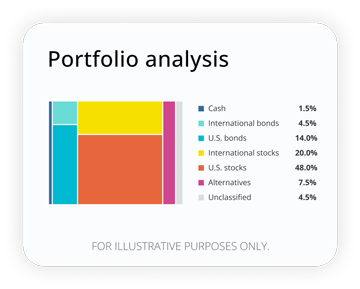
How well are your investments performing?
Analyze your portfolio in minutes and receive a target allocation for your goals.
* All balance data is derived from anonymized Empower Personal Dashboard™ data as of March 2026. “All Americans” includes users across all age groups (20s through 90s), as well as those without available age data.
1 IRS, “Retirement topics - Required minimum distributions (RMDs),” April 2026.
2 ICI, “The Role of IRAs in US Households’ Saving for Retirement, 2023,” February 2024.
RO5485003-0526
 Be current.



The Currency editors
Staff contributors
The CurrencyTM writers and editors cover the latest financial news and insights shaping how we live, work, and play. The team provides accurate, data-driven, and timely content aimed at empowering financial freedom for all.
The content contained in this blog post is intended for general informational purposes only and is not meant to constitute legal, tax, accounting or investment advice. You should consult a qualified legal or tax professional regarding your specific situation. No part of this blog, nor the links contained therein is a solicitation or offer to sell securities. Compensation for freelance contributions not to exceed $1,250. Third-party data is obtained from sources believed to be reliable; however, Empower cannot guarantee the accuracy, timeliness, completeness or fitness of this data for any particular purpose. Third-party links are provided solely as a convenience and do not imply an affiliation, endorsement or approval by Empower of the contents on such third-party websites. This article is based on current events, research, and developments at the time of publication, which may change over time.
Certain sections of this blog may contain forward-looking statements that are based on our reasonable expectations, estimates, projections and assumptions. Past performance is not a guarantee of future return, nor is it indicative of future performance. Investing involves risk. The value of your investment will fluctuate and you may lose money.
Certified Financial Planner Board of Standards Inc. (CFP Board) owns the certification marks CFP®, CERTIFIED FINANCIAL PLANNER™, CFP® (with plaque design), and CFP® (with flame design) in the U.S., which it authorizes use of by individuals who successfully complete CFP Board's initial and ongoing certification requirements.