

5 ways to manage your personal finances
5 ways to manage your personal finances
Tracking how income is earned, spent, and saved offers a clearer view of your financial status and where money can be better allocated
5 ways to manage your personal finances
Tracking how income is earned, spent, and saved offers a clearer view of your financial status and where money can be better allocated

04.14.2026
Key takeaways
Cash flow tracks how money moves through income, spending, and savings.
Adjusting spending, timing of income, and bill payments can improve flexibility.
Automating savings and investing can help money work more effectively.
Smart financial management can boil down to whether you’re making the most of your money, and cash flow monitors how your money moves — arriving into your budget as income and then being allocated as spending or saving. To get a better sense of how hard your money is working for you, take a deep dive into your income and how to better harness where it goes next.
1. Track your spending and revisit your budget
Having a budget sets a benchmark that has some flexibility if unexpected needs arise, though you still have a baseline for spending to refer back to. Households that subscribe to streaming services spend $69 a month, on average.1 But is that necessarily where dollars need to go? U.S. food prices have risen 3.1% compared to last year, so money may need to be reallocated away from discretionary entertainment and toward everyday essentials depending on your situation.
Financial tools like the Empower Personal DashboardTM — where people can connect their financial accounts like credit cards — often provide a visual breakdown of expenses, which can help people more easily digest where they spend their money.
Read more: What is lifestyle creep, and how can you control it?
Having a sense of category spending by total dollars spent and as a percentage of your overall budget can help you determine where you may have room to cut back. Budgeting frameworks like the 50-30-20 budget method can be a useful starting point for dividing your income between spending, saving, and investing.
2. Change when and how your money arrives
Now that you have a better sense of how money is being spent, it’s time to manage income arriving in your accounts. Over 92% of people get paid via direct deposit, where the funds land automatically in an account without the need for a physical check.2 But what many people don’t know is that you can maximize direct deposit by diverting funds to multiple destinations.
Just as people can set aside pre- or post-tax dollars from their paycheck to a 401(k) for retirement savings, it’s possible to send your net pay to one or more additional accounts if your employer allows — on either a flat dollar amount or percentage basis — using a payroll feature referred to often as “split direct deposit.”3
For example, you could choose to send a percentage of your paycheck directly to an emergency fund. People have saved a median of $500 for a rainy day, though there’s room to add more cushion: 29% of Americans can’t cover an emergency expense over $400. Generally, an emergency fund should cover three to six months of typical spending.
You also have flexibility to allocate your federal tax refund to up to 3 accounts at U.S. financial institutions or mobile apps by providing this information with your return.4
3. Consider multiple savings accounts for different goals
In addition to an emergency fund, having recurring transfers into other savings accounts can support socking away money. Having money automatically make its way to savings and bypassing normal daily accounts may help avoid the temptation to spend.
Savings accounts can have different time horizons for when you’ll tap the funds. For example, saving up for a home down payment could be a goal you’ll put money toward for the next five years, given the jump in median mortgage payments and home prices to start 2026.5 Meanwhile, a beach vacation fund could only be a year-long journey.
4. Set different payment dates for bills
Staying on top of debt payments and bills is essential to managing your cash flow. Federal data shows that Americans held $18.8 trillion of debt at the end of 2025.6 Late payments on accounts like credit cards and mortgages don’t just result in late fees – they can damage credit scores. To better monitor the state of your credit and work toward paying down debt, you can request a free copy of your credit report each year.7
To try and keep payments on time, you may have flexibility in requesting different payment due dates for your bills. Some people may want the payments due around the time they get paid, while others could consolidate them into one part of the month depending on the availability of funds and what’s convenient for them to remember.
Credit cards and federal student loans typically have processes on the issuer or servicer website to make these changes, though be mindful that they may not take effect immediately (possibly 1-2 billing cycles).8,9
5. Allocate some money for investing
Another place to carve out some space in your cash flow can be investments. Whether it’s in stocks, mutual funds, ETFs, or other choices, more than a quarter (27%) of Americans think investing in the stock market is the most effective way to build long-term wealth, according to Empower research.
Adult investors across age groups keep anywhere from 30% to 41% of their portfolio assets in U.S. stocks, based on Empower Personal DashboardTM data. Teens have been learning about the power of compounding and investing through personal finance courses that have become more of a requirement in U.S. high schools.
Read more: How to start investing: A beginner’s guide to investment basics
Using tax-advantaged accounts through your employer like a 401(k) can be one way to get started with investing. Americans held over $49 trillion in retirement assets at the end of 2025, rising 11.2% for the year.10 Employers can also offer a 401(k) match (also known as “free money”), in which they’ll contribute additional funds into your account depending on how much you allocate from your paycheck.
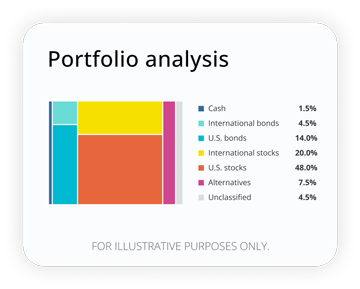
How well are your investments performing?
Analyze your portfolio in minutes and receive a target allocation for your goals.
1 Deloitte, “Deloitte: From Subscribers to Superfans: Fan Engagement Shapes the Next Phase of Media and Entertainment Growth,” March 2026.
2 PayrollORG, “2025 ‘Getting Paid in America’ Survey Results,” accessed April 2026.
3 Experian, “How to Split Your Direct Deposit Into Multiple Bank Accounts,” accessed April 2026.
4 IRS, “Frequently asked questions about splitting federal income tax refunds,” accessed April 2026.
5 Redfin, “Monthly Payments Tick Up For First Time in 6 Months As Mortgage Rates, Home Prices Jump,” April 2026.
6 Federal Reserve Bank of New York, “Household Debt and Credit Report,” accessed April 2026.
7 Experian, “Does a One-Day-Late Payment Affect Your Credit Score?” accessed April 2026.
8 myFICO, “The Benefits of Moving Your Credit Card Payment Dates and How to Do It,” accessed April 2026.
9 Edfinancial Services, “How to Change Your Payment Due Date,” accessed April 2026.
10 Investment Company Institute, “Release: Quarterly Retirement Market Data, Fourth Quarter 2025,” March 2026.
RO5390572-0426
 Get The Currency newsletter



The Currency editors
Staff contributors
The CurrencyTM writers and editors cover the latest financial news and insights shaping how we live, work, and play. The team provides accurate, data-driven, and timely content aimed at empowering financial freedom for all.
The content contained in this blog post is intended for general informational purposes only and is not meant to constitute legal, tax, accounting or investment advice. You should consult a qualified legal or tax professional regarding your specific situation. No part of this blog, nor the links contained therein is a solicitation or offer to sell securities. Compensation for freelance contributions not to exceed $1,250. Third-party data is obtained from sources believed to be reliable; however, Empower cannot guarantee the accuracy, timeliness, completeness or fitness of this data for any particular purpose. Third-party links are provided solely as a convenience and do not imply an affiliation, endorsement or approval by Empower of the contents on such third-party websites. This article is based on current events, research, and developments at the time of publication, which may change over time.
Certain sections of this blog may contain forward-looking statements that are based on our reasonable expectations, estimates, projections and assumptions. Past performance is not a guarantee of future return, nor is it indicative of future performance. Investing involves risk. The value of your investment will fluctuate and you may lose money.
Certified Financial Planner Board of Standards Inc. (CFP Board) owns the certification marks CFP®, CERTIFIED FINANCIAL PLANNER™, CFP® (with plaque design), and CFP® (with flame design) in the U.S., which it authorizes use of by individuals who successfully complete CFP Board's initial and ongoing certification requirements.