

How do I invest in mutual funds? Get a Sense Check
How do I invest in mutual funds? Get a Sense Check
In this edition of Sense Check, Empower’s Joseph Chang, CFP® weighs in on how to invest in mutual funds and key considerations for beginners
How do I invest in mutual funds? Get a Sense Check
In this edition of Sense Check, Empower’s Joseph Chang, CFP® weighs in on how to invest in mutual funds and key considerations for beginners

09.05.2025

Listen
·How do I invest in mutual funds? Get a Sense Check
Key takeaways
- Mutual funds pool investors’ money to buy a mix of stocks, bonds, or other securities.
- They are either actively managed (by financial professionals) or passively managed (by tracking an index).
- Taxes on mutual funds depend on the account type: Retirement accounts defer or eliminate taxes, while taxable accounts may generate annual tax obligations.
Mutual funds give investors access to a broad range of investments, often with minimums of just a few hundred dollars. Consider these essentials before getting started.
If you’re wondering how to invest in mutual funds, you’re not alone. Many people want to participate in the financial markets but feel uncertain about where to begin. Mutual funds are often the first investment I point to when someone says, ‘I want to invest, but I don’t know where to start.’ They offer an accessible way to step into the financial markets without needing to research and trade individual securities.
The first step is understanding how to choose mutual funds to invest in based on your goals, timeline, and risk tolerance.
What is a mutual fund?
Mutual funds are SEC-registered investment vehicles, designed to provide investors with the ability to invest in a pool of assets that can provide access to broader market exposure. I tell clients to picture a mutual fund as a pot of money many investors contribute to. That pot is then invested in a mix of investments that may include stocks, bonds, or other securities depending on the type of mutual fund. That pot can end up owning hundreds — sometimes thousands — of securities, giving you diversification in a single investment.
Before investing, review the fund’s prospectus, which outlines the fund’s objectives, risks, expenses, and redemption terms.
There are two main management approaches:
Actively managed funds are overseen by financial professionals who research and select investments with the goal of outperforming the fund’s benchmark index.
Passively managed funds (such as index funds) track a specific index, such as the S&P 500, and generally aim to mirror index performance at a lower cost than an actively managed fund. (Keep in mind that you cannot invest directly in an index.) Index funds can track broad benchmarks like the S&P 500, but there are also thousands of indexes covering everything from specific industries to international markets.
Both approaches can give investors access to a broad range of investments that could be difficult to build on their own.
Read more: How to start investing: A beginner’s guide
Why consider investing in mutual funds?
The appeal of mutual funds is simple: Someone else does the heavy lifting, your money is spread across dozens or hundreds of investments, and you don’t need a large balance to get started. For many people, these characteristics make mutual funds a practical way to begin investing. Keep in mind that fees and expenses vary by fund and can affect returns over time.
How do I invest in mutual funds?
There’s no single way to buy mutual funds. Some people open an account directly with a fund provider, others prefer the convenience of a brokerage platform, and many get their first exposure through a workplace retirement plan, like a 401(k). Some investors also work with a financial professional, who can place buy and sell orders and help align fund choices with long-term goals.
However you start, remember that mutual funds are typically priced once per day at their net asset value (NAV), so they work differently than stocks you trade intraday.1
For beginners, a passively managed index fund is often the simplest starting point, providing broad market exposure with low fees.
Read more: Guide to understanding index funds
Types of mutual funds
I often tell clients to think of mutual funds like ice cream — the overall category is the same, but there are different “flavors” depending on your needs and preferences. The main categories include:
- Equity funds invest in stocks which are typically selected for their growth, value, or income potential.
- Bond funds focus on fixed income securities and are often used for stability and income.
- Money market funds invest in short-term fixed income securities with the aim to preserve capital and provide liquidity.
- Index funds track a specific market benchmark, offering diversification at a generally lower cost.
- Target-date funds automatically adjust their mix of stocks and bonds to become more conservative as a chosen date — such as retirement — approaches.
This range of options allows investors to align their fund selection with specific goals, time horizons, and risk preferences. Within these categories, there are subgroups. Equity funds, for example, can focus on large or small companies, growth or value styles, or even specific industries known as sector funds. These subcategories give investors more ways to match investments to their outlook and goals.
Choosing the right fund
The right mutual fund depends on your objectives and tolerance for risk.
- Long-term investors — such as those saving for retirement — may consider equity or index funds with higher growth potential.
- Shorter-term savers may prefer more conservative bond or money market funds.
- Hands-off investors might find target-date funds convenient, as they automatically rebalance to become more conservative over time.
I always encourage people to ask themselves: How long will I keep this money invested, and how much risk am I comfortable with?
Those who feel uncertain could benefit from guidance. A financial professional can help assess goals, risk tolerance, and investment timelines, then provide information on funds that may fit the investor’s unique circumstances.
Risks to keep in mind
As I remind clients, all investing involves risk. The key is making sure the level of risk matches your stage of life and goals. The value of shares will fluctuate with market performance, and past results do not guarantee future returns.
Fees also matter. Expense ratios and other costs, while often small percentages, can add up over time and reduce total returns. Balancing risk and cost against your goals is a critical part of fund selection.
How are mutual funds taxed?
Tax treatment depends on the type of account:
Retirement accounts (401(k), IRA): Taxes on gains are deferred until withdrawal or eliminated entirely for qualified withdrawals from Roth accounts.
Taxable brokerage accounts: Dividends and capital gain distributions are reported each year on Form 1099-DIV and are taxable in the year distributed — even when reinvested.2
Some municipal bond funds generate income that’s exempt from federal taxes — and sometimes state and local taxes — which can be attractive for investors in higher tax brackets.3
For many investors, holding mutual funds in retirement accounts may help minimize the impact of taxes over the long term.
FAQs about mutual funds
How much money do I need to start investing in mutual funds?
Many mutual funds have minimums of a few hundred dollars, though minimums vary by fund and platform, and some funds allow very small ongoing contributions.
Are mutual funds better than ETFs?
Both mutual funds and exchange traded funds (ETFs) help you diversify your portfolio and spare you the task of picking individual securities. Mutual funds are typically priced at NAV once daily, while ETFs trade throughout the day on an exchange.
Read more: Mutual fund vs ETF
Can I lose money in a mutual fund?
Market risk is always present, though diversification reduces exposure to any single company or sector.
What’s the difference between active and passive funds?
Active funds rely on managers to select investments. Passive funds track indexes, often at lower cost.
The bottom line
Mutual funds provide access to a diversified portfolio with relative ease. They can play a role in a variety of strategies, from saving for retirement to building wealth over the long term. For many investors, mutual funds are a practical and accessible way to start investing.
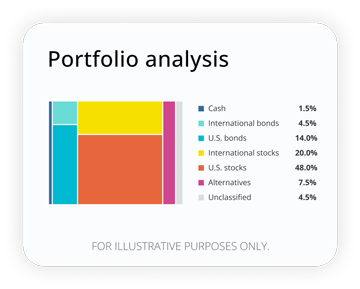
How well are your investments performing?
Analyze your portfolio in minutes and receive a target allocation for your goals.
1 SEC, “Mutual Funds and ETFs,” September 2025.
2 IRS, “Mutual Funds (Costs, Distributions, etc.),” July 2025.
3 IRS, “Tax-exempt bonds,” February 2025.
Investing involves risk, including possible loss of principal.
The S&P 500 Index is a registered trademark of Standard & Poor’s Financial Services LLC. It is an unmanaged index considered indicative of the domestic large-cap equity market and is used as a proxy for the stock market in general.
An index is not actively managed, does not have a defined investment objective, and does not incur fees or expenses. Performance of an index fund will generally be less than its benchmark index. You cannot invest directly in an index.
RO4793027-0925
 Get The Currency newsletter



Joseph Chang, CFP®
Certified Financial Planner® Professional
Joseph Chang is a Certified Financial Planner® Professional at Empower. He is responsible for developing and delivering comprehensive certified financial plans to clients.
The content contained in this blog post is intended for general informational purposes only and is not meant to constitute legal, tax, accounting or investment advice. You should consult a qualified legal or tax professional regarding your specific situation. No part of this blog, nor the links contained therein is a solicitation or offer to sell securities. Compensation for freelance contributions not to exceed $1,250. Third-party data is obtained from sources believed to be reliable; however, Empower cannot guarantee the accuracy, timeliness, completeness or fitness of this data for any particular purpose. Third-party links are provided solely as a convenience and do not imply an affiliation, endorsement or approval by Empower of the contents on such third-party websites. This article is based on current events, research, and developments at the time of publication, which may change over time.
Certain sections of this blog may contain forward-looking statements that are based on our reasonable expectations, estimates, projections and assumptions. Past performance is not a guarantee of future return, nor is it indicative of future performance. Investing involves risk. The value of your investment will fluctuate and you may lose money.
Certified Financial Planner Board of Standards Inc. (CFP Board) owns the certification marks CFP®, CERTIFIED FINANCIAL PLANNER™, CFP® (with plaque design), and CFP® (with flame design) in the U.S., which it authorizes use of by individuals who successfully complete CFP Board's initial and ongoing certification requirements.