

What to do when a loved one dies: A financial checklist
What to do when a loved one dies: A financial checklist
Not every financial decision is urgent — and knowing what can wait may be as important as knowing what can’t
What to do when a loved one dies: A financial checklist
Not every financial decision is urgent — and knowing what can wait may be as important as knowing what can’t

09.28.2026
Key takeaways
- The first 30 days are about gathering documents, taking stock of finances, securing benefits, and keeping essential expenses covered.
- The first 90 days are about following up on estate and tax matters and adjusting your budget to your new financial reality.
- At the first-year mark, you can start looking ahead by reassessing long-term goals, investments, and your own estate plan.
Finances most likely are not the first thing on your mind when someone you love passes away, but money questions can come up within days or even hours. Who pays the mortgage? What happens to the bank and retirement accounts? Is there life insurance? Those and other important financial questions can feel overwhelming on top of emotional distress.
The death of a loved one can create an abrupt financial shift, especially if the person was your spouse. A household built around two people, and perhaps two incomes, becomes a household of one — yet many expenses like a mortgage, property taxes, or home repairs barely change. Depending on who managed household finances, you may suddenly be responsible for decisions your spouse previously handled.
In many cases these important matters typically aren’t emergencies. While you may feel that everything needs urgent attention, the first priority may be financial continuity, not optimization. It can be helpful to think about the process in three stages: the first 30 days, the first 90 days, and the first year.
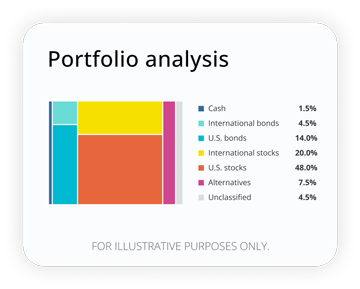
How well are your investments performing?
Analyze your portfolio in minutes and receive a target allocation for your goals.
The first 30 days: Secure, organize and stabilize
In the weeks after a death, rather than redesigning your financial life, this time is normally more about gathering information to help protect what you have, establishing what needs immediate attention, and giving yourself enough time to make bigger decisions with a clearer head.
These steps can help you understand what exists and keep important things from falling through the cracks.
Get multiple certified copies of the death certificate
Death certificates are a key that unlocks much of the administrative process after a loved one passes. Banks, insurers, retirement-plan administrators, and other institutions may request a certified copy before they will transfer assets or provide information.
The funeral home can often help you obtain these. How many you need will depend on the complexity of the estate, so first make a list of the institutions and entities that may require one rather than automatically ordering an excessive number.
Find the estate documents
Locate the will, trust documents, beneficiary designations, and any instructions the deceased left behind.
The will may identify an executor — the person responsible for administering the estate. Depending on the assets involved and state law, the executor may need to begin a probate proceeding before gaining authority to act.
The will may not control every asset. Life insurance, retirement accounts, and certain accounts with payable-on-death or transfer-on-death beneficiaries generally pass according to their beneficiary designations. Jointly owned property may also pass outside the will, depending on how ownership is structured and applicable state law. So before moving or distributing money, be sure to establish the rightful legal beneficiaries.
Read more: 5 essential estate planning documents
Build a financial inventory
Before you can make decisions about money, you need to know what’s there. Creating a master list of the deceased person’s financial life can help surface assets, debts, and benefits that might otherwise be overlooked, including:1
- Checking, savings and money-market accounts
- Brokerage and investment accounts
- 401(k)s, 403(b)s, IRAs, pensions and other retirement benefits
- Life insurance and annuities
- A home and other real estate
- Mortgages, home-equity loans, and other secured debts
- Credit cards and personal loans
- Vehicles and vehicle loans
- Employer benefits, unpaid wages, bonuses, or stock compensation
- Social Security and veterans benefits
- Business interests
- Safe-deposit boxes
- Recurring bills and subscriptions
- Recent tax returns
- Digital financial accounts and other valuable digital property
Recent bank and credit-card statements can be particularly useful because they may show both income and recurring expenses.
For the time being, resist the urge to close every account you find. Some accounts may be needed while the estate is being administered, and changing ownership or withdrawing assets prematurely can create legal or tax complications.
Read more: What happens when you inherit a 401(k)?
Protect the household's cash flow
A mortgage, utilities, insurance premiums, and other bills keep coming after someone passes. You’ll need to determine how these essential bills will be paid over the next few months.
Start by identifying available cash flow, and then prioritize housing, utilities, insurance, taxes, and other expenses necessary to keep the household running.
At the same time, do not automatically pay the deceased person's individual debts from your own money. Relatives generally aren't responsible for someone else's debts simply because that person died, although there are exceptions for certain joint debts, co-signed loans and obligations under state law.
The Consumer Financial Protection Bureau has guidance on debts after a spouse dies.2
Check Social Security and other survivor benefits
Eligible spouses, divorced spouses, children, and dependent parents may qualify for Social Security survivor benefits based on the deceased worker's record.3 Eligibility and the amount will depend on factors such as age and family circumstances.
Don't assume Social Security has taken care of everything because the death has been reported. Survivors must contact the Social Security Administration within two years of the date of death to apply for benefits, and a qualifying spouse or child may also be eligible for a one-time $255 death benefit if they meet certain requirements.4
You should also contact current and former employers about life insurance, pensions, retirement accounts, and other death benefits. If the deceased served in the military, check with the U.S. Department of Veterans Affairs potential survivor benefits.5
Read more: Is Social Security income taxable?
The first 90 days: Understand your new financial picture
By the second and third months, you should have a clearer picture of the assets, debts, and benefits involved. This can be a good time to follow up on outstanding life insurance, pension, retirement, and employer-benefit claims. Keep a simple record of whom you contacted, documents submitted, and next steps.
If you're administering the estate, it’s important to understand any valid creditor claims and tax obligations before distributing assets. Probate rules vary by state, and some estates may be complicated, insolvent, or even disputed, so it may make sense to consult with an estate attorney.
Read more: How do I create a solid estate plan? Get a Sense Check
Don't overlook taxes
A final federal income-tax return, including income, estate, and gift tax returns, may need to be filed for the person who died — along with any unfiled returns for preceding years.6 If you’re a surviving spouse, you may be able to file a joint return for the year of death if the criteria are met. Specific filing requirements depend on the deceased person’s gross income, age, and filing status.7 Taxes generally will be due at the same time they would have had the person not passed away.
Rebuild the household budget
If you've lost someone who contributed substantially to household finances, it may make sense to start the budget over rather than trying to modify the old one. A well-structured budget can help ease financial stress and identify possible issues.
To start, calculate reliable monthly income after the death and compare it with essential and discretionary expenses. Remember that certain costs, particularly housing and utilities, likely won't decline proportionately simply because the household is smaller, while expenses like food and discretionary spending probably will.
If expenses exceed sustainable income, you've identified a problem to solve — but it’s not necessarily a reason to sell a home or investments immediately.
Read more: 5 ways to manage your personal finances
What can probably wait
Weighing complicated choices while grieving can be challenging. You still may be learning details about your income, benefits, taxes, and the estate that can be important to your decision-making process.
Once immediate bills, benefits, and estate responsibilities are under control, it can be prudent to slow down and proceed with caution on financial matters that don’t have a pressing deadline.
Unless circumstances require immediate action, it can make sense to postpone making major life decisions such as selling or buying a home or leaving a job.8 A good rule of thumb can be to separate decisions that must be made now from those that merely can be made now. Sometimes waiting can be the decision.
By the first anniversary: Start looking ahead
There’s no timetable for grief, or financial rule that says you need to have everything figured out within a year. That said, immediate paperwork and estate matters may begin to settle around the first-year mark, and you might find you have more space to think beyond the next bill or deadline.
This can be a good time to take stock of where you are now — and start shaping a financial life that works for the future.
If you’ve lost a spouse, that may mean taking a fresh look at your finances. You can start by revisiting your retirement savings and projections using your current income, assess your Social Security benefits, and summarize your expenses. Ask yourself whether your housing still feels affordable, whether you have enough emergency savings, and whether your investment strategy still fits your needs and goals.
If you’ve received a substantial inheritance or life-insurance payout, you don’t need to rush to put every dollar to work. But you might start thinking about what you want the money to do for you — whether it’s to provide a financial cushion, help pay down debt, support retirement, or meet some combination of goals. Once you know the money’s purpose, you can make more thoughtful decisions about how to save or invest it.
The one-year mark can also be a good time to do some financial housekeeping. Take the time to review your will, powers of attorney, and health-care directives, and check the beneficiaries on retirement accounts and life-insurance policies. A loved one who has died may still be named on documents or accounts that now need updating.
Finally, give yourself permission to simplify. You may want to consolidate accounts, automate more bills, or organize important financial documents in one place. Small changes that make your finances easier to manage can be valuable as you adjust to a new normal.
Carefully consider all your options, including tax implications, fees and expenses, before moving money between accounts. Assess all features of current accounts before moving money.
Generally, the goal isn’t to have every financial question answered in the first year. It’s to move from responding to a loved one’s death toward making decisions that support the life you’re building going forward.
Read more: What should I do with an inheritance? Get a Sense Check
Keep the priorities simple
Some costly mistakes after a death may often share one characteristic: Taking action without knowing all the facts. While there are some true deadlines after a death, getting finances in order doesn’t need to be a rush to finish a checklist.
The first 30 days are normally about protecting and organizing. The first 90 days are typically about understanding and stabilizing. The first year is commonly about planning for the life that comes next.
If everything feels equally urgent and overwhelming, remember that a basic hierarchy can help: Do what must be done, learn what you don't yet know, and give the biggest, hardest-to-reverse decisions the time they deserve.
1 Consumer Financial Protection Bureau, “Taking Control of Your Finances: Help for surviving spouses,” accessed September 2026.
2 Consumer Financial Protection Bureau, “Am I responsible for my spouse’s debts after they die?” accessed September 2026.
3 Social Security Administration, “Survivor benefits,” accessed September 2026.
4 Social Security Administration, “Who is eligible to receive Social Security survivors benefits and how do I apply?” March 13, 2024.
5 U.S. Department of Veterans Affairs, “Survivors Pension,” accessed September 2026.
6 Internal Revenue Service, “Publication 559 (2025), Survivors, Executors, and Administrators,” April 30, 2026.
7 Ibid.
8 National Institute on Aging, “Coping with Grief and Loss,” accessed September 2026.
RO5954557-0926
 Get The Currency newsletter



The Currency editors
Staff contributors
The CurrencyTM writers and editors cover the latest financial news and insights shaping how we live, work, and play. The team provides accurate, data-driven, and timely content aimed at empowering financial freedom for all.
The content contained in this blog post is intended for general informational purposes only and is not meant to constitute legal, tax, accounting or investment advice. You should consult a qualified legal or tax professional regarding your specific situation. No part of this blog, nor the links contained therein is a solicitation or offer to sell securities. Compensation for freelance contributions not to exceed $1,250. Third-party data is obtained from sources believed to be reliable; however, Empower cannot guarantee the accuracy, timeliness, completeness or fitness of this data for any particular purpose. Third-party links are provided solely as a convenience and do not imply an affiliation, endorsement or approval by Empower of the contents on such third-party websites. This article is based on current events, research, and developments at the time of publication, which may change over time.
Certain sections of this blog may contain forward-looking statements that are based on our reasonable expectations, estimates, projections and assumptions. Past performance is not a guarantee of future return, nor is it indicative of future performance. Investing involves risk. The value of your investment will fluctuate and you may lose money.
Certified Financial Planner Board of Standards Inc. (CFP Board) owns the certification marks CFP®, CERTIFIED FINANCIAL PLANNER™, CFP® (with plaque design), and CFP® (with flame design) in the U.S., which it authorizes use of by individuals who successfully complete CFP Board's initial and ongoing certification requirements.