

Does the buck stop here? A look at Social Security eligibility after divorce
Does the buck stop here? A look at Social Security eligibility after divorce
Understanding the rules for ex-spouses could make a difference in long-term retirement income
Does the buck stop here? A look at Social Security eligibility after divorce
Understanding the rules for ex-spouses could make a difference in long-term retirement income

02.10.2026
Key takeaways
- Some divorced spouses may qualify for Social Security benefits based on a former spouse’s work history.
- Divorced spousal benefits can be worth up to 50% of a former spouse’s full retirement age benefit and do not reduce the ex-spouse’s benefit.
- Survivor benefits for divorced spouses can be higher — up to 100% — if eligibility requirements are met.
- These benefits may be especially valuable for people with limited work histories or time spent out of the workforce.
Divorce can have a significant impact on finances — from where to live and how to save and spend money to vision and goals for retirement. While it may come as a surprise, one thing that may not change is the ability to claim Social Security benefits based on a former spouse’s work history.
For many divorced Americans, Social Security benefits can be a meaningful source of income — and a financial lifeline some don’t know they have.
Read more: Is Social Security income taxable?
Can an ex really collect Social Security benefits?
The short answer: Yes. Social Security rules allow a qualifying former spouse to claim benefits post-divorce based on the work history of a higher-earning ex. Benefits could be worth up to half of the former spouse’s full retirement age (FRA) benefit — and potentially more if the former spouse passes away.1
Divorced spousal benefits can be important for partners who have never worked or for those who have left the workforce for a period of time, which can lead to smaller Social Security checks later on. Claiming based on a higher-earning ex’s record can help close that gap.
Eligibility
To qualify for Social Security benefits on a former spouse’s record, these eligibility requirements generally must be met:2
Your marriage lasted at least 10 years
You have not remarried
You are aged 62 or older
Your ex-spouse is entitled to Social Security retirement or disability benefits
The benefit you’re entitled to on your own is less than the amount you could receive as a divorced spouse
Social Security treats a divorced spouse’s claim as a family benefit, which is separate from the ex-spouse’s own benefit — so claiming on an ex’s record does not reduce what the ex or their current spouse (if they’ve remarried) can receive.3,4 Keep in mind, your ex does not need to be collecting yet for you to claim on their record, but you must be divorced for at least two years to do so if they haven’t applied for their own benefits yet.
If you’re already collecting Social Security based on your own earnings but are eligible for a benefit tied to a former spouse’s record, you’ll receive a single monthly benefit equal to the higher of the two amounts.5 Social Security won’t stack the two payments.
Read more: To collect or not to collect: Does waiting for a bigger Social Security benefit pay off?
Social Security Survivor benefits after divorce
Divorced spouses may also be eligible to collect Social Security survivor benefits if a former spouse has died, and survivor benefits can be higher — up to the full 100% if the surviving ex-partner has reached their FRA.6,7 Survivor benefits can be claimed as early as age 60, though claiming before FRA may reduce the amount.
A surviving divorced spouse may qualify for Social Security survivor benefits if:
- They do not remarry before age 60 (age 50 if disabled)8
- Their own Social Security benefit is less than what they would receive based on the deceased ex-spouse’s earnings record9
- Their marriage lasted at least 10 years — unless they are caring for the deceased worker’s child who is under age 16 or has a disability and qualifies for benefits
Final thoughts
Divorce doesn’t automatically close the door on Social Security benefits. Taking the time to understand divorced spousal and survivor rules could pay off in a bigger monthly check down the road.
Read more: More Americans are taking Social Security early — is it the right move?
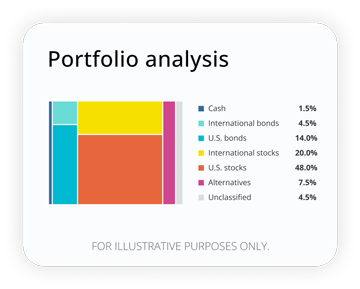
How well are your investments performing?
Analyze your portfolio in minutes and receive a target allocation for your goals.
1 Social Security Administration, “What you could get from Family benefits,” accessed February 2026.
2 AARP, “Am I entitled to my ex-spouse's Social Security?,” December 11, 2025.
3 Social Security Administration, “Family benefits,” accessed February 2026.
4 AARP, “Am I entitled to my ex-spouse's Social Security?,” December 11, 2025.
5 Ibid.
6 Social Security Administration, “What you could get from Survivor benefits,” accessed February 2026.
7 AARP, “When someone who was married more than once dies, who is eligible for their Social Security benefits?” November 25, 2025.
8 Social Security Administration, “Survivors Benefits,” accessed February 2026.
9 Ibid.
RO5199527-0226
 Get The Currency newsletter



The Currency editors
Staff contributors
The CurrencyTM writers and editors cover the latest financial news and insights shaping how we live, work, and play. The team provides accurate, data-driven, and timely content aimed at empowering financial freedom for all.
The content contained in this blog post is intended for general informational purposes only and is not meant to constitute legal, tax, accounting or investment advice. You should consult a qualified legal or tax professional regarding your specific situation. No part of this blog, nor the links contained therein is a solicitation or offer to sell securities. Compensation for freelance contributions not to exceed $1,250. Third-party data is obtained from sources believed to be reliable; however, Empower cannot guarantee the accuracy, timeliness, completeness or fitness of this data for any particular purpose. Third-party links are provided solely as a convenience and do not imply an affiliation, endorsement or approval by Empower of the contents on such third-party websites. This article is based on current events, research, and developments at the time of publication, which may change over time.
Certain sections of this blog may contain forward-looking statements that are based on our reasonable expectations, estimates, projections and assumptions. Past performance is not a guarantee of future return, nor is it indicative of future performance. Investing involves risk. The value of your investment will fluctuate and you may lose money.
Certified Financial Planner Board of Standards Inc. (CFP Board) owns the certification marks CFP®, CERTIFIED FINANCIAL PLANNER™, CFP® (with plaque design), and CFP® (with flame design) in the U.S., which it authorizes use of by individuals who successfully complete CFP Board's initial and ongoing certification requirements.