

What Is dollar-cost averaging?
What is dollar-cost averaging?
Dollar-cost averaging involves investing a fixed amount regularly, regardless of market prices. Learn how it works, with examples, benefits, and risks
What is dollar-cost averaging?
Dollar-cost averaging involves investing a fixed amount regularly, regardless of market prices. Learn how it works, with examples, benefits, and risks

10.15.2026
Key takeaways
- Dollar-cost averaging involves investing a fixed amount on a regular schedule, regardless of market moves, rather than investing it all at once.
- Investing a fixed amount means buying more shares when prices are low and fewer when prices are high, potentially lowering the average cost per share.
- Dollar-cost averaging may ease market-timing concerns, but it does not prevent investment losses
Investing can feel complicated for many Americans. The Federal Reserve reported that 53% of U.S. adults expressed they were either not comfortable or only slightly comfortable choosing and managing investments.1
One approach that can simplify the process is dollar-cost averaging (DCA). Investing a set amount on a regular basis can help reduce the pressure of timing the market and risking a large investment all at once.
Explore what dollar-cost averaging is, how it works, and when to consider incorporating it into your broader financial goals.
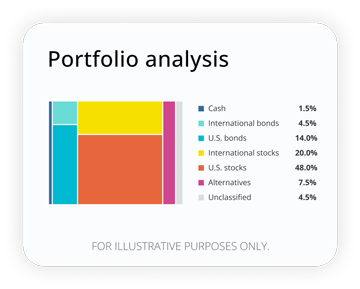
How well are your investments performing?
Analyze your portfolio in minutes and receive a target allocation for your goals.
What Is dollar-cost averaging in investing?
Dollar-cost averaging (DCA) is an investment strategy in which a fixed amount is invested in stocks or other assets on a regular basis, regardless of whether asset prices are rising or falling. Investors can choose a sustainable recurring amount that aligns with their cash flow, rather than making a larger lump-sum investment.
DCA can help:
- Make investing a consistent part of your long-term financial plan by investing a sustainable amount that aligns with your monthly cash flow.
- Potentially reduce risk by spreading out purchases over time, minimizing the chances of making lump-sum investment right before a market decline.
- Potentially lower your average share price as a greater number of shares are bought when prices are low.
DCA is often used to support long-term financial goals, such as saving for retirement. For example, 401(k)s and other workplace plans can automatically defer and invest a portion of each paycheck. These contributions may continue to accumulate and compound over time, potentially generating an income stream in retirement.
Read more: Investment strategies: Guide for beginners
How does dollar-cost averaging work?
Let’s look at an example of how dollar-cost averaging may look for an investor who purchases $200 worth of shares every month for four consecutive months.
Month | Amount invested | Share price | Shares purchased |
|---|---|---|---|
January | $200 | $20 | 10 |
February | $200 | $16 | 12.5 |
March | $200 | $25 | 8 |
April | $200 | $20 | 10 |
Total | $800 | — | 40.5 |
In this example, the investor spent $800 on 40.5 total shares, bringing their average cost per share (before fees) to:
$800 total invested ÷ 40.50 total shares = $19.75 per share
However, the average quoted price per share is:
($20 + $16 + $25 + $20) share price ÷ 4 months = $20.25 per share
In this hypothetical example, DCA resulted in a lower average share price — $19.75 as opposed to $20.25. This is because a greater number of shares could be purchased for $200 during months when prices dropped.
Say that the investor had instead spent the entire $800 in the first month, when shares were $20 apiece. They would’ve bought 40 shares at a rate higher than the DCA average ($19.75). Alternatively, the investor could have waited until the next month, February, and instead bought 50 shares at $16 apiece — even lower than the DCA average.
Although DCA didn’t necessarily result in the lowest cost per share, it helped the investor avoid investing the entire $800 in a higher-value month like March, when share prices reached $25 each. In this way, DCA may help reduce the impact of market volatility compared to lump-sum investing, although it does not eliminate market risk or protect against investment losses.
Dollar-cost averaging vs. lump-sum investing
Lump-sum investing (LSI) is another common investment strategy in which available cash is invested at once rather than broken up across regular intervals.
Here is a breakdown of the key differences between DCA and LSI:
Consideration | Dollar-cost averaging | Lump-sum investing |
|---|---|---|
Market timing risk | May be lower because purchases are spread out | May be higher because purchases are concentrated |
Potential returns | May be lower because funds are invested gradually | Often higher because money is invested sooner |
Complexity | Requires repeated transactions, though they can often be automated | One initial transaction |
Most useful for | Investors who prefer a gradual approach | Investors who are comfortable investing right away |
DCA may have lower risk associated with market timing when compared to LSI. This is because smaller amounts are invested over time, rather than all at once. If the market were to fall, later purchases may be made at lower prices, helping reduce the impact of having entered the market at a less favorable time.
LSI may offer greater potential investment growth than DCA as more money is invested up front. Typically, the longer money is invested, the more time it has to compound and generate returns.
LSI can also require less ongoing management because the full amount is invested at one time. However, deciding when and where to invest may feel like a bigger decision. Both LSI and DCA can benefit from ongoing portfolio management to help keep your investments aligned with your financial goals, time horizon, and risk tolerance.
How to start a dollar-cost averaging plan
You can set up a dollar-cost averaging plan by following these five steps:
- Define your financial goal and time horizon. Are you preparing for retirement, a child’s education, or something else?
- Evaluate your monthly expenses and cash flow. Identify a sustainable amount to invest that fits your budget.
- Choose an investment account. Depending on your goal, you might choose a retirement account, custodial investment account, or taxable brokerage account.
- Select investments to purchase. Your selection will depend on your goals, time horizon, and risk tolerance. Aim to build a diversified investment portfolio of stocks, bonds, or other types of investments.
- Automate your investments. Many banks and wealth management services support automated investing, as do most workplace plans including 401(k)s and health savings accounts (HSAs).
Consider reviewing your investment performance periodically. It may help to adjust your strategy as you experience changes in income, expenses, and goals. For example, consider transitioning to lower-risk investments as you near your financial goals and have less time to recover from market declines.
Dollar-cost averaging FAQs
How often should you invest using DCA?
Your investment frequency will depend on your own unique circumstances. It’s common for investment purchases to align with income. Some investors choose to automatically transfer a portion of each paycheck to an investment account. Others may decide to adjust their timing to meet certain investment minimums or to reduce purchase fees, which may apply to mutual funds.2
What are fractional shares?
A fractional share is a portion of a share that can be purchased by investors.3 Instead of buying a certain number of shares, investors can make purchases based on a dollar amount. This may be especially useful when investing in high-priced stocks or exchange-traded funds (ETFs).
What is a dividend reinvestment plan?
A dividend reinvestment plan (DRIP) automatically uses eligible cash dividends to buy additional shares — including fractional shares. Investors can continue to add to their portfolios with relative ease, then sell shares when necessary to generate income. Some DRIPs may charge fees, so it’s worth checking the disclosures.
Dollar-cost averaging does not ensure a profit or protect against loss.
1 Federal Reserve, "Report on the Economic Well-Being of U.S. Households in 2025 - May 2026," May 2026.
2 Investor.gov, "Purchase Fee," accessed October 2026.
3 Investor.gov, "Fractional Share Investing – Buying a Slice Instead of the Whole Share," accessed October 2026.
RO6021540-1026
 Get The Currency newsletter


The Currency editors
Staff contributors
The CurrencyTM writers and editors cover the latest financial news and insights shaping how we live, work, and play. The team provides accurate, data-driven, and timely content aimed at empowering financial freedom for all.
The content contained in this blog post is intended for general informational purposes only and is not meant to constitute legal, tax, accounting or investment advice. You should consult a qualified legal or tax professional regarding your specific situation. No part of this blog, nor the links contained therein is a solicitation or offer to sell securities. Compensation for freelance contributions not to exceed $1,250. Third-party data is obtained from sources believed to be reliable; however, Empower cannot guarantee the accuracy, timeliness, completeness or fitness of this data for any particular purpose. Third-party links are provided solely as a convenience and do not imply an affiliation, endorsement or approval by Empower of the contents on such third-party websites. This article is based on current events, research, and developments at the time of publication, which may change over time.
Certain sections of this blog may contain forward-looking statements that are based on our reasonable expectations, estimates, projections and assumptions. Past performance is not a guarantee of future return, nor is it indicative of future performance. Investing involves risk. The value of your investment will fluctuate and you may lose money.
Certified Financial Planner Board of Standards Inc. (CFP Board) owns the certification marks CFP®, CERTIFIED FINANCIAL PLANNER™, CFP® (with plaque design), and CFP® (with flame design) in the U.S., which it authorizes use of by individuals who successfully complete CFP Board's initial and ongoing certification requirements.