

What happens when you inherit a 401(k)?
What happens when you inherit a 401(k)?
Taxes and withdrawal deadlines can affect how inherited retirement savings are handled
What happens when you inherit a 401(k)?
Taxes and withdrawal deadlines can affect how inherited retirement savings are handled

09.22.2026
Key takeaways
- Inherited 401(k) options depend on the beneficiary’s relationship to the person who died, their age, and RMD status of the decedent.
- Many non-spouse beneficiaries generally must empty the account within 10 years; annual RMDs may also apply.
- Surviving spouses generally can roll eligible assets into a retirement account in their own name.
Inheriting a 401(k) can bring financial decisions at an already difficult time. Your options can depend on your relationship to the person who died, their age, whether they were taking required minimum distributions (RMDs), and the rules of the employer’s plan.
Your choices also will depend on your beneficiary status and relationship to the person who died.
Depending on your situation, you may be able to keep the money invested in the plan, transfer it to an inherited individual retirement account (IRA), take regular distributions or take a lump sum. Surviving spouses generally have the most options, including moving eligible assets into a retirement account in their own name.1
Before making a decision, you can find out what the plan allows, what deadlines apply, and how each option could affect your taxes and access to the funds.
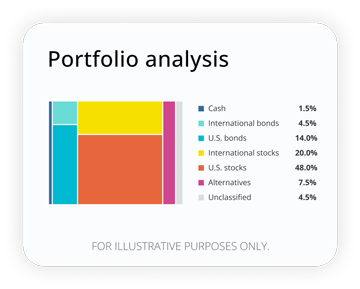
How well are your investments performing?
Analyze your portfolio in minutes and receive a target allocation for your goals.
What happens when you inherit a 401(k)?
Retirement plan administrators usually ask account owners to name a primary beneficiary, and a contingency beneficiary as a backup. There can also be co-beneficiaries, two or more primary beneficiaries that would share account funds based on the percentages set by the owner.
If beneficiaries are not designated, IRS rules allow for default elections under the terms of the plan.2 With most employer-sponsored retirement plans, a surviving spouse will inherit if no beneficiary was designated by the owner who died.
If you’re a beneficiary, you can contact the deceased person’s employer or the plan administrator to make a claim. The plan may ask for a death certificate and other documents before confirming your potential benefits and distribution options.3
What should you do first after inheriting a 401(k)?
You can gather information that can affect your options and deadlines. This can include steps like confirming the original account owner’s date of death, whether there are other beneficiaries, and whether the 401(k) owner was taking required minimum distributions (RMDs) from the account. You can ask whether any year-of-death RMDs remains unpaid.
You can also confirm whether the account contains pre-tax, Roth, after-tax or mixed money and ask for the plan’s distribution and direct-transfer options and deadlines. Understanding the potential tax and rollover consequences is important as you consider your options.
Options can depend on beneficiary status
Surviving spouse beneficiary
A surviving spouse generally has the most flexibility among types of plan beneficiaries.4
Depending on the plan rules, a spousal beneficiary can leave the inherited account as a beneficiary account in the plan, transfer eligible assets to an inherited IRA (an account holding the deceased spouse’s inherited 401(k) assets), roll eligible assets into an IRA or retirement plan in their own name, or take a lump-sum distribution.5
Rolling the money into your own retirement account is an option only available to spousal beneficiaries. But regular tax and withdrawal rules will apply if you roll into your own account. For example, if you’re younger than 59½, withdrawals from your own retirement account may be subject to the 10% additional tax on early distributions.
An inherited IRA works differently. A surviving spouse can generally take distributions from an inherited IRA without the 10% additional tax on early distributions. RMD timing depends on when the deceased spouse would have been required to begin taking them, and surviving spouses generally aren’t subject to the standard 10-year rule.6
A spouse may also choose to withdraw their share of the inherited 401(k) as a lump sum. Pre-tax amounts are generally taxable as ordinary income in the year they are distributed, while qualified Roth 401(k) distributions are generally tax-free.
Non-spouse beneficiary
A non-spouse beneficiary can leave the inherited account as a beneficiary account in the plan if permitted, transfer eligible assets to an inherited IRA, or take a lump-sum distribution.7 Unlike a surviving spouse, a non-spouse beneficiary generally cannot roll the assets into an IRA or retirement account in their own name.8
To move the assets to an inherited IRA, a non-spouse beneficiary generally must use a direct trustee-to-trustee transfer. The assets maintain their inherited status, and distributions generally aren’t subject to the 10% additional tax on early distributions.9
For many non-spouse beneficiaries of people who died after 2019, the account generally must be emptied by the end of the 10th year after the year of death. This is commonly known as the 10-year rule. Annual RMDs may also be required, depending on when the original account owner died in relation to their required beginning date.10
As with spouses, taking a lump sum provides immediate access to the money, but pre-tax amounts are generally taxable as ordinary income in the year they are distributed. Qualified Roth 401(k) distributions are generally tax-free.
Other eligible designated beneficiaries
Some non-spouse beneficiaries may qualify for different distribution rules. These include the participant’s minor child, a disabled or chronically ill individual, and someone who is not more than 10 years younger than the deceased account owner. They may qualify as eligible designated beneficiaries and may be exempt from the 10-year rule.11
What are your options for an inherited 401(k)?
Your options depend on your beneficiary status and what the 401(k) plan allows. Here’s how some of the common choices compare:12
Option | Who may have access | Key consideration |
Leave the money in the plan | Spouse or non-spouse beneficiary if the plan allows | Keeps the money tax-advantaged, but the plan may limit withdrawals or require a faster payout |
Transfer to an inherited IRA | Spouses and many non-spouse beneficiaries | May offer more investment or withdrawal flexibility, but inherited-account rules still apply |
Roll into your own IRA or plan | Surviving spouse | May consolidate accounts, but can change RMD timing and early-withdrawal treatment |
Take partial or periodic distributions | Depends on the plan | Can spread withdrawals over time, although RMDs or payout deadlines may apply |
Take a lump sum | Often available | Provides immediate access, but taxable amounts may be included in income in one year |
There is no single option that works best for every beneficiary. A financial or tax professional can help you understand how each option may affect your situation.
How do the 10-year rule and RMDs work?
The SECURE Act changed the rules for many beneficiaries of people who died after 2019.13 Non-spouse designated beneficiaries who are not eligible for exemptions generally must empty the account within ten years of the original owner’s death .
For most non-spouse beneficiaries subject to the 10-year rule, the account must be emptied by the deadline. If the person who died had already reached their required beginning date for RMDs, the beneficiary generally must also take annual RMDs in years 1 through 9.14
Different rules can apply to surviving spouses and other eligible designated beneficiaries. Depending on the circumstances, they may be able to take distributions based on life expectancy instead of following the standard 10-year rule.15
How are inherited 401(k) distributions taxed?
Inheriting a 401(k) does not necessarily make the full balance taxable right away. Pre-tax contributions and earnings are generally included in taxable income when they are distributed to the beneficiary. Keeping the assets in an inherited retirement account can allow them to remain tax-deferred until distributions are taken or required.16
How you take the money can affect when taxes are due. A lump sum can put a large amount of pre-tax money into taxable income in one year. An eligible direct rollover or trustee-to-trustee transfer can allow eligible assets to remain tax-deferred, although the options differ for spouse and non-spouse beneficiaries.17
Inherited Roth 401(k) assets are treated differently because the original contributions had been made with after-tax money. Qualified distributions, including earnings, are generally tax-free if the account meets the five-year holding period and other applicable requirements. If the five-year requirement has not been met, the earnings portion of a distribution may be taxable.18
Beneficiaries generally don’t have to pay the 10% additional tax on early distributions from an inherited 401(k), even if they are younger than 59½. The IRS provides an exception for distributions made to a beneficiary after the account owner dies. Income tax can still apply to taxable distributions.19
Before moving the money
Before deciding what to do with an inherited 401(k), make sure you understand which options the plan allows for your beneficiary status. The plan administrator can explain your available distribution and transfer options and any plan-specific requirements.
You’ll also want to know which RMDs and distribution deadlines apply. These can depend on factors such as your beneficiary status, when the account owner died and whether they had reached their required beginning date for RMDs.
Finally, consider the tax and access consequences before moving or withdrawing the money. A tax or financial professional can help you compare your options based on your circumstances.
1 IRS, “Retirement Products – Beneficiary,” August 2026.
2 IRS,” Internal Revenue Bulletin: 2024-33: Required Minimum Distributions under Internal Revenue Code Section 401(a)(9),” accessed August 2026.
3 IRS, “Retirement Products – Beneficiary,” August 2026.
4 Ibid.
5 Ibid.
6 IRS, “Publication 590-B (2025), Distributions from Individual Retirement Arrangements (IRAs),” accessed August 2026.
7 IRS, “Retirement Products – Beneficiary,” August 2026.
8 IRS, “Publication 575 (2025), Pension and Annuity Income,” April 2026.
9 IRS, “Publication 590-A (2025), Contributions to Individual Retirement Arrangements (IRAs),” April 2026.
10 IRS, “Retirement Products – Beneficiary,” August 2026.
11 Ibid.
12 Ibid.
13 Ibid.
14 IRS, “Publication 575 (2025), Pension and Annuity Income,” April 2026.
15 “Retirement Products – Beneficiary,” August 2026.
16 “Publication 575 (2025), Pension and Annuity Income,” April 2026.
17 IRS, “401k Resource Guide Plan Participants General Distribution Rules,” January 2026.
18 IRS, “Retirement plans FAQs on designated Roth accounts,” August 2026.
19 IRS, “401k Resource Guide Plan Participants General Distribution Rules,” January 2026.
RO5945761-0926
 Get The Currency newsletter



The Currency editors
Staff contributors
The CurrencyTM writers and editors cover the latest financial news and insights shaping how we live, work, and play. The team provides accurate, data-driven, and timely content aimed at empowering financial freedom for all.
The content contained in this blog post is intended for general informational purposes only and is not meant to constitute legal, tax, accounting or investment advice. You should consult a qualified legal or tax professional regarding your specific situation. No part of this blog, nor the links contained therein is a solicitation or offer to sell securities. Compensation for freelance contributions not to exceed $1,250. Third-party data is obtained from sources believed to be reliable; however, Empower cannot guarantee the accuracy, timeliness, completeness or fitness of this data for any particular purpose. Third-party links are provided solely as a convenience and do not imply an affiliation, endorsement or approval by Empower of the contents on such third-party websites. This article is based on current events, research, and developments at the time of publication, which may change over time.
Certain sections of this blog may contain forward-looking statements that are based on our reasonable expectations, estimates, projections and assumptions. Past performance is not a guarantee of future return, nor is it indicative of future performance. Investing involves risk. The value of your investment will fluctuate and you may lose money.
Certified Financial Planner Board of Standards Inc. (CFP Board) owns the certification marks CFP®, CERTIFIED FINANCIAL PLANNER™, CFP® (with plaque design), and CFP® (with flame design) in the U.S., which it authorizes use of by individuals who successfully complete CFP Board's initial and ongoing certification requirements.