

What is an IRA? How does it work?
What is an IRA? How does it work?
IRAs are retirement accounts that allow savers to build their retirement savings through consistent contributions, potential investment growth, and tax advantages.
What is an IRA? How does it work?
IRAs are retirement accounts that allow savers to build their retirement savings through consistent contributions, potential investment growth, and tax advantages.

06.03.2026
Key takeaways
- IRAs are retirement accounts that allow you to contribute money, invest it, and receive potential tax benefits that can help your savings grow.
- Roth and traditional IRAs are the two most common types of IRA, though they differ in when you receive a tax break.
- How you contribute, invest, and withdraw your IRA funds can impact what your savings will look like in retirement.
Individual retirement accounts, or IRAs, are a type of tax-advantaged account that can be used to supplement retirement savings beyond employer-sponsored plans. The amount you need to retire depends on your lifestyle, health, and income strategy. Contributing to a retirement account, like an IRA, is one key aspect of building the savings you need for financial happiness later in life.
Empower research shows that the biggest growth in IRA balances happens between your 30s and 50s, when earnings and contributions typically peak. By starting as soon as possible, IRAs have the capacity to play a considerable role in your retirement strategy.
What is an IRA?
An IRA is a type of tax-advantaged account that can help investors build their retirement savings by offering potential tax savings and investment opportunities. Unlike a 401(k) plan, which is enrolled through an employer and funded with payroll deductions, an IRA is typically self-initiated. You can open an IRA directly with a financial services provider, and in many cases, the account is relatively simple to maintain and access.
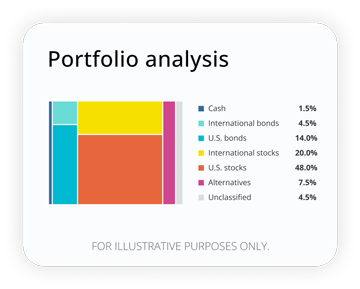
How well are your investments performing?
Analyze your portfolio in minutes and receive a target allocation for your goals.
Benefits of an IRA
Individual retirement accounts can offer several key benefits to investors, such as:
- Tax advantages: You may receive an upfront tax break or tax-free qualified withdrawals during retirement, depending on whether you choose a traditional or Roth IRA.
- Account ownership: An IRA is owned and controlled by the individual and is not tied to a specific employer. This means you can generally continue contributing to and managing the account regardless of changes in employment.
- Investment opportunities: IRAs may offer you a wider range of investment options than employer-sponsored retirement plans as they are not limited to those selected by your employer.
Types of IRAs
The two most common types of IRAs are Roth and traditional IRAs. Both types have broad investment flexibility, yet differ in their tax treatment, withdrawal rules, and income limits. There are several other types of IRAs that follow the same principles as Roth and traditional IRAs. These retirement accounts are designed for small business owners, freelancers, and households with unique needs.
The key types of IRAs are:
- Traditional IRAs: Personal retirement savings accounts that can offer an upfront tax deduction but are generally taxed when you withdraw your money. Traditional IRAs are subject to required minimum distributions (RMDs) once you reach age 73, meaning you’ll need to begin taking distributions from your retirement account and paying any income taxes on them.
Roth IRAs: Personal retirement savings accounts that are funded with after-tax dollars but can offer tax-free qualified withdrawals in retirement. Unlike traditional IRAs, they are not subject to RMDs, yet their income limits can prevent high-income individuals from contributing up to the annual IRA limit.
SIMPLE IRAs: Employer-sponsored retirement plan for small business owners who offer no other retirement plan to their employees. Contributions are tax-deductible and employers can make matching or nonelective contributions.
SEP IRAs: Employer-sponsored retirement plan for small business owners, freelancers, and self-employed workers. Employers, not employees, make tax-deductible contributions directly to the employee’s IRA.
Spousal IRAs: Allows married individuals to save for retirement based on their spouse’s taxable compensation rather than their own. Individuals can elect to make Roth (after-tax) or traditional (pre-tax) contributions.
Custodial IRAs: Set up by an adult on behalf of a minor child, and available to the child once they reach the age of majority—typically age 18. Individuals can elect to make Roth (after-tax) or traditional (pre-tax) contributions.1
Inherited IRAs: Roth or traditional IRAs that an individual inherits after the original owner dies. They are also known as beneficiary IRAs.
You may find that owning and contributing to more than one IRA is beneficial for reaching your retirement goals. It may also be the case if you have an inherited or custodial IRA that you wish to keep while still funding a separate account.
Consider using an online calculator like the Empower Pre-tax vs. Roth Analyzer to compare the potential growth and tax implications of traditional and Roth IRAs.
Read more: Roth vs. traditional IRAs: Which should I choose?
How does an IRA work?
IRAs allow you to contribute money up to the annual IRS limit, choose where to invest these funds, and let them potentially grow over time with tax advantages. Maximizing these opportunities is one way to help reach the $56,680 annual median retirement income for U.S. households age 65+.
IRA contribution limits for 2026
The IRS allows individuals to contribute up to $7,500 to their IRA(s) in 2026 — an increase from $7,000 in 2025 — or 100% of their earned income, whichever is less. Workers age 50 and older may also make a catch-up contribution of $1,100, bringing the total contribution limit to $8,600 for 2026. IRA contributions for the year may be made until the federal tax filing deadline, usually April 15. This means for the 2026 tax year, you have until April 15, 2027, to make your final IRA contribution.
If you own multiple IRAs, your total contributions made across all accounts must fall within the $7,500 limit – or $8,600 for those 50 years and older. Any rollovers from 401(k)s to IRAs will not count toward the maximum contribution limit for the year.
Excess IRA contributions may be subject to a 6% tax each year they remain in the account. To avoid this penalty, you can withdraw any excess funds before your individual income tax return is due. 2
IRA income and deduction limits
Income and deduction limits play different roles across Roth and traditional IRAs. The income cap for Roth IRAs limits who can contribute, whereas the income cap for traditional IRAs dictates who can deduct their contributions from their taxable income.
The Roth IRA income limits determine whether you can make a full contribution, a reduced contribution, or no direct contribution at all. These limits are based on your modified adjusted gross income (MAGI) along with your filing status.
Unlike with a Roth IRA, there's no income limit for those who can contribute to a traditional IRA. But your income (as well as your spouse's) affects whether you can deduct your traditional IRA contributions from your taxable income for the year.
Investing your IRA assets
When you contribute to your individual retirement account, these funds can then be invested in individual stocks and bonds, mutual funds, and exchange-traded funds (ETFs). These contributions have the potential to continue growing until they are withdrawn during retirement.
For context, the average traditional IRA balance of Americans in their 80s is $593,911 — over 10x the average balance of those in their 20s. This growth reflects the combined impact of consistent contributions, investment returns, and time in the market. Over multiple decades, your investments may continue to compound, potentially helping to turn relatively modest balances into substantially larger retirement savings.
The investment options available in the IRA are typically determined by the investment firm or provider you choose. The IRS, however, does not permit IRA funds to be invested in life insurance or collectibles.3 If you’re not comfortable managing investments by yourself, you may consider working with a financial professional or opening an IRA with a financial institution that provides advice or automated investing tools.
IRA withdrawals and distributions
IRA funds are intended to remain in the account until at least age 59 ½.4 Traditional IRA distributions at this time will be subject to income taxes. Taxes on Roth distributions vary between contributions and investment earnings, and qualifying contributions may be withdrawn at any time tax-free and penalty-free. Traditional IRAs, unlike Roth IRAs, are also subject to required minimum distributions (RMDs). Once you reach age 73, you’ll need to start taking distributions from your account and paying income taxes on them.
Unforeseen expenses may occur that may make it necessary to take a distribution from your IRA before age 59 ½. Although possible, these distributions may be subject to both income taxes and a 10% early withdrawal penalty. The IRS outlines certain exceptions that may make it possible to make early distributions without paying this penalty, although taxes can still apply.5
IRA transfers and rollovers
IRAs allow funds to be moved from one IRA to another. This is often done to consolidate IRA accounts. Retirement assets can also be rolled over from an employer-sponsored plan when leaving a job to an IRA. With direct rollovers, the plan directly transfers or makes your rollover payable to your IRA provider and no taxes are withheld. Alternatively, with indirect rollovers, you can choose to have the plan send a check payable to you for your balance. You’ll then deposit it into your IRA within the next 60 days before it’s considered taxable and possibly an early withdrawal.
IRA vs 401(k): Key differences
IRAs and 401(k)s are both retirement plans that can help build your savings, yet they operate in different ways. An IRA is opened by an individual and is not tied directly to an employer plan. A 401(k) is an employer-sponsored workplace retirement plan, so eligibility, plan features, and investment opportunities are shaped by the plan offered at work.
A few of the biggest differences between a 401(k) and IRA are:
- Contribution limits: 401(k)s generally let you contribute more each year than IRAs. As of 2026, the IRA contribution limit is $7,500 ($8,600 if you’re age 50 or older), while the 401(k) employee deferral limit is $24,500. Eligible 401(k) participants age 50 and older may make an additional $8,000 catch-up contribution, and certain 401(k) participants ages 60–63 may be eligible for a higher catch-up amount if permitted by their plan.
- Matching contributions: Some 401(k)s include employer matching contributions, which can increase the amount going into the account. Outside of SEP and SIMPLE IRAs, individual retirement accounts are not generally tied to an employer and are therefore not eligible for employer contributions.
- Investment opportunities: IRA investment options depend on the financial institution where you opened the account. 401(k) investment options are generally selected by the plan sponsor and may be more limited in nature.
Depending on your financial goals, you may decide that contributing to both a 401(k) and an IRA is beneficial. Supplementing your workplace retirement account is a great way to boost your retirement savings and put even more of your money to work in tax-advantaged accounts.
Read more: IRA vs 401(k): Key differences
How to open an IRA
You can open an IRA online at different types of financial services providers, such as banks, investment firms, and mutual fund companies. While many IRAs have no minimum deposits, others may require a specified initial investment.
The sign-up process typically involves providing some basic information — like your name, Social Security number and employment information — and then deciding how to move money into the account. You can make contributions by transferring funds from an existing bank account, transfer money from another IRA or rollover from a 401(k) plan (if eligible to do so). Carefully consider all your options, including tax implications, fees, and expenses, before moving money between accounts. Assess all features of current accounts before moving money.
Read more: How to open an IRA
The bottom line
An IRA can be a flexible way to save for retirement outside of an employer-sponsored plan. Whether you’re just beginning to explore your retirement options, or looking to supplement your existing financial strategy, IRAs can play a significant role in determining what your retirement income will look like.
Explore Empower’s free Retirement Planner to see how an IRA could fit into a bigger retirement picture based on retirement age, income needs, and savings scenarios.
IRA FAQs
Is it better to have an IRA or a 401(k)?
Neither is automatically better for everyone. A 401(k) is an employer-sponsored retirement plan and may include matching contributions, and it also has a higher annual contribution limit in 2026. An IRA is opened by the individual and may offer broader investment choices. Many savers can use both — subject to eligibility and contribution rules. If your workplace plan offers a match, it’s worth understanding how that match works before deciding where your next retirement dollar goes.
What happens to an IRA when you die?
An IRA typically passes to the named beneficiary. A surviving spouse beneficiary may have more flexibility, including treating the IRA as their own in some cases, while non-spouse beneficiaries must generally follow the 10-year distribution rule. Taxes and distribution requirements can also vary based on whether the IRA is traditional or Roth, so it’s important to review the account’s beneficiary rules and current IRS guidance.
Can a spouse contribute to an IRA?
Yes. If a married couple files a joint return, one spouse may be able to contribute to an IRA even if they didn’t have taxable compensation. As long as your spouse has enough earned income to cover the contributions and you meet any applicable eligibility requirements, both spouses can contribute to their own IRAs. However, the total amount contributed to both IRAs generally can't exceed the couple's combined earned income for the year.
How do you grow your savings in an IRA?
An IRA is an account, not an investment itself. The money contributed to the account may grow through interest, dividends, and investment gains from holdings such as stocks, bonds, mutual funds, or ETFs. Returns are not guaranteed, so the investments you choose inside the IRA matter.
Can I lose my IRA if the market crashes?
You generally wouldn’t lose the IRA itself, but the value of the investments inside the account can fall if markets drop. All investments involve risk, and mutual funds and ETFs can lose money. The impact on your IRA depends on what you hold in the account and how long you have before you need the money.
1 SSA, “Program Operations Manual System (POMS),” Accessed May 2026.
2 IRS, “Retirement topics - IRA contribution limits,” March 2026.
3 IRS, “Retirement plans FAQs regarding IRAs,” November 2025.
4 IRS, “Publication 590-B (2025), Distributions from Individual Retirement Arrangements (IRAs),” April 2026.
5 IRS, “Retirement topics - Exceptions to tax on early distributions,” December 2025.
Calculators are for informational purposes only and are not intended to provide investment, legal, tax or accounting advice, nor are they intended to indicate the performance, availability or applicability of any product or service.
RO5542743-0626
 Get The Currency newsletter


The Currency editors
Staff contributors
The CurrencyTM writers and editors cover the latest financial news and insights shaping how we live, work, and play. The team provides accurate, data-driven, and timely content aimed at empowering financial freedom for all.
The content contained in this blog post is intended for general informational purposes only and is not meant to constitute legal, tax, accounting or investment advice. You should consult a qualified legal or tax professional regarding your specific situation. No part of this blog, nor the links contained therein is a solicitation or offer to sell securities. Compensation for freelance contributions not to exceed $1,250. Third-party data is obtained from sources believed to be reliable; however, Empower cannot guarantee the accuracy, timeliness, completeness or fitness of this data for any particular purpose. Third-party links are provided solely as a convenience and do not imply an affiliation, endorsement or approval by Empower of the contents on such third-party websites. This article is based on current events, research, and developments at the time of publication, which may change over time.
Certain sections of this blog may contain forward-looking statements that are based on our reasonable expectations, estimates, projections and assumptions. Past performance is not a guarantee of future return, nor is it indicative of future performance. Investing involves risk. The value of your investment will fluctuate and you may lose money.
Certified Financial Planner Board of Standards Inc. (CFP Board) owns the certification marks CFP®, CERTIFIED FINANCIAL PLANNER™, CFP® (with plaque design), and CFP® (with flame design) in the U.S., which it authorizes use of by individuals who successfully complete CFP Board's initial and ongoing certification requirements.