

5 tax-smart ways grandparents can help their families
5 tax-smart ways grandparents can help their families
Grandparents can take advantage of tax benefits through education savings, retirement accounts, financial gifts, and estate planning
5 tax-smart ways grandparents can help their families
Grandparents can take advantage of tax benefits through education savings, retirement accounts, financial gifts, and estate planning

11.03.2026
Key takeaways
- Grandparents can contribute to 529 plans to maximize grandchildren’s education costs while potentially receiving state tax benefits.
- Custodial Roth IRAs, Trump Accounts, and I bonds offer ways to help grandchildren save for the future.
- Paying medical providers directly and naming account beneficiaries can help families transfer wealth more efficiently.
Grandparents give more than hugs and birthday gifts. Grandparents provide more than $172 billion in financial support to their grandchildren each year, according to AARP research. On average, they contribute $2,654 annually and spend more than 500 hours caring for their grandchildren.1
Tax-smart strategies can help grandparents make their generosity go further, supporting younger generations while potentially benefiting their own finances. Here are five ways they can help while potentially saving on taxes.
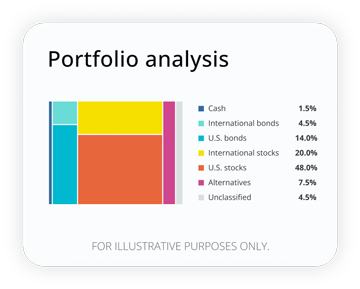
How well are your investments performing?
Analyze your portfolio in minutes and receive a target allocation for your goals.
1. Contribute toward family education in a 529
529 savings accounts allow families to set aside after-tax dollars for education and provide an opportunity to invest within the accounts for potential growth. Families have saved more than $602 billion in over 17.9 million 529 savings accounts, as of the end of 2025.2
These educational savings accounts are an especially attractive tax-advantaged prospect for grandparents because accounts that are set up with a grandparent as the owner — and their grandchild as the beneficiary — are not included in federal financial aid calculations, under the Federal Application for Student Financial Aid (FAFSA) form.
Read more: What is the 529 grandparent “loophole”?
529 plans can support both younger and older grandchildren, as expanded 529 eligible expenses now also include K-12 costs like tuition, books, tutoring, and support for students with disabilities or conditions that affect learning. Even older grandchildren who choose not to attend a traditional college can use 529 money for qualified apprenticeship programs, workplace training, and credentialing.
Grandparents could also see additional tax savings if they reside in a state that offers a deduction or credit for 529 contributions and depending on which 529 plan they pick.
2. Add to grandchildren’s retirement savings
An individual retirement account can be a valuable step for children to start saving for retirement from an early age. Grandparents can help fund a custodial Roth IRA, but the child must have earned income, and contributions cannot exceed that income or the annual IRA contribution limit, whichever is less. For 2026, the IRA contribution limit for individuals under age 50 is $7,500.
Because contributions are made with after-tax dollars, contributions can be withdrawn at any time without taxes or penalties. Any earnings that accumulate in the account are subject to Roth IRA withdrawal rules.
After contributions are made, the tax benefits of a custodial Roth IRA start to reveal themselves. If rules are followed, funds can be withdrawn tax-free later. Notably, any earnings growth within the account can be tax-free — as long as the withdrawal is qualified, the money won’t be subject to taxes on capital gains, dividends, or interest.
Read more: Average IRA balances by age: Traditional & Roth
The Treasury Department launched a special type of traditional IRA in July 2026 that can also benefit families looking to build a grandchild’s nest egg. Trump Accounts (also known as a 530A account) allow for grandparents to contribute after-tax dollars, up to an aggregate annual limit of $5,000 for 2026 and 2027.
Eligible children born between Jan. 1, 2025 and Dec. 31, 2028 can also receive a one-time contribution from the government of $1,000, which may be especially appealing for families with younger grandchildren. Unlike custodial Roth IRAs, Trump Accounts don't require children to have earned income to receive contributions, although investment and withdrawal restrictions apply.
3. Cover health care costs
American families pay about $5,600 a year for health insurance premiums, out-of-pocket costs, and associated taxes.3 While grandparents should save up to fund their own health care costs in retirement, covering an adult child or grandchild’s doctor bill in a time of need could also go a long way to maximize compounding.
A key consideration is whether the younger family members have access to a health savings account (HSA). HSAs feature a “triple tax advantage,” in which contributions are tax-deductible, earnings can grow tax-free, and withdrawals are tax-free when used for eligible medical expenses.
To contribute to an HSA, individuals generally must be enrolled in a qualifying high-deductible health plan (HDHP). In 2023, 30% of people who got health insurance through their employer were enrolled in a HDHP. 4 The growth of HSA savings has benefited from increased contributions and higher rate of investment — with almost $174 billion saved in the accounts as of the end of 2025.5
Because HSAs allow for asset allocation, it’s another opportunity to let contributions and potential earnings grow. Saving can let the power of compounding work on a long-term basis if they’re able to not tap HSA money until later in life.
Grandparents who can help cover a grandchild’s immediate medical expenses — such as an emergency room copay or urgent care bill — could allow the younger family to preserve HSA funds for the future. Another consideration is the federal gift tax exclusion, which addresses how much money people can give away in a given year before the gift tax takes effect.
Payments made directly to a medical provider for another person's qualified medical expenses generally don't count toward the annual gift-tax exclusion, regardless of the amount. This can provide a tax-efficient way to help adult children or grandchildren pay for care while allowing them without tapping into their own savings. Expenses reimbursed by insurance generally don't qualify for this exclusion.
4. Purchase I bonds as gifts
Another “giving while living” strategy for grandparents is to gift non-cash financial assets to family members. I bonds — also known as series I savings bonds — are backed by the U.S. government and do not lose principal value.
Individuals can purchase up to $10,000 in electronic I bonds annually, but bonds purchased as gifts for a minor count toward the child's annual limit rather than the person making the gift. In this case, grandparents or other adult family members could buy up to $10,000 worth of I bonds per grandchild per year if they choose.
I bonds can be attractive during periods of rising inflation, because they combine a fixed and a variable interest rate using a specific formulate to create overall composite earnings. I bonds also are exempt from state and local income taxes, and the interest is subject to federal income tax only when the bond is redeemed or reaches maturity. I bonds generally must be held for at least one year, and redeeming them before five years results in forfeiting the last three months of interest.
5. Ease future asset transfer with beneficiaries
After decades of building wealth, grandparents can take steps to ensure their assets pass smoothly to future generations. Estate planning strategies, including naming account beneficiaries, can help simplify the transfer of wealth while preserving potential tax benefits.
One of the five key estate planning documents is a durable power of attorney, and less than a third of people (27%) have one in place.6 This can be a valuable resource, as it designates a person to make financial or medical decisions should you be deemed incapacitated or incompetent.
Financial accounts that allow for designating beneficiaries should have at least one assigned, and grandparents can ease inheritance by avoiding assets going into probate. Properly designated beneficiaries can often receive assets outside the probate process, potentially simplifying the transfer. However, avoiding probate does not necessarily eliminate estate or income taxes.
Adult children and grandchildren who inherit retirement accounts generally fall under non-spouse beneficiary rules. Many non-spouse beneficiaries must fully withdraw inherited IRA or 401(k) assets within 10 years of the account owner's death, although exceptions and additional distribution requirements may apply. Withdrawals from inherited traditional retirement accounts are generally subject to income tax, while inherited Roth accounts may receive more favorable tax treatment.
Helping the next generation
Tax-smart giving can help grandparents support younger family members while making the most of their own finances. With 44% of Americans learning about money from family and friends, grandparents can also pass down valuable financial lessons and perhaps teach how to pay it forward.
1 AARP, “New AARP Research Reveals $900 Billion “Grandparent Economy” Powering American Families,” June 2026.
2 Education Data Initiative, “College Savings Statistics,” accessed October 2026.
3 KFF, “The Cost of Healthcare Is Hitting America Where It Hurts: The Wallet,” October 2026.
4 NPR, “How to make a high-deductible health plan and HSA work for you,” April 2026.
5 Plansponsor, “HSA Assets Hit $174B as Investment Rises,” April 2026.
6 U-M Institute for Healthcare Policy & Innovation, “7 things every family caregiver should know – but many don’t,” accessed October 2026.
RO6080018-1026
 Get The Currency newsletter



The content contained in this blog post is intended for general informational purposes only and is not meant to constitute legal, tax, accounting or investment advice. You should consult a qualified legal or tax professional regarding your specific situation. No part of this blog, nor the links contained therein is a solicitation or offer to sell securities. Compensation for freelance contributions not to exceed $1,250. Third-party data is obtained from sources believed to be reliable; however, Empower cannot guarantee the accuracy, timeliness, completeness or fitness of this data for any particular purpose. Third-party links are provided solely as a convenience and do not imply an affiliation, endorsement or approval by Empower of the contents on such third-party websites. This article is based on current events, research, and developments at the time of publication, which may change over time.
Certain sections of this blog may contain forward-looking statements that are based on our reasonable expectations, estimates, projections and assumptions. Past performance is not a guarantee of future return, nor is it indicative of future performance. Investing involves risk. The value of your investment will fluctuate and you may lose money.
Certified Financial Planner Board of Standards Inc. (CFP Board) owns the certification marks CFP®, CERTIFIED FINANCIAL PLANNER™, CFP® (with plaque design), and CFP® (with flame design) in the U.S., which it authorizes use of by individuals who successfully complete CFP Board's initial and ongoing certification requirements.