

How to open an IRA
How to open an IRA
Opening an IRA is simple and can help you build tax-advantaged savings for retirement with contributions up to $7,500 in 2026
How to open an IRA
Opening an IRA is simple and can help you build tax-advantaged savings for retirement with contributions up to $7,500 in 2026

06.18.2026
Key takeaways
- You can open an IRA at a bank or financial institution, sometimes with $0 minimums, though some require an initial investment to start.
- In 2026, you can contribute up to $7,500 ($8,600 if you are aged 50+) across all your IRAs combined.
- Traditional IRAs offer potential current tax deductions; Roth IRAs offer tax-free qualified withdrawals in retirement and no RMDs at age 73.
An individual retirement account (IRA) is a powerful tool designed to help you save for your future, and opening one can be surprisingly easy.
You can open an IRA online at a variety of institutions, such as a financial services provider, bank, and even mutual fund companies. While many IRAs have no minimum deposits, others may require a specified initial investment.
The sign-up process typically involves providing some basic information — like your name, Social Security number and employment information — and then deciding how to get money into the account. You can make contributions by transferring funds from a bank account or rolling over assets from an existing IRA or 401(k) plan (if eligible to do so).
Read more: How to roll over a 401(k)
1. Select what type of IRA you would like to open
The first step to opening an IRA is to determine what type of account best fits your financial goals. The two most common types of IRAs are traditional IRAs and Roth IRAs.
- Traditional IRAs: Contributions to traditional IRAs are potentially tax deductible. Any growth is tax-deferred, but withdrawals in retirement are taxed. Traditional IRAs also require you to begin making required minimum distributions (RMDs) beginning at age 73 .1
- Roth IRAs: Contributions to a Roth IRA are not tax-deductible; however, any earnings are tax-free until distributed, and qualified distributions are not subject to federal income tax. Roth IRAs also don’t require you to begin making RMDs as traditional IRAs do.
While most people with earned income can open an IRA, there are income limits with a Roth IRA — and sometimes with a traditional IRA — if you also have a workplace 401(k) plan account. Income limits for a traditional IRA don’t affect your ability to open one, just whether your contributions will be tax deductible.
You might consider a Roth IRA if you expect to be in a higher tax bracket during retirement. For example, if you’re currently young and earning an entry-level salary. You’re also allowed to have both types of IRAs and even multiple traditional or Roth accounts.
Read more: Roth vs. traditional IRA: Which should I choose?
If you’re a non-working spouse, you may be eligible for a spousal IRA, which lets your working spouse open a Roth or traditional IRA in your name.
Even children can have an IRA with an adult custodian. They must report income from work — such as babysitting — and their total contribution is limited to their annual earnings up to $7,500. A Roth IRA can often be a good choice for kids since their income likely puts them in a low- or zero-income tax bracket.
2. Choose a financial institution
Once you’ve decided between a Roth or Traditional IRA, it’s time to choose a financial institution to open your account. IRAs are offered by many types of providers, including banks, investment firms, and mutual fund companies. The sign-up process typically involves providing some basic information — like your name, Social Security number, and employment information.
Some factors to consider when choosing an IRA provider:
- Do they require minimum deposits? While many do not, some financial institutions may require a specified initial investment when opening an IRA.
- What fees are involved in opening and maintaining the account? These may vary depending on the institution and the specific features of the account.
- What account features or benefits are offered? Access to financial advisors, automatic contributions, or integrated retirement planning tools are some features you might consider.
- What investment options are available? IRA providers may vary in the types of investments they offer. Having a wide range of options can be beneficial depending on your financial goals.
3. Contribute to your IRA
You may contribute up to $7,500 to your IRA(s) in 2026 — an increase from $7,000 in 2025 — or 100% of your earned income, whichever is less. Workers age 50 and older may also make a catch-up contribution of $1,100, bringing the total contribution limit to $8,600 for 2026. Rollovers from 401(k)s to IRAs do not count toward the maximum contribution limit for the year.
IRA contributions may be made until the federal tax filing deadline, usually April 15. For the 2026 tax year, you have until April 15, 2027, to make your final IRA contribution.
If you own multiple IRAs, your total contributions made across all accounts must fall within the $7,500 limit – or $8,600 for those 50 years and older. Excess IRA contributions may be subject to a 6% tax each year they remain in the account, unless they are withdrawn before your individual income tax return is due.
You can use tools like the Empower Retirement Planner to see how your contributions align with your retirement goals and track your IRA investment performance over time.
4. Invest your IRA funds
Once you have opened and contributed to your IRA, you need to decide where to invest these funds. For example, within an IRA you can typically invest in stocks, bonds, mutual funds, and exchange-traded funds (ETFs). Along with the tax benefits, flexibility in investment choices is one of the chief advantages of an IRA.
If you’re not comfortable managing investments by yourself, you may consider working with a financial professional or opening an IRA with a financial institution that provides advice or automated investing tools.
Read more: How to start investing: A beginner’s guide to investment basics
FAQs
How much does it cost to open an IRA?
The fees associated with opening an IRA vary depending on the financial institution, the features of the specific account, and how funds will be invested. Some institutions do not require a minimum deposit or fee upon opening the account, yet they may require maintenance or advisor fees depending on the level of support you seek.
Depending on your investment strategy, there may be additional fees associated with trading, expense ratios, and portfolio management.
Is it better to have a 401k or an IRA?
401(k)s and IRAs offer two different avenues for retirement savings. IRAs may be opened and contributed to on your own, while 401(k)s are only available through your employer and may offer employer matching. 401(k)s have higher annual contribution limits, while IRAs typically offer a wider variety of investment options.
Contributing to both a 401(k) and an IRA is also possible. This can be a great way to boost your retirement savings and put even more of your money to work in tax-advantaged accounts.
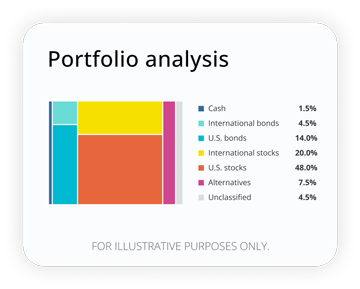
How well are your investments performing?
Analyze your portfolio in minutes and receive a target allocation for your goals.
Roth withdrawals are federally tax-free if they are qualified distributions as defined by the IRS. State and local taxes may apply. For a distribution to be qualified, the account must have been open for at least five years, and the withdrawal must occur after age 59½, death, or disability. Contributions may be withdrawn at any time without penalty. Earnings withdrawn before those conditions are met may be subject to taxes and penalties. Tax laws are subject to change. State and local taxes may still apply.
IMPORTANT: The projections or other information generated on the website by the investment analysis tool regarding the likelihood of various investment outcomes are hypothetical in nature, do not reflect actual investment results, and are not guarantees of future results. The results may vary with each use and over time.
Exchange-traded funds (ETFs) are a type of exchange-traded investment product that must register as either an open-end investment company (generally known as “funds”) or a unit investment trust. ETFs are not mutual funds.
Unlike with mutual funds, individual shares of ETFs are not redeemable directly with the issuer. ETF shares are a collection of securities bought and sold at market price, which may be higher or lower than the net asset value. Investment returns will vary based on market conditions and volatility, so an investor’s shares, when redeemed or sold, may be worth more or less than their original cost. ETFs are subject to risks, including those of their underlying securities.
1 IRS, “Retirement topics - Required minimum distributions (RMDs),” December 2025.
RO5590051-0626
 Get The Currency newsletter



The Currency editors
Staff contributors
The CurrencyTM writers and editors cover the latest financial news and insights shaping how we live, work, and play. The team provides accurate, data-driven, and timely content aimed at empowering financial freedom for all.
The content contained in this blog post is intended for general informational purposes only and is not meant to constitute legal, tax, accounting or investment advice. You should consult a qualified legal or tax professional regarding your specific situation. No part of this blog, nor the links contained therein is a solicitation or offer to sell securities. Compensation for freelance contributions not to exceed $1,250. Third party data is obtained from sources believed to be reliable; however, Empower cannot guarantee the accuracy, timeliness, completeness or fitness of this data for any particular purpose. Third party links are provided solely as a convenience and do not imply an affiliation, endorsement or approval by Empower of the contents on such third party websites. Certain sections of this blog may contain forward-looking statements that are based on our reasonable expectations, estimates, projections and assumptions. Past performance is not a guarantee of future return, nor is it indicative of future performance. Investing involves risk. The value of your investment will fluctuate and you may lose money. Advisory services are provided for a fee by either Personal Capital Advisors Corporation ("PCAC") or Empower Advisory Group, LLC (“EAG”) depending on your specific investment advisory services agreement. Both PCAC and EAG are registered investment advisers with the Securities and Exchange Commission (“SEC”) and subsidiaries of Empower Annuity Insurance Company of America. Registration does not imply a certain level of skill or training. © 2023 Empower Annuity Insurance Company of America. All rights reserved. “EMPOWER” and all associated logos, and product names are trademarks of Empower Annuity Insurance Company of America.