

Saving vs. investing: Key differences
Saving vs. investing: Key differences
Saving vs. investing depends on your goals and timeline. Saving can help with near-term needs, while investing may support longer-term financial goals
Saving vs. investing: Key differences
Saving vs. investing depends on your goals and timeline. Saving can help with near-term needs, while investing may support longer-term financial goals

10.08.2026
Key takeaways
- Saving generally involves setting aside money for emergencies or near-term goals. Investing is often used as a strategy for achieving long-term goals.
- Saving generally offers easier access and lower principal risk, while investing adds market risk in exchange for greater long-term growth potential.
- Saving and investing can work together, depending on financial goals, cash flow, and spending habits.
Saving and investing can help achieve different short-term and long-term financial goals. It's common to save for emergencies and near-term expenses, like travel, while investing for retirement and other substantial expenses. Explore the difference between saving and investing to see where each strategy shines and how they can be used together to help build financial security at every stage of life.
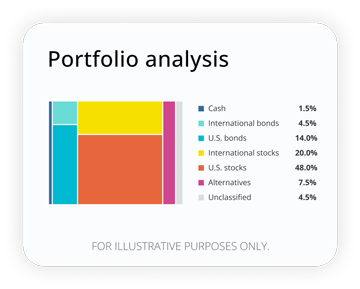
How well are your investments performing?
Analyze your portfolio in minutes and receive a target allocation for your goals.
What is saving?
Saving is the practice of setting money aside in a secure, accessible place for emergencies or near-term goals. Funds are typically transferred to savings accounts or other types of deposit accounts where they’re protected from market risk and can be easily withdrawn when needed.
Saving typically involves the following steps:
- Open a separate FDIC-insured savings account where funds can remain liquid1
- Regularly transfer amounts into the account based on each savings goal
- Allow funds to earn interest with lower principal risk
- Withdraw funds as needed to help cover financial emergencies or other expenses
- Continue to fund and rebuild the account over time
Saving prioritizes security and accessibility over potential investment growth. Interest rates on savings accounts are not guaranteed to keep up with inflation, which is one reason they are not ideal for long-term financial growth.
Read more: How to set financial goals & stick to them in 5 steps
Types of savings accounts
Savings are generally kept in FDIC-insured deposit accounts, including:2
- Traditional savings accounts
- High-yield savings accounts (HYSAs)
- Money market accounts
- Certificates of deposit (CDs)
FDIC-insured deposit accounts are generally insured up to $250,000 per depositor.3 HYSAs, MMAs, and CDs can also offer higher annual percentage yields (APYs) than traditional savings accounts, which can help counteract inflation and the loss of purchasing power.
Using multiple savings accounts can serve different goals and needs. Those saving for a home can place a portion of their funds in a fixed-rate CD — which offer terms ranging from one month to several years — potentially earning a higher rate than HYSAs or MMAs. An HYSA or MMA — which generally offer variable APYs — can be used for emergencies and ongoing savings.
What is investing?
Investing is the process of purchasing assets, such as stocks and bonds, with the aim of generating wealth over time. It’s often used as a strategy for achieving long-term goals like building an education or retirement fund.
Investing looks different for everyone, but it generally involves the following steps:
- Pick an investment strategy based on financial goals and risk tolerance.
- Open an investment account, like a brokerage account, 529 plan, or retirement account.
- Choose specific investments to buy, whether stocks, bonds, or mutual funds.
- Allow investments to potentially grow and compound.
- Regularly monitor investment performance and rebalance as needed.
- Ideally, generate income through dividends, interest, or selling investments.
Investments have the potential to grow at a greater rate than funds held in a savings account. However, they’re also subject to market risk, and an investment that drops in value may need time to recover. This is why it’s generally safer to reduce investment risk as the time horizon for a goal shortens.
Read more: Essential steps for retirement planning
Types of investments
Different types of investments come with varying levels of risk. Generally speaking, the higher the potential reward, the higher the risk.
There are several common types of investments:
- Stocks (equities)
- Bonds
- Cash alternatives
- ETFs
- Mutual funds
- Alternative investments (cryptocurrency, real estate)
According to recent Empower findings, most investment portfolios are made up of more than one type of investment. Portfolio allocation often changes as investors get closer to retirement and look to manage risk. Investors in their 20s, 30s, and 40s on average maintain about a 45-49% allocation of stocks and a 5% allocation of bonds in their financial portfolios. Those in their 50s tend to hold more in bonds (a 9% allocation) as they are typically considered lower-risk investments.
Read more: How to start investing: A beginner’s guide to investment basics
Saving vs. investing: when to use each
Saving typically works best for emergencies and shorter-term goals, while investing is generally used for longer-term goals with more time to weather market fluctuations.
A good rule of thumb when determining when to save or invest is:
- Save money that may be needed soon or where a drop in value could create financial strain. This may include an emergency fund, upcoming bills, a vacation, or a near-term down payment.
- Invest money that can remain untouched for several years and has time to recover from market swings. This may include funds for retirement, a child’s future education, or other long-term financial goals.
- Consider both when it makes financial sense to do so. A portion of income can be automatically transferred to savings and investment accounts each month to support different goals. 401(k) plans can make this easy by taking a percentage from each paycheck and investing it automatically.
The decision to save, invest, or do both often comes down to goals, cash flow, and spending habits. Identify how much monthly income remains after covering essential expenses and how much can be directed to saving or investing. Free financial tools, like the Empower Personal DashboardTM can help by automatically tracking cash flow and spending across accounts.
Continue to monitor the progress toward each goal and adjust strategies as necessary. For example, once an emergency fund is established and adequately funded, consider redirecting future earnings to different saving or investment goals. Or, when nearing retirement, reevaluate investment strategies to minimize risk.
Read more: 6 ways to balance your saving, debt payoff, and investing goals
The bottom line
Saving and investing are ways to achieve short-term and long-term financial goals. Saving is intended for near-term expenses, such as bills, emergencies or upcoming vacations, with access to funds a top priority. With greater potential growth, investing can help you accomplish longer-term financial goals, like savings for a child’s college education or building a retirement fund. When used together, saving and investing can help provide financial security throughout each stage of life.
FAQs
Does investing affect your credit score?
Investing doesn’t generally have a direct impact on credit, but borrowing money to invest comes with its own risks. Ordinary investment account activity is generally not reported to consumer credit bureaus, which compile credit reports based on an individual’s financial history. However, some choose to borrow money from their investment broker, which creates margin debt. Failing to pay off this debt may eventually lead to it being reported to consumer credit bureaus.
Is it better to pay off debt or invest?
The decision to pay off debt or invest depends on the nature of the debt and the investment. If employer matching is available through a 401(k), then contributing enough to receive the full match is a simple way to help build long-term savings. If an emergency fund is already in place, consider addressing any high-interest debt — especially credit cards.
Do you pay taxes on a brokerage account?
Yes, taxable brokerage accounts have the potential to generate taxes from interest, dividends, distributions, and realized capital gains. The exact tax treatment can depend on the type of investment, how long it’s kept, and when it’s sold.
Is a 401(k) a securities account?
A 401(k) is an employer-sponsored retirement plan, not a single security. Contributions are commonly invested in securities or pooled investment products offered by the plan, such as mutual funds or target-date funds, but available choices vary between employers.
Investing involves risk, including possible loss of principal.
Asset allocation, diversification, and rebalancing do not ensure a profit or protect against loss.
1 FDIC, "Deposit Insurance At A Glance," April 2024.
2 Ibid.
3 Ibid.
RO5991553-1026
 Be current.



The Currency editors
Staff contributors
The CurrencyTM writers and editors cover the latest financial news and insights shaping how we live, work, and play. The team provides accurate, data-driven, and timely content aimed at empowering financial freedom for all.
The content contained in this blog post is intended for general informational purposes only and is not meant to constitute legal, tax, accounting or investment advice. You should consult a qualified legal or tax professional regarding your specific situation. No part of this blog, nor the links contained therein is a solicitation or offer to sell securities. Compensation for freelance contributions not to exceed $1,250. Third-party data is obtained from sources believed to be reliable; however, Empower cannot guarantee the accuracy, timeliness, completeness or fitness of this data for any particular purpose. Third-party links are provided solely as a convenience and do not imply an affiliation, endorsement or approval by Empower of the contents on such third-party websites. This article is based on current events, research, and developments at the time of publication, which may change over time.
Certain sections of this blog may contain forward-looking statements that are based on our reasonable expectations, estimates, projections and assumptions. Past performance is not a guarantee of future return, nor is it indicative of future performance. Investing involves risk. The value of your investment will fluctuate and you may lose money.
Certified Financial Planner Board of Standards Inc. (CFP Board) owns the certification marks CFP®, CERTIFIED FINANCIAL PLANNER™, CFP® (with plaque design), and CFP® (with flame design) in the U.S., which it authorizes use of by individuals who successfully complete CFP Board's initial and ongoing certification requirements.