

Investing for kids: Account options and how to start
Investing for kids: Account options and how to start
Investing for kids can help build long-term savings and teach lifelong money skills. The right account can depend on goals, taxes, ownership, and when the money may be needed.
Investing for kids: Account options and how to start
Investing for kids can help build long-term savings and teach lifelong money skills. The right account can depend on goals, taxes, ownership, and when the money may be needed.

08.12.2026
Key takeaways
- Account options such as 529 plans, custodial accounts, custodial IRAs, Trump Accounts, and others serve different savings goals.
- Starting early gives investments more time to potentially benefit from compounding, though investment returns are not guaranteed and can lose value.
- A strong financial foundation — including emergency savings, retirement contributions, and managing high-interest debt — can help make investing for a child more sustainable.
Investing for kids can help build savings for a child's future while teaching lifelong money skills. The best approach can depend on your savings goals, along with other factors like access, ownership, taxes, and when the money may be needed.
Common options include 529 plans for education savings, custodial accounts for broader goals, custodial IRAs for children with earned income, and Trump Accounts for long-term savings.1
Choosing an account is one step; you'll also need to decide how to invest the money within it. Unlike FDIC-insured bank deposits, investments are subject to market risk and can lose value. A diversified portfolio can help manage, but not eliminate, market volatility.
Here’s how you can prepare your finances, compare account options, choose investments, and automate contributions — and help teach kids about saving and investing along the way.
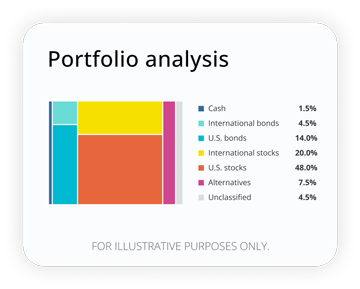
How well are your investments performing?
Analyze your portfolio in minutes and receive a target allocation for your goals.
Investing for kids: Starting early matters
Investing for kids can help build savings for future goals while creating opportunities to teach lifelong money skills. As children grow, real-world experiences can help introduce concepts such as earning interest, the power of compounding, investing, diversification, risk, and long-term planning.2
Starting early gives long-term investments more time to potentially benefit from compounding, where earnings can generate additional earnings over time. However, investing involves risk — returns are not guaranteed and investments can gain or lose value.
When deciding on saving and investing options, think about your goals and timeline. Money needed in the near future is generally better suited for lower-risk options, while money you won't need for several years may be appropriate for investments that have greater growth potential but also carry more risk.
Getting started doesn't require a large contribution. Regularly investing an amount you can afford can help you make progress toward your savings or investing goals over time.3
Check your financial foundation
A strong financial foundation can make any investing choice for a child more sustainable. While everyone’s situation is different, a few general considerations can help parents and others balance priorities as they decide when and how to invest for a child.
Essentials matter: Staying current on housing expenses, utilities, insurance, and other necessary bills sets up a strong foundation before making investment contributions.
Debt check: Paying down high-interest debt may also take precedence over investing for a child.
Emergency savings: Establishing and maintaining a properly funded emergency savings account can provide peace of mind and flexibility if unexpected expenses arise.
Retirement savings: Consider how investing for a child would fit alongside your retirement goals and progress. While retirement goals vary, one common guideline is to save about 25 times your annual expenses.
Fit your budget: Choose an investment contribution that can fit within your budget. Investing consistently over time may be more sustainable than contributing more than you can comfortably afford.
Goals, timeline, and control preferences
The best account for your situation can depend on how and when you expect your child to use the money. Here are a few factors to consider:
Your goal: What is the intended purpose of a kid’s account? Are you saving for education, their first home, retirement, or other future expenses? Are you using the account to help teach a child about investing?
Timeline: Consider when the money may be needed. Longer time horizons can generally accommodate more market fluctuation while money needed in the shorter term may be better suited for a savings account or other lower-risk options.
Ownership: Consider whether you want the money to become the child's irrevocable gift, such as with UGMA or UTMA accounts, as well as Trump Accounts, or remain under your control, as with 529 plans.
Access: Consider whether you want the money available for a wide range of future expenses or reserved for a specific purpose, such as education or retirement.
Risk tolerance: Separate from any time horizon, consider how much market volatility you’re comfortable accepting when choosing investments.
Tax and financial aid: Different account types have different tax rules, and ownership can affect how assets and income are reported for college financial aid. Understanding these differences can help you choose an account that fits your goals.
Compare investment accounts for kids
Identifying priorities can make it easier to compare accounts. Each account has different rules for ownership, taxes, eligible uses, and access to the money, while the investments you choose within the account are a separate decision. Here are some of the most common options.
529 plans for education-focused goals
A 529 plan is a tax-advantaged account designed to help you save for a child’s or another beneficiary’s future education. Savers can contribute after-tax dollars, invest for potential growth, and make tax-free withdrawals for college and other qualified expenses. There are no annual federal contribution limits, but they are subject to gift tax rules, and states set their own 529 lifetime contribution limits.
Unused 529 funds aren’t lost if a beneficiary doesn't attend college or use the full balance. The money can be used for other qualified education expenses, such as K-12 tuition, apprenticeships, student loan repayment, and professional credential programs. If eligibility requirements are met, unused funds can also be transferred to another qualifying family member or rolled over (up to $35,000) into the beneficiary’s Roth IRA retirement account.
UGMA and UTMA custodial brokerage accounts for flexible goals
UGMA and UTMA accounts are custodial accounts that can hold investments and other financial assets for a child. An adult manages the account until the child reaches the age specified under state law and takes control of the assets. There are no annual contribution limits, but the funds are considered irrevocable gifts that become the child's property and may have federal gift tax implications if they exceed the annual exclusion amount.
UGMA and UTMA accounts can hold a variety of financial assets, such as stocks, bonds, and mutual funds. In some states, UTMA accounts may also hold certain types of tangible property. They also come with tradeoffs. Investment earnings may be subject to the IRS's "kiddie tax" rules.4 Because UGMA and UTMA assets are generally considered the child's assets for financial aid purposes, they may have a greater impact on eligibility for need-based aid than parent-owned 529 plans.5
Custodial IRAs for children with earned income
Kids who are getting paid — through employers or odd jobs like babysitting or dog walking — may qualify for a custodial IRA. An adult opens and manages the account for an eligible child that has taxable earned income. Contributions can't exceed the child's annual earned income or the annual IRS limit ($7,500 for tax year 2026), whichever is lower.
Once the child reaches the age of majority under state law (often 18 or 21 years old), they assume control of the account. For Roth IRAs, contributions can generally be withdrawn at any time tax- and penalty-free. Investment earnings are generally subject to Roth IRA withdrawal rules, with exceptions for a first-home purchase or qualified higher education expenses.
Parent-owned brokerage accounts
A brokerage account in a parent's name but intended for a child offers flexibility and control. The parent remains the account owner and taxpayer and decides the amounts and how the money is invested, when it can be used, and when to transfer assets to the child.
One key difference between a brokerage account and some other investing options for kids is how it’s taxed. Brokerage accounts don't offer the child-specific tax benefits that some education or custodial accounts may provide. Instead, you contribute after-tax dollars, and any investment returns may be subject to either capital gains taxes or ordinary income taxes, depending on the type of income generated.
Trump Accounts
Trump Accounts (formally known as 530A accounts) are a new type of traditional IRA designed to support long-term saving and investing for children. Individual contributions are generally made with after-tax dollars; some other contributions — made by an employer, a charity, or the government — can be made with pre-tax dollars.
Investment earnings grow tax-deferred in qualifying low-cost U.S. equity index funds. The child does not need to have earned income to have a Trump Account.
Children born from Jan. 1, 2025, to Dec. 31, 2028, are eligible to receive a one-time federal contribution of $1,000, if an election is made during the account opening process. Total contributions made by parents, employers and others are subject to a $5,000 annual cap for tax years 2026 and 2027 — though any federal seed money doesn’t count toward the limits.6
Beginning at age 18, contributed funds can generally be used for any purpose. However, earnings generally follow traditional IRA withdrawal rules, meaning early distributions before age 59 ½ may be subject to taxes and potential penalties unless an exception applies, such as for qualified higher education expenses or a first-time home purchase.
Read more: Trump Accounts vs. custodial accounts: Key differences
ABLE Accounts
ABLE accounts are tax-advantaged savings accounts for children and eligible adults with qualifying disabilities. Contributions are generally made with after-tax dollars, any investment earnings can grow tax-free, and qualified withdrawals for disability-related expenses are generally tax-free.7
Like 529 education plans, ABLE programs are administered by states. Most states have established ABLE programs, and many ABLE programs are open to both in-state residents and out-of-state residents. Savings in an ABLE account can also help preserve eligibility for certain means-tested public benefits.8
Investment Accounts for Kids: Comparison Table
The comparison below shows some of the features and benefits of these common investment accounts for kids. Here’s how they stack up:
Account | Goal | Taxes | Contribution limits | Investment options |
529 plan | Education | After-tax contributions; tax-deferred growth potential; qualified withdrawals generally tax-free | No annual federal limit; states set lifetime contribution limits | Investment portfolios selected by the plan, including age-based portfolios and mutual funds |
UGMA/UTMA | Flexible goals | Investment income may be subject to IRS kiddie tax rules | No annual contribution limit; federal gift tax rules may apply | Stocks, ETFs, mutual funds, bonds, cash, and (for some UTMAs) certain other property |
Custodial Traditional or Roth IRA | Retirement savings | Pre-tax or after-tax contributions; For Roth IRAs, qualified withdrawals generally tax-free | Lower of the annual IRS limit or the child's earned income | Stocks, ETFs, mutual funds, bonds, CDs, and other investments offered by the provider |
Parent brokerage | Maximum flexibility | Taxable investment account | No contribution limits | Stocks, ETFs, mutual funds, bonds, other investments offered by the provider |
Trump Account | Long-term savings | After-tax contributions by individuals and pre-tax contributions from employers and others; tax-deferred growth potential; withdrawals taxed under account rules | $5,000 annual contribution limit (2026–2027); eligible children may receive a one-time $1,000 government contribution; employers and philanthropies can also contribute. | Qualifying low-cost U.S. equity index funds |
ABLE account | Disability savings | After-tax contributions; tax-free growth potential and qualified withdrawals | Annual IRS contribution limit applies | Investment options available through the state's ABLE program |
Choosing the right account starts with your goal
There's no single investment account that's right for every child or situation. Accounts have different purposes and the best approach for you can also depend on several individual factors such as goals, access, ownership, taxes, and when the money may be needed.9
A 529 plan is geared toward education savings, while a custodial IRA can help children with earned income begin saving for retirement. UGMA and UTMA accounts offer flexibility for a wide range of future expenses, and parent-owned brokerage accounts allow adults to retain control of the assets. Trump Accounts, designed for long-term savings, include a one-time federal contribution of $1,000 for eligible children born between 2025 and 2028.
A financial professional can help you evaluate your goals, compare account options, and build a plan that fits your family's needs.
How to start investing for a child
Opening an investment account for a child is generally straightforward and can often be completed online. While the process and required documentation varies by account type — including 529s, Trump Accounts, IRAs, and brokerage accounts — all U.S. providers require identifying information for both the adult and child, including names, dates of birth, Social Security numbers, and contact information.10
Once the application is complete, you can typically fund the account by linking a checking or savings account. Many providers also offer the option to make recurring automatic contributions. After the account is funded, you can select investments from the available options, such as age-based portfolios, mutual funds, or exchange-traded funds (ETFs), depending on the account.
Help kids build investing skills over time
Establishing an investment account for kids can also be an opportunity to teach lifelong money skills. Younger children can start learning basic concepts such as earning, saving, spending, and waiting for a larger reward.
Learning the basics of investing can follow the foundations of spending and saving. Opening an account can help kids see how money can potentially grow over time and build early confidence in managing finances.11
Older children and teens may also benefit from reviewing account statements, researching investments, and learning how market fluctuations affect long-term results, while investment decisions remain appropriately supervised.12
Some teens are even starting investment portfolios before they graduate, researching stocks and learning about long-term financial growth. These young investors often use beginner-friendly platforms or mock trading apps to hone their skills.13
The accessibility of financial information online can be a huge advantage, but it’s important to remember that the source matters. That’s why it’s critical to cross-check sources and learn from credible financial educators before making major money decisions.
There's no one right time to teach every investing lesson. Instead, you can build on what your child already understands and introduce new concepts as they grow. Here are a few conversation starters for different stages.
Age | Focus | Ideas |
Younger children | Saving and delayed gratification | Use simple examples, or family savings goals to explain how money can grow over time. |
Preteens | Investing basics | Discuss stocks, funds, diversification, and the difference between saving and investing. |
Teens | Long-term investing | Review account statements, fees, diversification, and market risk together before gradually involving them in investment decisions. |
Common mistakes to avoid when investing for kids
Good planning can help avoid mistakes. Choosing an account that matches your goal and timeline and avoiding investing money that may be needed in the near future. Make sure your emergency savings, high-interest debt, and retirement goals are on track, and understand how ownership, taxes, and financial aid may differ by account types.
Once you've opened an account, choose investments that fit your comfort with market risk. A diversified portfolio can help manage market volatility, while concentrating too much in a single stock or chasing recent returns can increase risk. Remember that diversification can't eliminate investment losses or guarantee profits.
Investing for a child is an ongoing process, not a one-time decision. Review your investments periodically and make adjustments as your goals, timeline, or family circumstances change.
Frequently Asked Questions
Who is eligible for a Trump Account?
In general, children are eligible for a Trump account if they’re younger than 18 before the end of the calendar year the election is made and have a valid Social Security number. Parents, legal guardians, and other authorized adults (adult siblings and grandparents) are eligible to open the account and act on behalf of the child. Be sure to check the latest guidance from the IRS before opening an account.
Who can contribute to a 529 plan?
Any U.S. citizen can contribute to a 529 plan, including parents, grandparents, other relatives, friends, and non-family members. There are no income limits for contributors or beneficiaries under IRS guidance. However, contributions may also be subject to federal gift tax rules, and states set their own lifetime account limits
What documents are needed to open a custodial IRA for a child?
To open your child’s custodial IRA, you’ll have to provide information about both your child and the custodian, including Social Security numbers, names and contact information, birth dates, and more. Providers may also request records supporting that child’s eligible earned income, such as pay stubs, tax forms, or other documentation.
How do I open a savings account for a child?
If your goal or timeline is better suited to saving than investing, consider choosing a federally insured bank or credit union. Many savings providers offer accounts specially designed for young people, with a parent or legal guardian on the account until adulthood. Compare youth and custodial account options, review fees, minimum balance requirements, and account access, then gather needed documents needed.14
1 FINRA, “Ways to Invest for Children,” June 2026.
2 Investor.gov, “Introduction on Investing,” accessed August 2026.
3 Ibid.
4 Internal Revenue Service, “Tax on a child's investment and other unearned income (kiddie tax),” June 10, 2026.
5 Saving for College, “What is a UGMA or UTMA Account?” June 2026.
6 TrumpAccounts.gov, “Trump Accounts: The American Dream starts now,” accessed August 2026.
7 Investor.gov, “Updated Investor Bulletin: An Introduction to ABLE Accounts,” January 2026.
8 Ibid.
9 CNBC, “Trump Accounts don’t ‘rule’ child investments, advisor says: How your options compare,” July 2026.
10 FINRA,” Customer Identification Program Notice,” accessed August 2026.
12 FINRA, “Financial Education for Kids: Creating a Path to Financial Fluency,” April 2025.
13 Ibid.
14 U.S. News & World Report, “Investing for Teens: How to Invest Money as a Teenager,” June 2026.
15 FDIC, “Your Child’s Financial Building Blocks,” April 2026.
Investing involves risk, including possible loss of principal.
Asset allocation, diversification, and rebalancing do not ensure a profit or protect against loss.
RO5824571-0826
 Get The Currency newsletter



The Currency editors
Staff contributors
The CurrencyTM writers and editors cover the latest financial news and insights shaping how we live, work, and play. The team provides accurate, data-driven, and timely content aimed at empowering financial freedom for all.
The content contained in this blog post is intended for general informational purposes only and is not meant to constitute legal, tax, accounting or investment advice. You should consult a qualified legal or tax professional regarding your specific situation. No part of this blog, nor the links contained therein is a solicitation or offer to sell securities. Compensation for freelance contributions not to exceed $1,250. Third-party data is obtained from sources believed to be reliable; however, Empower cannot guarantee the accuracy, timeliness, completeness or fitness of this data for any particular purpose. Third-party links are provided solely as a convenience and do not imply an affiliation, endorsement or approval by Empower of the contents on such third-party websites. This article is based on current events, research, and developments at the time of publication, which may change over time.
Certain sections of this blog may contain forward-looking statements that are based on our reasonable expectations, estimates, projections and assumptions. Past performance is not a guarantee of future return, nor is it indicative of future performance. Investing involves risk. The value of your investment will fluctuate and you may lose money.
Certified Financial Planner Board of Standards Inc. (CFP Board) owns the certification marks CFP®, CERTIFIED FINANCIAL PLANNER™, CFP® (with plaque design), and CFP® (with flame design) in the U.S., which it authorizes use of by individuals who successfully complete CFP Board's initial and ongoing certification requirements.