

Types of 401(k) plans
Types of 401(k) plans
Different variations of 401(k) plans support a mix of Americans’ income levels, employment situations, and retirement goals
Types of 401(k) plans
Different variations of 401(k) plans support a mix of Americans’ income levels, employment situations, and retirement goals

01.27.2026
Key takeaways
- Traditional 401(k) retirement plans allow for pre-tax contributions and tax-deferred growth.
- Roth 401(k)s are funded with after-tax dollars and offer tax-free withdrawals in retirement.*
- Solo 401(k)s can let self-employed individuals contribute as both employee and employer.
A 401(k) is a retirement savings plan that’s sponsored by a person’s employer, allowing employees to direct a portion of their wages into a tax-advantaged investment account. These plans, introduced via the Revenue Act of 1978, have become a core component of workplace benefits in the decades since.1 Today, the accounts are a cornerstone of retirement saving in the U.S., with around $10 trillion saved in 401(k) plans as of the end of Q3 2025.2
Some employers may choose to include matching contributions to 401(k) plans. Employees decide how much to contribute each pay period, and an employer may match a portion of their contributions. How much an employer contributes may vary. The employer’s contributions may be made before or after taxes, depending on the 401(k) chosen. The IRS sets contribution limits for employee and employer deposits every year.3
Read more: How to understand your 401(k) plan
Traditional 401(k)
A traditional 401(k) is the most common plan type.4 Contributions are made using pre-tax dollars, which typically reduce taxable income for the year in which the contributions are made. Any investment gains are tax-deferred until withdrawn, at which point they are then taxed as ordinary income in retirement. Early withdrawals may result in fees and tax obligations.
Some employers may make matching contributions to what employees put into their 401(k) account. For instance, an employer may decide to make matching contributions up to 6% of an employee’s salary, either at a 100% match or less depending on the benefits package. These matching contributions may be subject to vesting, meaning employees must stay with the company for a period of time before they can fully own the funds.
Traditional 401(k) accounts may benefit workers who expect to be in a lower tax bracket during retirement than they are today.5 In that case, the income taxes paid on withdrawals could be lower than the tax savings received at the time of contribution.6 Pre-tax contributions defer taxes until retirement, which may result in lower overall tax obligations depending on future income levels.
In 2026, workers under 50 years of age can contribute up to $24,500. Those aged 50 and older can contribute an additional $8,000 per year as catch-up contributions. Those between the ages of 60-63 can contribute an additional $11,250 or more per year (depending on the employer’s plan).
Read more: What are catch up contributions?
Roth 401(k)
Roth 401(k)s are funded with after-tax dollars. Contributions do not reduce current taxable income, but qualified withdrawals in retirement are not subject to income taxes. As of 2024, Roth 401(k)s are no longer subject to required minimum distributions (RMDs) during the account holder's lifetime.7** These plans do not have income-based eligibility restrictions. Traditional 401(k)s may be suitable for those seeking tax breaks today, while Roth 401(k)s may appeal to those focused on tax-free income later.8
Employers can offer both traditional and Roth 401(k) retirement plans, and employees may be allowed to split contributions between them.9 Matching contributions on Roth accounts are typically made on a pre-tax basis and go into a separate traditional 401(k) sub-account, unless the plan specifically allows Roth matching.
Beginning in 2026, however, employees age 50 or older with wages above IRS thresholds (currently $150,000 from the sponsoring employer) must make catch-up contributions to a Roth 401(k), if the plan offers one. Account limits still apply, however, so employees can spread money across accounts so long as they stay at the yearly IRS contribution limits.
Read more: Roth 401(k) vs. Roth IRA: Key differences
Solo 401(k)
A solo 401(k), also called an individual 401(k), is designed for self-employed individuals or business owners with no employees apart from a spouse. These plans allow contributions both as an employer and an employee, so a self-employed person could have more opportunities to invest and save.
In 2026, the combined employee and employer contributions can total up to $72,000, plus the same amounts as other plans for catch-up contributions.10 Solo 401(k)s may be either traditional or Roth and follow the same withdrawal and RMD rules as other plans.
Safe harbor 401(k)
A safe harbor 401(k) is structured to bypass IRS non-discrimination testing, which is designed to ensure benefits don't favor highly compensated employees. To qualify, employers must make mandatory contributions to employee accounts (either matching or nonelective), and those contributions must be 100% vested immediately. This means employees retain ownership of that money even if they leave the company.
Choosing the right 401(k) for your situation
The right type of 401(k) retirement plan may depend on employment status, tax outlook and available benefits. Traditional 401(k)s can be a good fit for people seeking tax breaks today, while Roth 401(k)s may appeal to those focused on tax-free income later. Self-employed individuals can benefit from the higher contribution ceiling of a solo 401(k). Small employers could prefer the streamlined compliance rules of a safe harbor 401(k). Understanding the differences between each plan can help workers choose an approach that fits their situation. Each option comes with contribution limits, distribution rules, and potential tax implications, so outcomes will vary by individual.
Read more: The average 401(k) balance by age
To better understand which plan can maximize tax benefits and your overall financial plans, consider speaking with a licensed financial advisor. You can also explore Empower’s retirement calculator — an educational tool that allows you to model different scenarios — as part of the planning process.
Frequently asked questions
Here are a few commonly asked questions about the different types of 401(k) plans.
What is the difference between Roth and traditional 401(k)?
A traditional 401(k) offers pre-tax contributions and is tax-deferred until withdrawal. A Roth 401(k) is funded with after-tax dollars and allows tax-free withdrawals in retirement.
Can someone have both a Roth and traditional 401(k)?
Yes, if both are offered by an employer, contributions can often be split between them. Annual IRS limits still apply to the combined total.
What 401(k) option is available for self-employed workers?
Solo 401(k) plans may offer greater flexibility for self-employed individuals, allowing for higher contributions and full control over plan design.
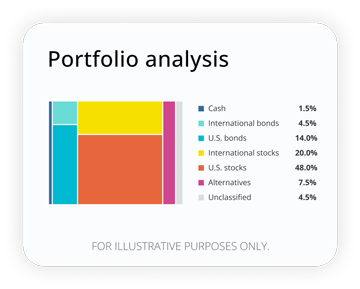
How well are your investments performing?
Analyze your portfolio in minutes and receive a target allocation for your goals.
*A withdrawal from a Roth account is not subject to federal taxation as long as it is qualified as defined under IRS regulations. However, state and local taxes may still apply.
**Any earnings on Roth contributions will be taxed unless a withdrawal is a qualified distribution as defined by the IRS. For a withdrawal to be considered a qualified distribution, Roth contributions must have been in the account for at least five years, and the money withdrawn after age 59½, death, or disability. Current rules are subject to change.
1 Congress.gov, “H.R.13511 – Revenue Act of 1978,” accessed January 2026.
2 Investment Company Institute, “Release: Quarterly Retirement Market Data, Third Quarter 2025,” January 2026.
3 Internal Revenue Service, “Retirement topics - 401(k) and profit-sharing plan contribution limits,” accessed January 2026.
4 ICI Research, “Ten Important Facts About 401(k) Plans,” July 2024.
5 Bipartisan Policy Center, “Who Benefits from Retirement Tax Breaks?” November 2024.
6 Thomson Reuters, “401(k) tax FAQ: Tax considerations for contributions and withdrawals,” November 2025.
7 Internal Revenue Service, “Retirement plan and IRA required minimum distributions FAQs,” accessed January 2026.
8 Investor.gov, “Traditional and Roth 401(k) Plans,” accessed January 2026.
9 Internal Revenue Service, “Retirement plans FAQs on designated Roth accounts,” accessed January 2026.
10 Society for Human Resource Management, “IRS Announces 401(k) Contribution Limit for 2026,” November 2025.
RO5160400-0126
 Get The Currency newsletter
News and know-how for whatever money decision comes next.
*If you’re already registered with Empower, please use the same email address as your existing account.
Recent Articles
💨 Drift happens
Money
Theme Slug
category--money
Pathauto Slug
money
More than 1 in 3 Americans say they may have lost track of funds from a former employer, according to Empower research. Here's this month's money news.
Zero-based budgeting: What it is and how it works
Money
Theme Slug
category--money
Pathauto Slug
money
Learn how zero-based budgeting works, how to give every dollar a job, and how to build a monthly plan with categories, steps, and a practical example.
Inherited a retirement account? Understanding your options
Money
Theme Slug
category--money
Pathauto Slug
money
Learn what to do after inheriting a retirement account, including how to contact the administrator, gather documents, and navigate tax and withdrawal rules.

The Currency editors
Staff contributors
The CurrencyTM writers and editors cover the latest financial news and insights shaping how we live, work, and play. The team provides accurate, data-driven, and timely content aimed at empowering financial freedom for all.
The content contained in this blog post is intended for general informational purposes only and is not meant to constitute legal, tax, accounting or investment advice. You should consult a qualified legal or tax professional regarding your specific situation. No part of this blog, nor the links contained therein is a solicitation or offer to sell securities. Compensation for freelance contributions not to exceed $1,250. Third-party data is obtained from sources believed to be reliable; however, Empower cannot guarantee the accuracy, timeliness, completeness or fitness of this data for any particular purpose. Third-party links are provided solely as a convenience and do not imply an affiliation, endorsement or approval by Empower of the contents on such third-party websites. This article is based on current events, research, and developments at the time of publication, which may change over time.
Certain sections of this blog may contain forward-looking statements that are based on our reasonable expectations, estimates, projections and assumptions. Past performance is not a guarantee of future return, nor is it indicative of future performance. Investing involves risk. The value of your investment will fluctuate and you may lose money.
Certified Financial Planner Board of Standards Inc. (CFP Board) owns the certification marks CFP®, CERTIFIED FINANCIAL PLANNER™, CFP® (with plaque design), and CFP® (with flame design) in the U.S., which it authorizes use of by individuals who successfully complete CFP Board's initial and ongoing certification requirements.