

Solo 401(k): Understanding self-employed retirement plans
Solo 401(k): Understanding self-employed retirement plans
A solo 401(k) lets self-employed individuals save for retirement as both employee and employer, unlocking higher contribution limits and flexible tax advantages
Solo 401(k): Understanding self-employed retirement plans
A solo 401(k) lets self-employed individuals save for retirement as both employee and employer, unlocking higher contribution limits and flexible tax advantages
02.09.2026
Key takeaways
- In 2026, the maximum self-employed individuals can contribute to a solo 401(k) is $24,500 as the employee plus an additional 25% of compensation as the employer.
- The employee contribution limit applies across all 401(k)s; those with a workplace plan may be limited to employer contributions in a solo 401(k).
- Solo 401(k) plans offer the same tax benefits as traditional 401(k)s, with the added advantage of greater control over investments and lower administrative requirements.
When you’re self-employed, you don’t have an employer helping you save for retirement through a company-sponsored plan or matching contributions. But it’s still just as important — if not more important — to prioritize retirement planning.
If you’re self-employed, you have several options you can adopt to help you save for retirement, both as an individual and a business owner. One of the popular options is the solo 401(k), thanks to its high contribution limits and tax advantages.
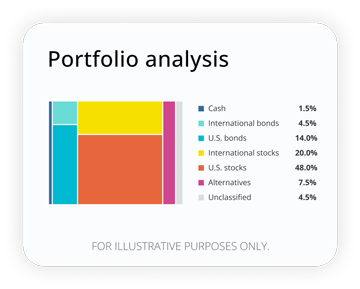
How well are your investments performing?
Analyze your portfolio in minutes and receive a target allocation for your goals.
What is a solo 401(k) plan?
A solo 401(k), also known as a one-participant 401(k) plan, is for anyone who is self-employed or runs a business with no other employees besides their spouse. A solo 401(k) shares all the characteristics of other 401(k) plans, but it only covers the business owner and their spouse.
Solo 401(k) eligibility criteria
To open and contribute to a solo 401(k), you’ll have to meet two criteria:
- You have self-employment income
- Your business has no employees other than you (or you and your spouse)
Solo 401(k) contribution limits for 2026
A solo 401(k) is unique because the business owner and the employee are the same person. With a solo 401(k), self-employed individuals can make contributions in two ways: as the employee through elective deferrals and as the employer through employer non-elective contributions. There are contribution limits on both sides of the equation. The total contribution limit for employee and employer contributions combined in $72,000 for 2026.1
Elective deferrals
In 2026, self-employed individuals can contribute up to the maximum of $24,500 as the employee. Those ages 50-59 can make an additional catch-up contribution of up to $8,000; those ages 60-63 can make a catch-up contribution of up to $11,250.2 Starting with the 2026 plan year, individuals age 50 or older whose prior-year FICA wages exceed $150,000 must make any catch-up contributions on an after-tax Roth basis under the SECURE 2.0 Act.
Employer nonelective contributions
As a business owner, you may also make employer contributions to your solo 401(k) plan. Your business can contribute up to 25% of your compensation.3 Your compensation is considered your net earnings minus one-half of your self-employment tax and your employee elective deferrals. The maximum compensation for the purpose of employer nonelective contributions is $360,000 in 2026.4
Contributing to a solo 401(k) and an employer-sponsored 401(k)
Keep in mind that if you have access to a 401(k) plan, your employee contribution limit applies across all plans, not per plan. If you max out your contributions to a different employer-sponsored 401(k), you may only be able to make employer contributions to your solo 401(k).
Read more: What are the 401(k) contribution limits for 2024 and 2025?
Solo 401(k) taxes
Solo 401(k) plans have the same tax benefits as the 401(k) plans offered by larger companies.
The most common type of 401(k) contributions are pre-tax or “traditional” 401(k). It’s a pre-tax account, meaning your contributions are tax-deferred until you take a distribution from your account. They reduce your taxable income for the current year and, therefore, your current tax liability.
Let’s say you have a taxable income of $100,000. However, you contribute the maximum amount — $24,500 in 2026 — to your 401(k). Because you’ve made pre-tax 401(k) contributions, your current taxable income is reduced to $75,500.
Once you contribute to your 401(k) plan, your money can potentially grow tax-free until you start taking distributions. Then you’ll pay income taxes on the amount withdrawn.
You can also opt for Roth contributions in a solo 401(k). A Roth 401(k) is one where you make after-tax contributions, meaning there’s no upfront tax benefit. However, you’ll then have the benefit of tax-free investment growth potential and tax-free qualified distributions.* Under the Secure 2.0 Act, anyone age 50 or older who had W-2 compensation of $150,000 or more in 2025 must make any catch-up contributions on a Roth basis in 2026.
Solo 401(k) distributions
Just as solo 401(k) plans have the same tax benefits as other 401(k)s, they also have the same distribution rules. Generally, it’s wise to avoid withdrawing from your 401(k) plan until you reach at least age 59 ½. Any withdrawals earlier than that are subject to a 10% additional tax, and that’s on top of the ordinary income taxes you’ll already pay on those distributions.
However, there are a few other exceptions that allow you to access your money early without the additional 10% tax (though ordinary income taxes will still apply):
- You become totally and permanently disabled
- You’re the beneficiary on a 401(k) plan where the participant has passed away
- You pay for qualified birth or adoption expenses (up to $5,000)
- You sustain an economic loss due to a federally declared disaster (up to $22,000)
- You’re the victim of domestic abuse (up to $10,000)
- You must pay under a Qualified Domestic Relations Order
- You experience a personal or financial emergency (up to $1,000 once per year)
- You take a series of substantially equal payments
- Your plan is subject to an IRS levy
- You pay for unreimbursed medical expenses of more than 7.5% of your AGI
- You’re a qualified military reservist called to active duty
- You leave your job during or after the year you turn 55
- You’re terminally ill, as certified by a physician
Benefits of a solo 401(k)
Solo 401(k) plans have some key benefits that make them a popular choice among self-employed individuals.
Alternative to employer-sponsored retirement plans
If you’re self-employed, you don’t necessarily have access to the company-sponsored retirement plans many people use. However, a solo 401(k) offers nearly all the same benefits as one offered by a larger company.
Tax advantages and deductions
A solo 401(k) comes with considerable tax benefits, regardless of whether you choose pre-tax or Roth 401(k) contributions. A pre-tax 401(k) contribution offers an upfront tax benefit, while Roth 401(k) contributions offer a tax benefit during retirement.
For most people, there are no wrong answers when choosing between the two. After all, either tax benefit is better than no tax benefit at all. However, certain people may find that one or the other is best suited for them.
For example, someone with a high income and tax rate might prefer making pre-tax 401(k) contributions since it allows them to reduce their tax liability right away. On the other hand, someone with a relatively low income or tax rate now might prefer to defer the tax benefit until retirement, when they might be in a higher tax bracket.
If you aren’t sure which tax benefit is better for you, consider consulting a tax professional who can look at your unique situation and help you evaluate your options.
High contribution limits for retirement savings
A key benefit of 401(k) plans is their contribution limits. 401(k) plans have higher contribution limits than individual retirement accounts (IRAs), which only allow for contributions up to $7,500 per year. They also offer higher contribution limits than certain other self-employed retirement plans, such as SIMPLE IRAs, which allow contributions up to $17,000.
Catch-up contributions
If you’re 50 or older, a solo 401(k) can help you save $8,000 extra per year thanks to catch-up contributions, and an increased catch-up provision that boosts the limit to $11,250 for workers aged 60-63. If you’re nearing retirement, this catch-up contribution can be an excellent opportunity to push you over the finish line of your retirement savings goals.
Flexibility and control over investments
When you contribute to a company-sponsored 401(k) plan, you’re limited to choosing from the menu of investments the company chooses. But when you have a solo 401(k), you can choose your plan provider, as well as what to invest in. You have more control, not only over your investment options but also over your fees.
Ability to cover both the business owner and their spouse
A key benefit of a solo 401(k) that doesn’t exist with other retirement plans is that it can cover both you and your spouse. In fact, your spouse is the only other person that can be covered by your solo 401(k).
When you include your spouse in your solo 401(k), you essentially double the amount you can contribute as a couple. You both have a separate $72,000 total contribution limit, which can be made up of a combination of elective deferrals and employer nonelective contributions.
Keep in mind that for your spouse to be covered by your solo 401(k), they must be employed by and have income from your business. Additionally, the employer contributions you can make on their behalf are limited to 25% of their income.
How to open a solo 401(k) plan
Setting up a solo 401(k) is easier than you might think. Many financial institutions offer solo 401(k) plans. Here are the steps to set up a solo 401(k):
- Get an employer identification number (EIN): You’ll need an EIN to open a solo 401(k), so if you don’t already have one, that should be your first course of action. You can apply for an EIN directly on the IRS website.
- Choose an institution: You can open a solo 401(k) with many financial institutions. Both large and small institutions may offer solo 401(k) plans.
- Complete a plan adoption agreement: When you start the process of opening your solo 401(k), your financial institution will provide you with an adoption agreement, which you’ll have to complete, sign, and return.
- Open your account: After you’ve completed your adoption agreement, you’ll complete an account application. On this form, you’ll provide personal information about yourself, as well as information about your business.
- Contribute to your account: Once your solo 401(k) is set up, you can set up your contributions. You can make manual contributions or set up automatic recurring contributions to ensure consistency. You can also contribute on behalf of your business.
- Choose your investments: You can invest your solo 401(k) in a wide variety of investments, including individual stocks and bonds, mutual funds, exchange-traded funds, and more.
Investment options and diversification
When you contribute to an employer-sponsored retirement plan through a company, you’re typically given a limited menu of investments to choose from. This menu generally includes mutual funds and collective investment trusts, but there may only be a limited menu which may include target-date funds.
When you open a solo 401(k), you have complete control of your investments. By choosing an online brokerage for your 401(k), you have access to all the securities that the platform offers.
While it’s a major benefit to be able to choose your own investments, it’s also a big decision. When selecting investments in your solo 401(k), it’s important to build a diversified portfolio designed to help you reach your retirement goals while mitigating your risk.
Special considerations for freelance or gig workers
If you have a job with a company that offers a 401(k) plan and you also earn self-employment income, you can still open a solo 401(k). You can contribute to both that and your employer-sponsored 401(k), but with an important caveat.
The 401(k) contribution limits apply per person, not per plan. That means that you as an individual, can contribute $24,500 to 401(k) plans in 2026. That could look like:
- Contributing $24,500 to your employer’s 401(k) and $0 to your solo 401(k)
- Contributing $0 to your employer’s 401(k) and $24,500 to your solo 401(k)
- Contributing some money to your employer’s 401(k) and some to your solo 401(k)
There’s no right way to allocate your 401(k) contribution across multiple plans. If your employer offers a matching contribution, it’s generally worth contributing at least enough to that plan to earn that extra contribution. However, you might prefer to contribute any additional money to your solo 401(k) since you have more control over your investments and fees.
Ongoing compliance
Solo 401(k) plans don’t require as much ongoing administration and compliance as traditional company plans. But keep in mind that if your solo 401(k) has more than $250,000 in assets at the end of the year, you’ll be required to file an annual report on Form 5500-EZ. For assets less than $250,000, no annual report is required.5
Seeking professional assistance
If the idea of opening and managing a solo 401(k) sounds overwhelming, but you want to start saving for retirement, you don’t have to do it alone. There are plenty of resources available to help make your investing journey easier. Here are a few things to consider:
- Hire a financial professional: A financial professional can help you set up your solo 401(k) and manage your investments on your behalf.
- Use an online service: An online financial provider offers the benefits of a digital tool and may also offer access to an in-person financial professional.
Exploring self-employed retirement options
The solo 401(k) is one of the most popular options for self-employed retirement savings. However, there are some other options to consider. Here are a few:
- SEP IRA: A SEP IRA ( Simplified Employee Pension Plan) is similar to a solo 401(k) in that it allows business owners to save a large amount of money for retirement. It has features like the solo 401(k) but is available to business owners with employees. However, if you have employees and choose to open a SEP IRA, you’ll also have to contribute to their accounts.
- Traditional or Roth IRA: Rather than investing in an account specifically designed for self-employed individuals, you can choose to invest in a traditional or Roth IRA. These accounts offer the same tax advantages as a solo 401(k). However, they have considerably lower contribution limits and don’t allow contributions from your business. Therefore, they can be viewed as a complement to a solo 401(k) rather than as a replacement.
- SIMPLE IRA: A SIMPLE IRA (Savings Incentive Match Plan for Employees) is another type of self-employed retirement plan. Like the SEP IRA, it allows business owners to contribute both to their own retirement accounts and those of their employees. However, this type of account has considerably lower contribution limits and inflexible contribution rules.
The bottom line
Saving for retirement often takes a back seat when you’re trying to grow and run a business. After all, you don’t have an employer doing the heavy lifting of setting up the plan for you. However, self-employment makes it perhaps even more important to prioritize your retirement.
A solo 401(k) can be one of the best options available to help you save for retirement as a self-employed individual. It can help you save tens of thousands of dollars per year while enjoying tax advantages.
As you’re setting up your solo 401(k) or other self-employed retirement savings tool, a financial professional can be a valuable asset in helping you open your account and plan your investments.
* Any earnings on Roth contributions will be taxed unless a withdrawal is a qualified distribution as defined by the IRS. For a withdrawal to be considered a qualified distribution, Roth contributions must have been in the account for at least five years, and the money withdrawn after age 59½, death, or disability. Current rules are subject to change and state and local taxes may still apply.
1 IRS, “2026 Amounts Relating to Retirement Plans and IRAs, as Adjusted for Changes in Cost-of-Living,” February 2026.
2 IRS, “401(k) limit increases to $24,500 for 2026, IRA limit increases to $7,500,” November 2025.
3 IRS, “One-participant 401(k) plans,” August 2025.
4 IRS, “2026 Amounts Relating to Retirement Plans and IRAs, as Adjusted for Changes in Cost-of-Living,” February 2026.
5 IRS, “One-participant 401(k) plans,” August 2025.
RO5194520-0226
 Get The Currency newsletter



The Currency editors
Staff contributors
The CurrencyTM writers and editors cover the latest financial news and insights shaping how we live, work, and play. The team provides accurate, data-driven, and timely content aimed at empowering financial freedom for all.
The content contained in this blog post is intended for general informational purposes only and is not meant to constitute legal, tax, accounting or investment advice. You should consult a qualified legal or tax professional regarding your specific situation. No part of this blog, nor the links contained therein is a solicitation or offer to sell securities. Compensation for freelance contributions not to exceed $1,250. Third-party data is obtained from sources believed to be reliable; however, Empower cannot guarantee the accuracy, timeliness, completeness or fitness of this data for any particular purpose. Third-party links are provided solely as a convenience and do not imply an affiliation, endorsement or approval by Empower of the contents on such third-party websites. This article is based on current events, research, and developments at the time of publication, which may change over time.
Certain sections of this blog may contain forward-looking statements that are based on our reasonable expectations, estimates, projections and assumptions. Past performance is not a guarantee of future return, nor is it indicative of future performance. Investing involves risk. The value of your investment will fluctuate and you may lose money.
Certified Financial Planner Board of Standards Inc. (CFP Board) owns the certification marks CFP®, CERTIFIED FINANCIAL PLANNER™, CFP® (with plaque design), and CFP® (with flame design) in the U.S., which it authorizes use of by individuals who successfully complete CFP Board's initial and ongoing certification requirements.