

5 ways to help future-proof your retirement
5 ways to help future-proof your retirement
These practical steps can help you strengthen your financial future and build a more resilient retirement plan
5 ways to help future-proof your retirement
These practical steps can help you strengthen your financial future and build a more resilient retirement plan

04.28.2026
Key takeaways
- Set clear retirement goals and revisit them often to stay on track through life and market changes.
- Maximizing tax-advantaged savings opportunities like 401(k)s, matching contributions, and IRAs can help build a strategy for saving and withdrawing income.
- Americans have saved $532,291 on average for retirement — starting early and staying consistent can help harness potential compounding.
Future-proofing your retirement isn’t about predicting the future — it’s about preparing for it. Factors such as evolving personal priorities, longer life expectancies, and shifting market and economic conditions mean building a resilient retirement plan may require thoughtful goal-setting, disciplined saving, and ongoing adjustments. And taking a proactive approach today can make a difference in helping you better position your finances to support the lifestyle you envision tomorrow.
Here are five practical steps to help you get prepared for the retirement you envision.
1. Visualize your future: Set practical goals
Establishing clear and realistic goals is a vital first step toward positioning yourself for financial success in retirement. One way to do this is to visualize where you want to be in the long-term and then set small, incremental checkpoints to help you get there. A financial professional can help you navigate this process and steer you at key decision points.
Keeping your goals in focus to guide your money decisions and having checkpoints for achieving each milestone along the journey can help you stay motivated and on track. Keep in mind, unpredictable market fluctuations and changes in personal circumstances can detour the best laid plans, so it’s also important to use each checkpoint and an opportunity to review and adjust as necessary. This can help ensure your portfolio keeps pace with economic conditions and stays aligned with your evolving needs.
Read more: How do I know if I’m ready to retire? Get a Sense Check
2. Pay yourself first: Optimize 401(k) contributions
The automated nature of contributing to a 401(k) or other employer-sponsored plan simplifies saving for retirement: Contributions typically are deducted from your paycheck before you receive it, so you’re paying yourself first. As a tax-optimized investment vehicle, your 401(k) can be a valuable tool to help you save for your future.
Consider contributing the maximum amount allowed if possible but pay attention to limits — up to $24,500 in 2026, plus an additional $8,000 if you’re age 50 or older. Many employers also match employee contributions up to a certain amount. If yours does, be aware of the level you need to contribute to receive the full match — falling short essentially can mean walking away from free money.
Read more: Top benefits of a 401(k) plan: Start saving early
3. Fine-tune your foresight: Build a robust saving and withdrawal strategy
Developing a comprehensive saving and withdrawal strategy can help solidify your foundation for the retirement you envision. Look ahead for opportunities to help maximize the money you accumulate through an array of vehicles, including brokerage accounts, traditional and Roth IRAs, and annuities to health savings accounts and high yield accounts. Consider speaking with a financial professional to identify the options that are best for your specific circumstances and goals.
According to Empower Personal DashboardTM data, the typical American has $532,291 saved for retirement on average. Whatever approach you choose, commit to saving as soon and consistently as possible. Even if you’re behind, it’s never too late to prioritize saving, and depending on your age, you may be eligible to make catch up contributions to your IRA or 401(k).
Read more: Average retirement savings by age
A plan for putting away money is just part of the future-proofing equation — your strategy should also factor in a plan for withdrawals. With an average retirement age of 65 for men and 63 for women and average life expectancy on the rise at 79, retirement income and savings may need to last for decades. When considering your withdrawal rate, be sure to familiarize yourself with any requirements for accessing your money, such as Roth IRA withdrawal rules, and also be mindful of required minimum distribution rules for other tax-advantage retirement accounts, which generally kick in at age 73.
Read more: 401(k) round-up: A guide to contributions, rollovers, and withdrawals
4. Find your magic number: Assess retirement income and spending
To start, calculate your potential income streams: These might include Social Security benefits, 401(k)s and other retirement accounts, pensions, dividends, and other investment income.
Estimating what you’ll spend in retirement can include considerations like gauging what you’ll need to cover fixed costs. You’ll also need to think about the kind of retirement lifestyle you want. For example, will things like entertainment and travel be priorities? Given continuing price fluctuations in places from the grocery store and the gas station to the pharmacy, it may make sense to allow a cushion for some unexpected or overlooked expenses. If your projected income isn’t adequate to offset anticipated expenses, think about whether you’ll be taking on part-time work or identifying other income streams to bridge the gap.
Tools like the Empower Retirement Planner allow you to run different scenarios, create a spending plan, anticipate large expenses, and simulate a recession to help you optimize your chances for financial success in retirement.
Read more: To collect or not to collect: Does waiting for a bigger Social Security benefit pay off?
5. Keep time on your side: Start early
There’s no way to predict exactly what the future holds, so taking advantage of time is one of the best future-proof moves you can make. Half of Americans believe they’re running out of time to save for retirement, and Empower research reveals that 43% wish they could turn back time to start saving sooner. The earlier you start and the more frequently you sock money away, the greater the potential for your savings to grow through compound earnings.
Consider this: According to Empower Personal Dashboard™ data, the average 401(k) balance for people in their 20s is $116,872. To get a sense of how compound earnings can affect retirement savings, try applying the Rule of 72, a formula for calculating theoretically how long it takes for balances to double:
- 72 / Rate of return = Years to double
Assuming a 6% rate of return on investments, hypothetically the $116,872 for dashboard users in their 20s could double to $233,744 in 12 years, likely at some point in their 30s.
- 72 / 6% = 12 Years to double*
Keep in mind the Rule of 72 isn’t perfectly accurate (past market results do not predict future market behavior), but it does demonstrate the potential payoff of compounding over time.
Read more: What is the rule of 72
A retirement you envision
There’s no one-size-fits-all solution, but a multi-pronged plan aimed at longevity can go a long way toward helping future-proof your retirement. Taking a proactive, disciplined approach combined with some fundamental retirement income planning strategies will help position your finances to withstand the unpredictable, so when the future arrives, you can enjoy your retirement with confidence.
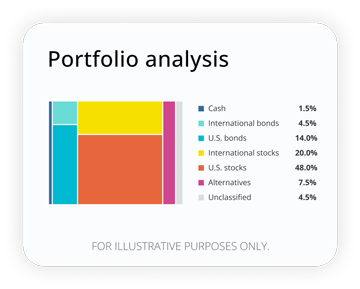
How well are your investments performing?
Analyze your portfolio in minutes and receive a target allocation for your goals.
*FOR ILLUSTRATIVE PURPOSES ONLY. This hypothetical illustration does not reflect a particular investment and is not a guarantee of future results. The rule of 72 is a mathematical rule used to approximate the number of years it takes a given investment to double in value. Rates of return may vary.
Investing involves risk, including possible loss of principal.
RO5435534-0426
 Get The Currency newsletter


The Currency editors
Staff contributors
The CurrencyTM writers and editors cover the latest financial news and insights shaping how we live, work, and play. The team provides accurate, data-driven, and timely content aimed at empowering financial freedom for all.
The content contained in this blog post is intended for general informational purposes only and is not meant to constitute legal, tax, accounting or investment advice. You should consult a qualified legal or tax professional regarding your specific situation. No part of this blog, nor the links contained therein is a solicitation or offer to sell securities. Compensation for freelance contributions not to exceed $1,250. Third-party data is obtained from sources believed to be reliable; however, Empower cannot guarantee the accuracy, timeliness, completeness or fitness of this data for any particular purpose. Third-party links are provided solely as a convenience and do not imply an affiliation, endorsement or approval by Empower of the contents on such third-party websites. This article is based on current events, research, and developments at the time of publication, which may change over time.
Certain sections of this blog may contain forward-looking statements that are based on our reasonable expectations, estimates, projections and assumptions. Past performance is not a guarantee of future return, nor is it indicative of future performance. Investing involves risk. The value of your investment will fluctuate and you may lose money.
Certified Financial Planner Board of Standards Inc. (CFP Board) owns the certification marks CFP®, CERTIFIED FINANCIAL PLANNER™, CFP® (with plaque design), and CFP® (with flame design) in the U.S., which it authorizes use of by individuals who successfully complete CFP Board's initial and ongoing certification requirements.