

3 ways to help optimize eye care expenses
3 ways to help optimize eye care expenses
With most U.S. adults relying on eyewear, vision care costs — from exams to surgery — can affect long-term health and financial planning
3 ways to help optimize eye care expenses
With most U.S. adults relying on eyewear, vision care costs — from exams to surgery — can affect long-term health and financial planning

03.02.2026
Key takeaways
45% of people believe their vision plan is among the most important employer-sponsored benefits.
Preventive exams can help identify costly conditions like glaucoma and cataracts.
FSAs and HSAs allow pre-tax savings for qualified vision expenses, helping offset rising healthcare costs.
Having good vision can impact people’s health and wealth, with 92% of America’s 240 million adults using some form of eyewear like glasses or contact lenses. The $68.3 billion optical market looks to expand with future generations, as around 32% of children under age 10 need vision correction.1
Vision care and eyewear can be seen as nice-to-haves, though in the long run, spending on prevention and treatments now can be a smart money move for both health and wealth.
1. Use insurance coverage and preventive care
Seeing clearly is a big priority for U.S. workers: More than two in five Americans (45%) say their vision plan is among the top workplace benefits, according to Empower research.
On average, monthly premiums for vision insurance cost around $19 for an individual. Plans often cover preventive eye care like exams at little to no cost, and prescription eyewear like glasses and contact lenses have set dollar limits for coverage. People should check their specific plan to see the frequency in which eye care is covered; for example, a comprehensive eye exam could be free once every calendar year, though the cost could jump significantly should there be another exam during the same period.2
Since premiums could add up to hundreds of dollars over the course of a year, it’s worth tapping into the offered benefits before coverage resets.
Prescription glasses cost around $300-$700 including frames and lenses, though prices can vary widely depending on insurance benefits and where consumers shop; the eyewear market has diversified to include direct-to-consumer sellers and warehouse clubs.3
2. Avoid larger health costs later
Concerns identified through regular eye exams can also act as a warning sign for more complex health conditions like diabetes and high blood pressure, which is the number one chronic health concern for older Americans.4
Vision problems are common among adults eligible for Medicare — the federal health insurance program for people 65 or older (and some younger people with disabilities). Some 41% of Medicare beneficiaries have had at least one claim related to four vision conditions: age-related macular degeneration (AMD), glaucoma, diabetic retinopathy (DR), and cataracts.5
America’s oldest Baby Boomers are turning 80 in 2026, and the generation as a whole accounts for 20% of the U.S. population (67 million people).6 The country’s shift in population dynamics has affected spending habits; from 2010-2019, over 40% of U.S. healthcare expenses were for people older than 65.7
Read more: Understanding the costs of a healthy retirement
Keeping vision strong can help prevent falls and increase independence, especially as most older adults — 75% of people aged 50 and older — aim to stay in their homes and age in place. In a given year, a fourth of adults ages 65 and older has a fall, which is the top cause of injuries for older Americans and can lead to hospitalizations.8,9
Treatment costs can vary for eye conditions and may accumulate out-of-pocket costs even with insurance. Glaucoma surgeries can cost around $2,000 for a laser procedure, and more complex surgeries could be around $5,000.10 Surgery for cataracts could be in the hundreds of dollars for Medicare enrollees, while those without any type of insurance could be spending upwards of $6,000.11
3. Lower tax burden with tax-advantaged accounts
Health spending is projected to account for 19.7% of the U.S. economy by 2032, driven by the aging population and changes to the labor market and prescription-drug costs. This compares to 17.6% in 2023.12
With this increase in overall costs, people should prepare their finances to both handle the immediate payments and plan ahead for tax savings.
Qualified eye care expenses like prescription glasses, contact lenses, and exam co-pays qualify for reimbursement through both flexible savings accounts (FSAs) and health savings accounts (HSAs). Both provide workers the chance to allocate pre-tax dollars to cover health costs, though FSAs have a more limited time frame to accumulate expenses.
Read more: What are the benefits of a health savings account?
HSAs are specifically available for people who are enrolled in high-deductible healthcare plans, and the 2026 contribution limits for HSAs rose to $4,400 for individuals and $8,750 for family coverage. The contributions themselves reduce a person’s taxable income, and any earnings are tax deferred within the account. If funds are taken out to cover medical expenses, there’s also the benefit of withdrawals being tax-free, though state income taxes could still apply.*
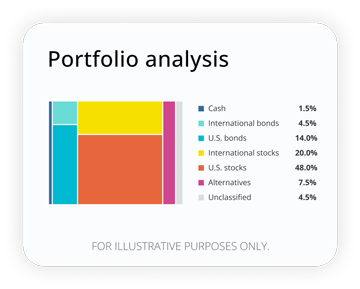
How well are your investments performing?
Analyze your portfolio in minutes and receive a target allocation for your goals.
* Contributions, any earnings, and withdrawals are federal income tax-free if used to pay for qualified medical expenses. State income taxes may still apply. HSA funds used for nonqualified medical expenses may be subject to applicable federal and state income taxes and/or penalties.
1 The Vision Council, “U.S. Optical Industry Grows to $68.3 Billion, According to The Vision Council’s New Market inSights Report,” January 2025.
2 Forbes, “Is Vision Insurance Worth It?” accessed February 2026.
3 Glasses.com, “How Much Do Glasses Cost in the U.S.? Average Prices, Factors, and Ways to Save,” January 2026.
4 American Optometric Association, “See the Full Picture of Your Health with an Annual Comprehensive Eye Exam,” accessed February 2026.
5 U.S. Centers for Disease Control and Prevention, “Economic Studies,” May 2024.
6 Pew Research Center, “The oldest Baby Boomers turn 80 in 2026,” January 2026.
7 Institute for Health Metrics and Evaluation, “Most comprehensive study on US health care spending by county reveals wide variation,” February 2025.
8 U.S. Centers for Disease Control and Prevention, “About Vision Impairment and Falls Among Older Adults,” May 2024.
9 The Wall Street Journal, “How to Set Up Your Home to Age in Place for $1,500,” January 2026.
10 Glaucoma Research Foundation, “Glaucoma Treatments, Surgeries, and Costs,” accessed February 2026.
11 GoodRx, “How Much Does Cataract Surgery Cost?” June 2022.
12 KFF, “Health Care Costs and Affordability,” October 2025.
RO5261754-0226
 Get The Currency newsletter



The Currency editors
Staff contributors
The CurrencyTM writers and editors cover the latest financial news and insights shaping how we live, work, and play. The team provides accurate, data-driven, and timely content aimed at empowering financial freedom for all.
The content contained in this blog post is intended for general informational purposes only and is not meant to constitute legal, tax, accounting or investment advice. You should consult a qualified legal or tax professional regarding your specific situation. No part of this blog, nor the links contained therein is a solicitation or offer to sell securities. Compensation for freelance contributions not to exceed $1,250. Third-party data is obtained from sources believed to be reliable; however, Empower cannot guarantee the accuracy, timeliness, completeness or fitness of this data for any particular purpose. Third-party links are provided solely as a convenience and do not imply an affiliation, endorsement or approval by Empower of the contents on such third-party websites. This article is based on current events, research, and developments at the time of publication, which may change over time.
Certain sections of this blog may contain forward-looking statements that are based on our reasonable expectations, estimates, projections and assumptions. Past performance is not a guarantee of future return, nor is it indicative of future performance. Investing involves risk. The value of your investment will fluctuate and you may lose money.
Certified Financial Planner Board of Standards Inc. (CFP Board) owns the certification marks CFP®, CERTIFIED FINANCIAL PLANNER™, CFP® (with plaque design), and CFP® (with flame design) in the U.S., which it authorizes use of by individuals who successfully complete CFP Board's initial and ongoing certification requirements.