

You hit $1 million in retirement savings. Now what?
You hit $1 million in retirement savings. Now what?
Reaching $1 million in retirement savings is a milestone worth celebrating — and an opportunity to revisit financial goals, investments, and plans for the future.
You hit $1 million in retirement savings. Now what?
Reaching $1 million in retirement savings is a milestone worth celebrating — and an opportunity to revisit financial goals, investments, and plans for the future.

11.13.2026
Key Takeaways
- Reaching $1 million in retirement savings is a significant milestone and can be a natural opportunity to revisit your financial plan.
- Reviewing your retirement goals, investment mix, taxes, and broader financial picture can help you assess whether your plan still fits.
- Your next financial milestone doesn’t have to be another dollar amount. What matters is having a plan that reflects your goals and priorities.
Reaching $1 million in retirement or other savings is a significant achievement. It’s a milestone worth recognizing, regardless of how you got there or when retirement may be.
Crossing into seven figures doesn’t necessarily mean that anything needs to change overnight. What $1 million means for your financial future is unique to you, shaped by factors like your retirement timeline, spending expectations, other savings, and sources of income.
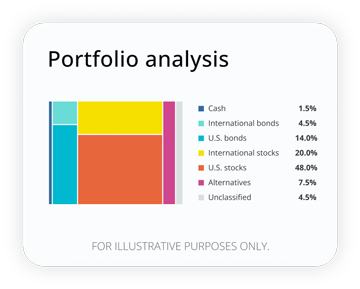
How well are your investments performing?
Analyze your portfolio in minutes and receive a target allocation for your goals.
But the $1 million mark can be a good opportunity to revisit your retirement plan. It might be worth exploring whether you still have the same goals or whether your investment strategy still fits. What do you want your savings to help you accomplish next?
Be sure to take the win — you've earned it. Then consider taking stock. Here are five things to consider after reaching $1 million in retirement savings.
1. Revisit what you’re saving for (and who)
A lot can change over the years, including your vision for retirement. The age you expect to stop working, where you want to live, how you hope to spend your time, and what you expect life to cost may look different today than when you first started planning.
Rising costs, especially for healthcare and other essential living expenses can impact how much you'll need to support the retirement you envision. The $1 million savings mark can be an opportunity to revisit those assumptions and see whether your plan is suited for the lifestyle you envision.
The $1 million milestone can also be a great time to revisit your estate plan. What happens to your assets after you die? It can be a life-changing amount of money, so it’s especially important to make sure that you have your estate plan set up the way you’d like it to be.
Depending on where you live, estate taxes may also be worth considering. According to the Tax Foundation, 12 states and the District of Columbia have estate taxes, kicking in as low as $1 million in Oregon. Five states also impose inheritance taxes.1
Read more: Understanding the costs of a healthy retirement
2. Check your investment mix
Crossing the $1 million mark isn’t, by itself, a reason to change how your money is invested. But recent life events, along with your current goals, retirement time horizon and tolerance for risk may have changed as your balance has grown.
Reviewing your asset allocation with a financial professional can help you see whether the mix of investments in your portfolio still aligns with your short-term and long-term goals.
Read more: What is the average asset allocation by age?
Individuals with a net worth exceeding $1 million, excluding their primary residence and subject to applicable liability calculations, may qualify as accredited investors. Private investments can involve additional risks, including limited liquidity and potential loss of principal. Accredited investors are considered “sophisticated and able to fend for themselves or sustain the risk of loss, thus rendering unnecessary the protections that come from a registered offering,” according to the Securities and Exchange Commission.2
Just because you can make certain investments doesn't mean you should. Give thoughtful consideration and due diligence when evaluating private, complex investments, and consider seeking guidance from a financial professional.
Read more: Private equity vs. public equity: What’s the difference?
3. Look beyond the balance
Your retirement account is just one part of your overall financial picture. Other savings and investments, Social Security, pensions, and additional sources of income can all play a role in planning for the future.
How you approach retirement also matters. Whether you plan to stop working entirely, transition to part-time work, or take a break between different jobs or even a potential new career can affect your income needs and how you use your savings. Your asset mix may have gotten you this far, but how will it serve you moving forward?
It's also worth understanding how different sources of retirement income are taxed, including withdrawals from 401(k)s and IRAs, Social Security benefits, pensions and investment gains. Required minimum distributions can also affect your taxes. Factoring in taxes can help you see how your $1 million balance fits into your long-term plan. This can help you to decide if adjustments to your future savings plan are warranted from here.
Read more: Essential steps for retirement planning
4. Decide what your next milestone looks like
Once you’ve reached a milestone number, setting your sights on the next one can seem like the obvious move. But financial progress doesn’t always have to be measured around an overall account balance.
Your next goal could be retiring at a certain age, reaching a target level of retirement income, paying off your mortgage, helping your family, having greater flexibility around work or something else your savings can help make possible.
The important thing is having a financial goal that reflects what matters to you — and a plan to work toward it.
It’s important not to focus on just the next milestone, but your larger goals over time, including to and through retirement, and adjust your goals and plan along the way. It’s hard to move towards your goals without all four tires of your car headed in the same direction; likewise, you will naturally want to steer and adjust course as you make your way to your destination.
Read more: How to set financial goals & stick to them in 5 steps
5. Keep doing what’s working
There’s no rule that says reaching seven figures requires a new strategy. Depending on your goals and circumstances, some of what comes next may look a lot like what came before.
Continuing to save, keeping your investments aligned with your plan and checking in as your circumstances change matters regardless of your savings number. Sometimes reaching a major financial milestone like $1 million in savings isn’t a signal to do something different — it’s a reason to keep going.
Read more: Average retirement savings by age
1 Tax Foundation, "Estate and Inheritance Taxes by State, 2026," October 2026.
2 Securities and Exchange Commission, "Accredited Investors – Investor Bulletin," accessed November 2026.
RO6112944-1127
 Get The Currency newsletter



The content contained in this blog post is intended for general informational purposes only and is not meant to constitute legal, tax, accounting or investment advice. You should consult a qualified legal or tax professional regarding your specific situation. No part of this blog, nor the links contained therein is a solicitation or offer to sell securities. Compensation for freelance contributions not to exceed $1,250. Third-party data is obtained from sources believed to be reliable; however, Empower cannot guarantee the accuracy, timeliness, completeness or fitness of this data for any particular purpose. Third-party links are provided solely as a convenience and do not imply an affiliation, endorsement or approval by Empower of the contents on such third-party websites. This article is based on current events, research, and developments at the time of publication, which may change over time.
Certain sections of this blog may contain forward-looking statements that are based on our reasonable expectations, estimates, projections and assumptions. Past performance is not a guarantee of future return, nor is it indicative of future performance. Investing involves risk. The value of your investment will fluctuate and you may lose money.
Certified Financial Planner Board of Standards Inc. (CFP Board) owns the certification marks CFP®, CERTIFIED FINANCIAL PLANNER™, CFP® (with plaque design), and CFP® (with flame design) in the U.S., which it authorizes use of by individuals who successfully complete CFP Board's initial and ongoing certification requirements.