

How 2025 changed your money: 10 stories that mattered
How 2025 changed your money: 10 stories that mattered
Personal finances shifted in 2025 with rate cuts, strong markets and stabilizing inflation
How 2025 changed your money: 10 stories that mattered
Personal finances shifted in 2025 with rate cuts, strong markets and stabilizing inflation

01.05.2026
Key takeaways
Staying invested through the early‑year stock pullback mattered more than trying to time the market, as some stock indexes reached record highs at the end of the year.
The Fed cut rates three times, and this, combined with inflation averaging 2.7% year-over-year in November, helped on the margins. But high prices on food and rising credit‑card debt kept real‑life budgets under pressure.
Housing remained expensive even as some 30-year mortgage rates fell to 6.21% at one point, while nearly 20% of new car loans had monthly payments of $1,000 or more.
Policy changes — from student loan repayment and SECURE 2.0 to the One Big Beautiful Bill — reshaped the tax and retirement landscape.
2025 didn’t deliver a single defining financial moment, but it did bring a series of shifts that added up to a big year. Stocks stumbled early and finished strong, the Federal Reserve (Fed) started cutting rates, and inflation cooled without making life feel much cheaper. At the same time, housing stayed tough, cars and credit cards became potential budget busters, student‑loan rules were revised, and new tax and retirement rules changed how some people think about paychecks, planning, and big‑ticket purchases.
With 2026 here, the financial picture might feel calmer than some economic moves of the past few years. And yet, for anyone trying to build wealth, pay down debt, or buy a home, 2025 was a big transition year — the year money started to get cheaper again while life for some stayed expensively complicated.
The question isn’t just what happened, but what it did to your wallet. Here’s a year‑end wrap of 10 stories that shaped personal finance in 2025 — and what they meant.
Empower research shows that 21% of Americans use December as a financial checkpoint, and 21% also believe that the choices they make this month set the tone for the year ahead.
Read more: U.S. economic and market outlook
1. A first‑quarter scare for stocks — and a strong year anyway
After a blockbuster 2023–2024 run, by the end of January 2025, U.S. stocks were at historically elevated levels.1 But stocks began falling in February, and in Q1, the S&P 500® Index fell more than 10% from record highs — its worst quarter since 2022 — as investors digested high valuations, tariff worries, and signs of slower growth.2
By December, patience was rewarded. As of market close on Dec. 31, the S&P 500 was up 16.4% year‑to‑date, near all‑time highs around 6,800, while the Dow was up 13% after setting a record above 48,000 in November, Nasdaq was up 20.4%, and the Russell 2000® was up 11.3%.3 Analysts forecast the S&P 500 to grow 14% in 2026, buoyed by technology companies, despite a potential drag on earnings due to tariffs.
What it meant for your money
If you stayed invested and kept dollar‑cost averaging, 2025 could have resulted in positive returns for your discipline.*
If you panicked during the Q1 drop and moved to cash, you might have locked in losses and missed much of the rebound.
2. The Fed finally pivoted on rate cuts
For most of the year, the Federal Reserve kept its key rate in the 4.25%–4.50% range — the highest borrowing costs in decades. Then, in the fall, the pivot nearly everyone had been waiting for finally arrived.
September 2025: Fed lowered rates by a quarter of a percentage point, bringing the range down to 4.00%–4.25%.
October 2025: Second cut to 3.75%–4.00%.
December 2025: Third cut to 3.50%–3.75%, the lowest in nearly three years.
The Fed moved because inflation has cooled from its 2022 peak and the job market showed signs of fatigue: softer payroll growth, higher unemployment, and weaker manufacturing data.
But the message was mixed, as Fed Chair Jerome Powell said additional rate cuts might be tougher to justify.4
What it meant for your money
Cash yields peaked. High‑yield savings and short‑term Treasury rates are still attractive by historical standards, but they’re drifting lower.5
Variable‑rate debt became a little less painful — but only a little. Credit‑card and many auto loan rates remain high.6
3. Inflation cooled on paper — but affordability stayed the story
The official numbers finally look tame. The Consumer Price Index rose 2.7% year-over-year in November, with “core” inflation (excluding food and energy) at 2.6%. Prices for everyday food at home were up 2.6% in November, compared to 12 months earlier, and energy costs were up 4.2% for the same period.
After several years of price surges, households are dealing with the level of prices, not just the rate of change. And core items, such as coffee (+18.8%), beef (+15.8), and shelter (+3%), are making some families feel the squeeze more than others.
Fifty-four percent of Americans say the cost of living rose in 2025, although 28% feel more optimistic than they did in January, according to Empower research.
What it meant for your money
Budget assumptions based on pre‑2021 prices are no longer relevant. Nearly a third of Americans (31%) followed a budget in 2025.
Emergency funds matter more when everything — from groceries to car repairs — has a higher baseline price. Empower research shows that 37% of Americans added to their emergency savings this year.
Read more: Housing market update: Refinancing is back in play as rates ease
4. Mortgage rates finally fell — but housing is still a slog
For would‑be homebuyers or those selling a home, 2025 was the year of mixed news.
The average 30‑year fixed mortgage rate fell from more than 7% in 2023 to about 6.2% in December, near its low for 2025.
That’s still high versus the pandemic lows of sub-3% rates — but buyer activity remains soft with homes on the market three days longer than a year earlier, at a median of 64 days.7
Affordability is still historically strained. The housing affordability index measures whether a typical family earns enough income to qualify for a mortgage on a median-priced home, assuming standard financing. A reading above 100 means the median household has more than enough income to buy; below 100 means it does not.
In October, the index stood at 106.2 — an improvement from a low of 95.1 in June this year, but still far below the 156.6 of February 2019.8,9 Historically weaker periods can be found during the early-1980s rate shock, the late 2008-2009 housing and financial crisis , and the 2023 affordability trough, all of which are documented in long-run data from the National Association of Realtors and the Federal Reserve Economic Database (FRED).
The median list price for homes was $415,000 in November, down 0.4% from a year earlier and 2.2% from October.10 However, the typical list price is up 36.1% since November 2019.11
Builders are feeling the strain too: sentiment rose to an eight‑month high in December but remained below “neutral” for the 20th straight month, with two‑thirds of builders offering incentives and about 40% cutting prices.12
What it meant for your money
If you bought or refinanced at peak 2023–2024 rates, 2025 may have opened the door to a modest refinance — especially if your credit improved.
First‑time buyers still face a tough trade‑off: stretch for a home now with slightly better rates, or keep renting and saving while betting that prices don’t run away from you. A Q3 analysis by Empower showed that renting is more cost-effective than buying in 32 of the top 50 metros in the U.S.
For mid‑career households, the “home vs. retirement savings” tension stayed very real. Tying up too much in a down payment can slow progress on 401(k)s and IRAs — something a savings planner tool could help with.
Read more: Home sweet home: A majority of Americans want to age in place
5. The car became the new budget buster
If housing felt out of reach, the driveway wasn’t much better.
The average listing price for a new car was $49,422 in November, with a loan rate of 9.01%.13 Used cars averaged $25,730, with an auto loan rate of $13.78%.14 At the same time, nearly one in five new‑car borrowers took on payments of $1,000 or more per month in November, and 22% of borrowers opted for 84-month loans.15
The result: auto‑loan delinquencies surged, with 6.65% of subprime borrowers falling behind on their car payments in October, the highest rate on record.16
What it meant for your money
The monthly auto loan payment — not the sticker price — became the critical metric. Small rate differences translated into big long‑run costs with high loan balances and 72–84‑month terms.
Leasing, buying used intelligently, or keeping your current car longer, were often the most powerful “savings strategies” available. Last year, Empower research showed that 60% of Americans were keeping their car longer to save money.
6. Credit‑card and other consumer debt rising
It wasn’t just car loans. By the third quarter of the year, total U.S. household debt hit $18.59 trillion, according to the New York Fed, with balances rising across mortgages, auto loans, credit cards, and other categories.17 Credit cards alone represented $1.23 trillion in Q3 2025, up $24 billion from the previous quarter.18
The trend in credit card delinquencies shows that the rate of missed payments is declining , down to 2.98% in September, compared to 3.22% in June 2024.19
However, with Fed cuts arriving late in the year, the annual percentage rate (APR) for most cards barely budged — the average rate was 25.32% in November.20 Empower research shows that 36% of Americans who do not pay their credit card bill in full each month are carrying more than $10,000 in credit card debt.
What it meant for your money
Empower research shows that the math of carrying balances led 19% of Americans to borrow from family or friends, 18% used balance transfers, 15% took on a second job, and 14% consolidated debt with loans.
Building a 3–6‑month emergency fund is no longer a “nice to have”; it’s the main defense against seeing everyday setbacks turn into delinquency. However, the median emergency savings for Americans is $500, and 32% have no emergency savings set aside.
7. Student‑loan borrowers undergo changes as SAVE unraveled
If you have federal student loans, 2025 might have been confusing at best.
Student loan debt collections were on pause since 2020, due to the pandemic. While regular repayments began in 2023, collections were on hold. This year, the federal government restarted involuntary collections on defaulted student loans. With one in three households expecting their monthly student loan repayments to reach at least $1,000, this can make an impact on household budgets.
The One Big Beautiful Bill, signed into law in July, also set the stage for a new Repayment Assistance Plan (RAP) in 2026 and tweaked rules around existing income-driven repayment plans.21
What it meant for your money
For millions of borrowers, 2025 was a “phantom” year: balances grew again, even if no payments were due, complicating long‑term plans.
Tax planning around future forgiveness became more important, with some protections expiring after 2025 and potential tax bills on canceled balances looming in 2026 and beyond.
8. Retirement saving quietly changed under SECURE 2.0
While the headlines focused on rates and inflation, 2025 was a big implementation year for the SECURE 2.0 Act, the sprawling retirement law passed in late 2022. Many of its most tangible provisions kicked in this year.
Highlights that matter for individuals and plan sponsors:
Expanded auto‑enrollment and auto‑escalation rules for new 401(k) and 403(b) plans, nudging more workers into saving by default.
New and evolving catch‑up contribution rules for older workers, especially those in their early 60s, with some catch‑ups shifting toward Roth treatment depending on income.
What it meant for your money
If you changed jobs or joined a new plan in 2025, there’s a good chance you were auto‑enrolled, so it’s a good time to review to ensure the default rate and investment mix match your goals.
Older workers should revisit their catch‑up strategy, particularly around the Roth vs. pre‑tax trade‑off and future tax‑rate expectations.
Coordinating workplace plans with IRAs, HSAs and taxable accounts is more valuable now that the rulebook is more complex.
Read more: What percentage should I contribute to my 401(k)?
9. A new tax law rewrote parts of the playbook
The One Big Beautiful Bill Act became law and provided a sweeping tax‑and‑spending package that extended many 2017 tax cuts and added new twists aimed at workers, families, and seniors.
Key personal‑finance changes for 2025 and the next few years:
Individual tax brackets and the nearly doubled standard deduction from the 2017 Tax Cuts and Jobs Act were extended, avoiding a scheduled “tax cliff” after 2025. For 2025, the standard deduction for single or married filing separately is $15,750, for head of household it’s $23,625, and for married filing jointly its $31,500. For 2026, it’s $16,100 for single or married filing jointly, $24,150 for head of household, and $32,200 for married filing jointly.
The cap on state and local tax (SALT) deductions increases to $40,000 in tax year 2025 and is scheduled to revert to the prior $10,000 cap after tax year 2029. The $40,000 cap is subject to an income phase-out that begins when a taxpayer’s income exceeds $500,000.
A new car‑loan interest deduction allows eligible taxpayers to deduct up to $10,000 per year in interest on qualifying U.S.-assembled vehicles purchased after 2024, subject to income limits and sunset rules.
A new deduction for workers in tipped and hourly jobs allows tips (up to $25,000) to be excluded from taxable income and overtime pay (up to $12,500 / $25,000 married) to be deducted through 2028, again with income phase‑outs.
The existing maximum child tax credit of $2,000 was set to sunset at the end of this year. The law permanently increases it to $2,200 in 2025, and it will be indexed for inflation beginning in 2026. In addition, the law introduced tax-deferred savings known as Trump Accounts for babies born Jan. 1, 2025 through Dec. 31, 2028, giving them a government-granted $1,000 nest egg in an index fund.
Along with making the higher standard deduction permanent, the law provides an additional $6,000 standard deduction for individuals age 65 and over who earn less than $75,000 a year ($150,000 for couples) and runs through tax year 2028.
What it meant for your money
High‑tax‑state homeowners may see meaningful relief from the higher SALT cap, especially if they itemize and fall under income thresholds.
The new car‑loan interest deduction changes the calculus of financing vs. paying cash — but only for qualifying purchases, and only for a few years.
10. M&A came roaring back — reshaping portfolios and paychecks
Dealmaking revived in 2025, with merger and acquisition (M&A) deal value up 146.5% and overall activity was up 8.3% year-over-year in October, bringing more mergers, buyouts, and consolidation across sectors, particularly technology and life sciences.22 For investors and workers, it reinforced the value of diversification — and understanding how equity compensation works.
The surge was driven by:
A wave of $5 billion‑plus megadeals, contributing 75% the projected $4.8 trillion in deals for the year.23
A big rebound in technology and AI‑related deals, and heavy activity in advanced manufacturing.24
For individual investors, this showed up as buyouts of familiar portfolio names, sector‑wide consolidation, and occasional job uncertainty at acquired firms.
What it meant for your money
Index funds generally absorb merger churn automatically, while concentrated single-stock exposure carries more headline risk.
Employees at deal-active companies may consider reviewing equity awards, tax timing, and benefit changes.
Read more: Momentum behind large-scale M&A deals is growing
A quieter year on the surface — but a pivotal one under the hood
No single event in 2025 defined your finances the way the pandemic did in 2020 or the inflation spike in 2022. Instead, this was a year where the underlying rules and price levels quietly reset:
The Fed began easing, but promised not to go back to zero rates.
Inflation cooled, but the cost‑of‑living reset remained.
Mortgages and the housing? The stock market rewarded patience; cars and credit cards impacted those who over-stretched.
Tax and retirement rules shifted in ways that will ripple for years.
The headlines may fade, but the decisions you made last year — or will make in response — will shape your balance sheet for years to come.
Investing involves risk, including possible loss of principal. Past performance is not an indication of future results.
This material is neither an endorsement of any security, index or sector nor a solicitation to offer investment advice or sell products or services.
The S&P 500® Index and associated data are a product of S&P Dow Jones Indices LLC, its affiliates and/or their licensors and has been licensed for use by Empower Retirement, LLC. © 2025 S&P Dow Jones Indices LLC, its affiliates and/or their licensors. All rights reserved. Redistribution or reproduction in whole or in part are prohibited without written permission of S&P Dow Jones Indices LLC. For more information on any of S&P Dow Jones Indices LLC’s indices please visit www.spdji.com. S&P® is a registered trademark of Standard & Poor’s Financial Services LLC (“SPFS”) and Dow Jones® is a registered trademark of Dow Jones Trademark Holdings LLC (“Dow Jones”). Neither S&P Dow Jones Indices LLC, SPFS, Dow Jones, their affiliates nor their licensors (“S&P DJI”) make any representation or warranty, express or implied, as to the ability of any index to accurately represent the asset class or market sector that it purports to represent and S&P DJI shall have no liability for any errors, omissions, or interruptions of any index or the data included therein.
Russell® is a trademark of Frank Russell Company and is used under license. All rights in the Russell 2000® Index and related data vest in the relevant LSE Group company which owns the index or the data. The Russell 2000® Index is an unmanaged index of U.S. small-cap stocks and may not be invested in directly.
An index is not actively managed, does not have a defined investment objective, and does not incur fees or expenses. You cannot invest directly in an index.
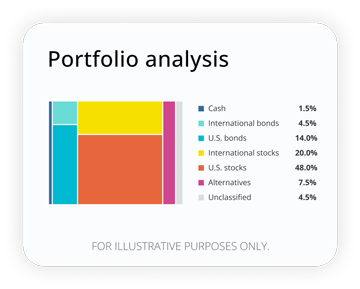
How well are your investments performing?
Analyze your portfolio in minutes and receive a target allocation for your goals.
1 Wall Street Journal, “Major U.S. Stock Indexes,” Accessed December 2025.
2 NASDAQ, “First Quarter 2025 Review & Outlook,” Accessed December 2025.
3 Yahoo Finance, “How major U.S. stock indexes fared Wednesday, 12/31/2025,” Dec. 31, 2025.
4 CNN, “Takeaways: Powell says the Fed has delivered enough rate cuts for now,” Dec. 10, 2025.
5 CNN, “The Fed just cut interest rates for the sixth time. Here’s why you’re not seeing much of a difference in your loans,” Dec. 10, 2025.
6 Ibid.
7 Realtor.com, “November 2025 Monthly Housing Market Trends Report,” Dec. 8, 2025.
8 Federal Reserve Bank of St. Louis, “Housing Affordability Index (Fixed),” Accessed December 2025.
9 Federal Reserve Bank of St. Louis, “Housing Affordability Index (Composite),” Accessed December 2025.
10 Realtor.com, “November 2025 Monthly Housing Market Trends Report,” Dec. 8, 2025.
11 Ibid.
12 NAHB, “Builder Sentiment Inches Higher but Ends the Year in Negative Territory,” Dec. 15, 2025.
13 Cox Automotive, “Auto Market Snapshot,” Dec. 18, 2025.
14 Ibid.
15 Edmunds, “$1,000 Car Payments Hit Record Highs,” Nov. 18, 2025.
16 Marketplace, “A record number of Americans are behind on their auto loans,” Nov. 12, 2025.
17 Federal Reserve Bank of New York, “Household Debt and Credit Report (Q3 2025),” Accessed December 2025.
18 Ibid.
19 Reuters, “U.S. consumer delinquency glass is half full,” Dec. 4, 2025.
20 Forbes, “What Is The Average Credit Card Interest Rate This Week?” Nov. 24, 2025.
21 Federal Student Aid, “Income-Driven Repayment Plans,” Accessed December 2025.
22 EY, “US M&A activity insights: October 2025,” Nov. 17, 2025.
23 Bain & Company, “Global M&A stages great rebound in 2025 with $4.8 trillion deal value to mark second-highest total on record,” Dec. 11, 2025.
24 Ibid.
*Dollar-cost averaging does not ensure a profit or protect against loss.
RO5094424-0126
 Get The Currency newsletter



The Currency editors
Staff contributors
The CurrencyTM writers and editors cover the latest financial news and insights shaping how we live, work, and play. The team provides accurate, data-driven, and timely content aimed at empowering financial freedom for all.
The content contained in this blog post is intended for general informational purposes only and is not meant to constitute legal, tax, accounting or investment advice. You should consult a qualified legal or tax professional regarding your specific situation. No part of this blog, nor the links contained therein is a solicitation or offer to sell securities. Compensation for freelance contributions not to exceed $1,250. Third-party data is obtained from sources believed to be reliable; however, Empower cannot guarantee the accuracy, timeliness, completeness or fitness of this data for any particular purpose. Third-party links are provided solely as a convenience and do not imply an affiliation, endorsement or approval by Empower of the contents on such third-party websites. This article is based on current events, research, and developments at the time of publication, which may change over time.
Certain sections of this blog may contain forward-looking statements that are based on our reasonable expectations, estimates, projections and assumptions. Past performance is not a guarantee of future return, nor is it indicative of future performance. Investing involves risk. The value of your investment will fluctuate and you may lose money.
Certified Financial Planner Board of Standards Inc. (CFP Board) owns the certification marks CFP®, CERTIFIED FINANCIAL PLANNER™, CFP® (with plaque design), and CFP® (with flame design) in the U.S., which it authorizes use of by individuals who successfully complete CFP Board's initial and ongoing certification requirements.