

How can I plan for taxes in retirement? Get a Sense Check
How can I plan for taxes in retirement? Get a Sense Check
In this edition of Sense Check, Empower’s Tony Johnson highlights some key topics to keep in mind for tax planning in retirement, including Social Security, 401(k) withdrawals, capital gains, and charitable giving.
How can I plan for taxes in retirement? Get a Sense Check
In this edition of Sense Check, Empower’s Tony Johnson highlights some key topics to keep in mind for tax planning in retirement, including Social Security, 401(k) withdrawals, capital gains, and charitable giving.

11.11.2025

Listen
·How can I plan for taxes in retirement? Get a Sense Check
Key takeaways:
Some Social Security benefits are taxable once income exceeds certain thresholds
Withdrawals from traditional 401(k)s and traditional IRAs are taxed as ordinary income and could affect tax brackets
Roth withdrawals are generally tax-free after age 59½ and five years from the time the account is opened
Qualified Charitable Distributions (QCDs) can reduce increases in taxable income from required minimum distributions
Coordinate RMDs, Medicare, and capital gains to avoid surprises at tax time
Planning for taxes in retirement means understanding how income sources are taxed — and how they interact. Most retirees will owe some tax on Social Security and withdrawals from traditional retirement accounts, while Roth income is generally tax-free. RMDs start at age 73 (age 73 if born 1951-1959, age 75 if born 1960 or later) and can affect both taxes and Medicare premiums. Strategic charitable giving and timing of withdrawals could help you manage your tax bill. Planning holistically could make a big difference.
Taxes don’t disappear when you retire — they just look different. Some income streams may taper off, while at the same time you may have new sources of income like Social Security, retirement accounts, and possibly investments or pensions, and each is taxed in its own way.
Social Security: What’s taxed and what’s changing
A portion of your Social Security income may be taxable, but not all of it — and unless it’s your only source of income, most people are going to pay some tax on Social Security. Once income reaches $25,000-$34,000 for individuals or $32,000-$44,000 for married couples, as much as 50% of your benefits become taxable, and above those thresholds, up to 85% can be taxed. Keep in mind, the Social Security benefit amount increases the longer you wait to collect, up until age 70, which can push income higher. And if you’re a high earner also collecting Social Security, your effective tax rate may increase too.
There’s also a temporary change to exemptions on the horizon. Based on the One Big Beautiful Bill Act, there’s a per person exemption of up to $6,000 (up to $12,000 for couples) from 2025 through 2028 — but the exemption phases out at higher incomes. So, if you are eligible for the exemption, you may pay less tax because your exemption will be higher. (Note: This exemption is additive to both the standard deduction and age 65+ benefit — so the maximum benefit is $31,500 + 1,600 + 1,600 + 6,000 + 6,000 = $46,700.)
Read more: Is Social Security income taxable?
What to expect from retirement account withdrawals
As a general rule of thumb, if you haven’t ever paid taxes on the money in a retirement account, you likely will when you withdraw it. And withdrawals from a traditional 401(k) or traditional IRA are taxed like wages — as ordinary income at rates that range from 10% to 37%.
Beginning at age 73 (or 75, see above), Required Minimum Distributions (RMDs) from certain tax-deferred retirement accounts are a mandatory withdrawal under IRS rules, and that income is taxable. Of course, withdrawals can be made before age 73 — but if you're under 59½ at the time of the withdrawal, you can also expect to pay a 10% early withdrawal penalty. There are some exceptions — like the “rule of 55,” which lets you tap a 401(k) early if you retire or leave a job at or after age 55, and the “72(t)” rule, which allows you to set up equal, scheduled withdrawals from an IRA before 59½ without penalties. In these cases, you’ll still be taxed on the ordinary income from withdrawals.
For Roth accounts, the story’s different: Because Roth contributions are made with after-tax money, the growth is generally tax-free when you withdraw the funds — assuming the account has been open for at least five years and you’re over age 59½.
Read more: 401(k) withdrawal rules: How to avoid penalties
How pensions and annuities are taxed in retirement
Whether pension or annuity payments are taxable depends on how they were funded. Basis is after-tax money that you contribute (your original investment, which may be tax free) If you didn’t contribute anything, then there's no basis. If there's no basis, the money will be fully taxable. If you have contributed some money, then you have some basis, and there’s a split on what is taxed and what is not — meaning the growth portion will be taxed. In most cases, both annuities and pensions are taxed as ordinary income rates, not capital gains rates. But there are also some government pensions that are exempt from any kind of taxation except at the state level.
Read more: What is an annuity & how does it work?
Capital gains rules still apply
The rules for capital gains don't change when you retire. However, because you may be earning less income, you could fall into a lower tax bracket — and potentially pay less tax as a result when you sell investments.
Short-term capital gains are taxed at the same rate ordinary income, while at the federal level long-term gains are taxed at 0%, 15%, or 20% brackets, depending on taxable income. People with income above a certain threshold ($250,000 married filing jointly, $200,000 individual) may also be subject to a 3.8% net investment income tax.1
As a reminder, capital gains don't apply to an IRA, Roth, or Health Savings Account (HSA). Those accounts grow tax-deferred or tax-free, depending on the type. Additionally, every state has their own specific rules for how capital gains are taxed.
Read more: Understanding long-term capital gains tax
Charitable giving in retirement: Bunching, DAFs, and QCDs
Charitable giving can be a powerful tax tool at any age — but the tax strategy may differ while working vs. in retirement. Pre-retirement, some people use an approach called “bunching, which essentially is grouping several years’ worth of charitable deductions into one year for optimal tax efficiency. Funding Donor-Advised Funds (DAFs) with charitable contributions and appreciated stock, especially with bunching strategies, are also common. DAFs are established for charitable purposes — contributions are made directly to the fund, and the money potentially grows tax-free, creating the possibility to give a larger gift. Blending bunching with a DAF strategy allows you to get the tax benefit in one year and spread out the giving over time (under certain circumstances, that also can potentially be beneficial to your chosen charity if they are reliant on donations for funding each year to be paid over time).
Once you reach age 70½, you have the option to give to charity by making qualified charitable distributions (QCDs) of up to $108,000 in 2025 (indexed to inflation). QCDs let you donate an RMD directly from an IRA to a qualifying charitable organization. To reap the tax benefit, the distribution must go directly to the charity, and the check must be processed before the end of the year. If those conditions aren’t met, you may be subject to a 25% penalty on the amount of the RMD.
Read more: Don’t need the RMD? Tax smart strategies for Required Minimum Distributions
Medicare premiums and seeing the whole picture
Keep in mind, RMDs may push your taxable income higher — and that can have ripple effects. Larger withdrawals may not only increase your tax bill, but they could also raise your Medicare premiums. The brackets for Medicare are firm, meaning even a small increase in income can move you into a higher premium tier. The same applies if you’re managing income under the Affordable Care Act. That’s why it’s important to look at your entire financial picture — ordinary income, capital gains, and healthcare impacts — before making big tax moves.
Read more: Tax 101: Understanding the basics
FAQs about tax planning for retirement
How much of my Social Security is taxable?
Between 50%-85% of your benefits may be taxable once income reaches ($25,000–$34,000 for individuals, $32,000–$44,000 for couples) or exceeds certain levels. Temporary exemptions of up to $6,000 per person (2025–2028) may apply under new legislation.
How are retirement account withdrawals taxed?
Withdrawals from traditional 401(k)s and IRAs are taxed as ordinary income. Early withdrawals before age 59½ may also face a 10% penalty unless an exception applies. Required Minimum Distributions (RMDs) from tax-deferred accounts generally begin at age 73 (or 75, see above) and are taxable in the year they’re taken.
Are Roth withdrawals tax-free?
Yes — if you’re over age 59½ and the account has been open for at least five years, both contributions and earnings can be withdrawn tax-free, and do not impact income for the tax year.
Can charitable giving reduce my taxes?
Potentially. If you’re 70½ or older, you can make Qualified Charitable Distributions (QCDs) directly from an IRA to a charitable organization. These donations can satisfy part or all of your RMD, reducing taxable income. Charitable donations can also reduce your tax liability if you itemize deductions.
This is not intended to be investment, fiduciary, financial, legal, or tax advice. Please consult with your investment advisor, attorney, and/or tax advisor as needed.
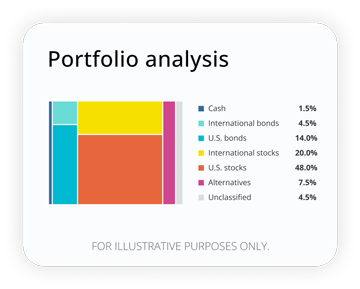
How well are your investments performing?
Analyze your portfolio in minutes and receive a target allocation for your goals.
1 Internal Revenue Service, “Topic no. 559, Net investment income tax,” October 9, 2025.
*This information is accurate as of date of publication.
RO4975648 -1125
 Get The Currency newsletter



Tony Johnson, CFP®, CMSA®, CPWA®, EA, ASBC®
Contributor
Tony Johnson is a Financial Planning Specialist at Empower. A Certified Financial Planner™, Capital Markets & Securities Analyst™ (CMSA), Certified Private Wealth Advisor®, Enrolled Agent, and Accredited Small Business Consultant®, he provides proactive, holistic guidance across a wide range of advanced planning topics.
The content contained in this blog post is intended for general informational purposes only and is not meant to constitute legal, tax, accounting or investment advice. You should consult a qualified legal or tax professional regarding your specific situation. No part of this blog, nor the links contained therein is a solicitation or offer to sell securities. Compensation for freelance contributions not to exceed $1,250. Third-party data is obtained from sources believed to be reliable; however, Empower cannot guarantee the accuracy, timeliness, completeness or fitness of this data for any particular purpose. Third-party links are provided solely as a convenience and do not imply an affiliation, endorsement or approval by Empower of the contents on such third-party websites. This article is based on current events, research, and developments at the time of publication, which may change over time.
Certain sections of this blog may contain forward-looking statements that are based on our reasonable expectations, estimates, projections and assumptions. Past performance is not a guarantee of future return, nor is it indicative of future performance. Investing involves risk. The value of your investment will fluctuate and you may lose money.
Certified Financial Planner Board of Standards Inc. (CFP Board) owns the certification marks CFP®, CERTIFIED FINANCIAL PLANNER™, CFP® (with plaque design), and CFP® (with flame design) in the U.S., which it authorizes use of by individuals who successfully complete CFP Board's initial and ongoing certification requirements.