

What is portfolio management?
What is portfolio management?
Portfolio management is the process of building and maintaining investments to match your risk tolerance and support your financial goals
What is portfolio management?
Portfolio management is the process of building and maintaining investments to match your risk tolerance and support your financial goals

10.01.2026
Key takeaway
- Portfolio management is the process of building, monitoring and adjusting investments to support your goals, time horizon, and risk tolerance.
- Portfolio managers are responsible for creating investment strategies, conducting market analysis, and rebalancing investor portfolios.
- Core principles of portfolio management include asset allocation, diversification, and rebalancing to keep investments aligned with your strategy.
Portfolio management is the ongoing process of selecting and adjusting investments to align with your goals, risk tolerance, and time horizon. Every investor has unique goals, such as saving for retirement or for a child's education. Good portfolio management is key to ensuring you're on the right track to meeting these goals.
Whether you choose to manage your own investments or hire a portfolio manager, it can help to understand what portfolio management is and how it works.
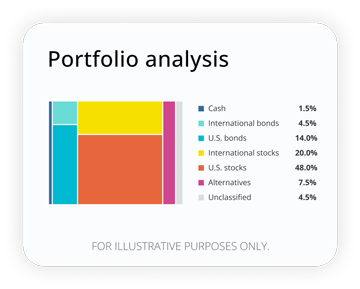
How well are your investments performing?
Analyze your portfolio in minutes and receive a target allocation for your goals.
What is portfolio management?
Portfolio management refers to the process of building and maintaining an investment portfolio to support your short-term and long-term financial goals. You can pick and choose the types of assets you'd like to invest in, either on your own or by hiring a professional portfolio manager. Over time, you can monitor how well your investments are performing and make adjustments as needed.
Most portfolios consist of stocks, bonds, and cash (or cash alternatives). Some investors prefer to hold individual stocks and bonds, while others choose mutual funds and ETFs. A portfolio can also include alternative assets, including real estate, cryptocurrency, gold, and more.
There’s no one-size-fits-all solution to portfolio management. Your investment strategy and financial goals generally guide the types of investment you buy, and the amount of time and effort required to manage them. Portfolio managers typically take one of two approaches: active or passive investing.
Active vs. passive portfolio management
Active and passive investment strategies offer investors different approaches to portfolio management:
- Active investing: A hands-on approach to choosing investments. Its goal is to outperform benchmarks — generally a broad market or market-segment stock and bond index. This often requires actively buying and selling investments, which requires significant management.
- Passive investing: Seeks to match the performance of a market index over time and generally involves less trading. Rather than trying to beat the stock market, you’re simply matching its returns. This usually involves investing in index funds, which are mutual funds or exchange-traded funds (ETFs) that track the performance of an underlying index, such as the S&P 500® Index.
Both types of investment strategies carry a level of risk. Active portfolio managers must make strategic calls and stay on top of market changes to be successful. Although less frequently, passive investment strategies also require making similar tactical shifts, making them subject to market volatility.
Read more: Active vs. passive investing: Key differences
What does a portfolio manager do?
A portfolio manager is someone who manages investment portfolios. While someone can technically be their own portfolio manager, the term usually refers to an advisory firm or a financial professional.
Professional portfolio managers are typically responsible for:
- Creating an investment strategy that supports your short-term and long-term financial goals and corresponds to your risk tolerance
- Conducting market analysis to understand what conditions and trends may impact your current and future investments
- Auditing and rebalancing your portfolio on a regular basis to ensure that it remains aligned with your investment strategy
Working with a professional portfolio manager or robo advisor has some key benefits. Not only does it free up the time you would have otherwise spent researching and managing your portfolio, but it also provides a level of knowledge and expertise.
How to get started managing your portfolio
Managing your own portfolio should start with identifying both your short-term and long-term financial goals. These might include big, long-term goals such as retirement, or short-term goals like your next vacation. They might also include mid-term goals like buying your dream home or paying for your child’s college education.
Once you've identified your goals, there are several key principles to consider as you choose your investments and manage your own portfolio.
Asset location
Your portfolio asset location refers to where you hold your investments. There are generally two types of accounts:
- Taxable account: An investment account, such as a brokerage account, where you can buy and sell investment. With taxable accounts, you’ll pay taxes on annual investment income.
- Tax-advantaged account: Similar to a traditional 401(k) plan or individual retirement account (IRA), where you invest with pre-tax dollars and don’t pay taxes on your earnings until you pull them out of the account.
When you’re planning your investment strategy, your asset location can have major tax implications. Assets that generate significant income might be better off in your tax-advantaged account, while more tax-efficient investments might be best for your taxable account.
Asset allocation
Investment portfolios are typically distributed across various asset categories, including stocks, bonds, cash, and alternative investments. Generally speaking, the higher the potential reward of an investment, the higher the risk. How you divide your portfolio depends on your investment goals and risk tolerance, which may fluctuate throughout your life and as you near retirement.
Diversification
Having a diverse portfolio can help mitigate investment risk by dividing your asset allocation across different asset classes and individual assets. This way, the performance of a single company or industry generally has less of an impact on your overall portfolio returns. Assets can be distributed across asset categories, companies, industries, and geographic regions.
Rebalancing
Rebalancing your portfolio involves buying and selling investments to maintain your desired asset allocation. Investment performance and market fluctuations can cause your asset allocation to deviate from your goals and risk tolerance. Different rebalancing strategies help counteract these deviations while allowing you to adjust your investments as you transition from growing your assets to preserving your nest egg.
Some people rebalance their portfolios when their portfolio deviates by a certain amount. Meanwhile, others rebalance at specific intervals, such as once or twice per year.
Tax minimization
Taxes can erode a significant portion of your investment returns, especially in a taxable brokerage account. When choosing your investments, you can use several strategies to minimize your tax liability, including:
- Being strategic with your asset location
- Investing in tax-efficient investments
- Offsetting investment gains with losses
The bottom line
Portfolio management is an important part of every investment strategy. If you have investments, whether you manage them yourself or work with a professional, you’re engaging in portfolio management. It’s important to take a strategic approach to ensure that your portfolio is best suited to help you reach your financial goals while minimizing your risk and tax liability.
Active strategies may involve higher fees and trading costs and may underperform their benchmark. Passive strategies are subject to the risks of the index they track and may not respond to changing market conditions. Both involve market risk and potential loss of principal.
Asset allocation, diversification, and rebalancing do not ensure a profit or protect against loss.
Investing involves risk, including possible loss of principal.
The S&P 500 Index is a registered trademark of Standard & Poor’s Financial Services LLC. It is an unmanaged index considered indicative of the domestic large-cap equity market and is used as a proxy for the stock market in general.
RO5977548-0926
 Get The Currency newsletter



Alex Graesser, CFP®, ChFC®
Contributor
Alex Graesser is a Senior Financial Professional at Empower. A Certified Financial Planner (CFP®) professional and Chartered Financial Consultant (ChFC®), he is responsible for developing enduring relationships with his clients by providing expert guidance for a lifetime of financial security.
The content contained in this blog post is intended for general informational purposes only and is not meant to constitute legal, tax, accounting or investment advice. You should consult a qualified legal or tax professional regarding your specific situation. No part of this blog, nor the links contained therein is a solicitation or offer to sell securities. Compensation for freelance contributions not to exceed $1,250. Third-party data is obtained from sources believed to be reliable; however, Empower cannot guarantee the accuracy, timeliness, completeness or fitness of this data for any particular purpose. Third-party links are provided solely as a convenience and do not imply an affiliation, endorsement or approval by Empower of the contents on such third-party websites. This article is based on current events, research, and developments at the time of publication, which may change over time.
Certain sections of this blog may contain forward-looking statements that are based on our reasonable expectations, estimates, projections and assumptions. Past performance is not a guarantee of future return, nor is it indicative of future performance. Investing involves risk. The value of your investment will fluctuate and you may lose money.
Certified Financial Planner Board of Standards Inc. (CFP Board) owns the certification marks CFP®, CERTIFIED FINANCIAL PLANNER™, CFP® (with plaque design), and CFP® (with flame design) in the U.S., which it authorizes use of by individuals who successfully complete CFP Board's initial and ongoing certification requirements.