

How crypto investments affect tax returns
How crypto investments affect tax returns
A new IRS tax form, the 1099-DA, will change how cryptocurrency transactions are reported, expanding paperwork for investors and businesses
How crypto investments affect tax returns
A new IRS tax form, the 1099-DA, will change how cryptocurrency transactions are reported, expanding paperwork for investors and businesses

01.14.2026
Key takeaways
Digital asset brokers must send the Form 1099-DA by Feb. 16, 2026.
Each crypto sale, trade, or payment can trigger its own form, or they can be combined, depending on the situation and the broker.
Transactions from crypto ETFs are still reported using Form 1099-B.
Crypto investors could have more paperwork to keep an eye on, with a new tax form on the scene for the 2025 tax year: Form 1099-DA.1 People who buy, sell, or trade cryptocurrency will receive a copy from their digital asset brokers by Feb. 16, 2026, in order to accurately file their 2025 tax return.2 The form also applies to businesses that accept crypto as payment. Transactions that include exchanging one digital asset for another are also eligible to be covered by one of these forms.
A 2025 Empower study found that more than a fifth of Americans (21%) hold investments in cryptocurrencies. This represents an uptick from just 4.3% of U.S. households owning crypto in 2022, based on the Federal Reserve’s Survey of Consumer Finances.3
Older Americans are showing the highest adoption of alternative assets across generations: Baby Boomers hold a median of $19,057.77 of alternative investments — which can include cryptocurrencies — followed by Gen Xers with a median of $13,871.90, according to Empower Personal DashboardTM data.
What does form 1099-DA cover?
Similar to how the IRS requires reporting of investment sales (like stocks) using Form 1099-B, Form 1099-DA now documents proceeds from cryptocurrencies, applying to both short- and long-term gains and losses.4 In the eyes of the government, crypto is treated as property rather than a currency, so the process is similar to that of stocks; crypto is still subject to capital gains laws, which can affect your overall tax liability.
Read more: Ways to avoid or minimize capital gains tax
Each crypto transaction will be reported on a separate Form 1099-DA, so investors could receive multiple during the tax filing season. For transactions made in 2025, brokers have the choice whether to report basis information (purchase price plus expenses such as commissions) for sales of digital assets. For sales made starting in 2026 and beyond, reporting is required for gross proceeds and basis information.5
Some of the different fields on Form 1099-DA cover:6
The number of digital assets sold or exchanged
Original date that assets were acquired, though it could be blank if the multiple dates apply or if the date is unknown
Sale/disposition date
Total proceeds from the transaction
Whether the digital asset sold was a noncovered security, qualified stablecoin, or specified non-fungible token (NFT)
It’s important to ensure that any 1099-DA forms are included in your paperwork, whether you’re preparing the return yourself or enlisting the help of a tax professional before April 15. The IRS received 163,594,000 individual income tax returns in 2025.
Read more: When are taxes due? Deadlines for the 2026 filing season
What about crypto ETFs?
If you hold crypto ETFs, you may not see the new form this year, as sales of and proceeds from those securities are still covered by a Form 1099-B received from a broker.7
The expansion of crypto ETFs in recent years can appeal to investors who want to add crypto to their portfolio without having to manage digital wallets or exchanges. As the new Form 1099-DA shows, crypto sales can trigger taxable events, and investing in an ETF instead could give investors more favorable tax treatment while still gaining exposure to the space.
Read more: Spotlight on Bitcoin ETFs
Interest in crypto could be climbing as prices have cooled over the past quarter and ETFs have made participation more accessible: American spot Bitcoin ETFs started the first full trading week of the 2026 with around $697 million in net inflows on just Jan. 5 alone.8
Crypto landscape in 2026
Bitcoin — the world’s largest cryptocurrency — started 2026 up around 3.4% for the year, hovering around $90,500 as of Jan. 8. The second-largest crypto, Ethereum, was up around 5% so far in 2026. Digital investments like crypto can be affected by lower borrowing costs across the economy, since investors could see them as more attractive compared to lower-yield choices.9 Upcoming interest-rate decisions from the Federal Reserve in late January could put more attention on the crypto market.
Payment provider Stripe announced its first crypto partnership in early January, in which customers can pay for goods and services using crypto assets at merchants using Stripe as their processor. Americans get the first taste of the service this month before it expands to other countries.10 The ability to pay with crypto has been available for PayPal merchants and customers since summer 2025.11
If consumers use more crypto for day-to-day transactions, they’ll have to monitor their usage and be aware of possible tax implications. Younger Americans are more likely to fall into this group, as 34% of Gen Z use cryptocurrencies, according to Empower research. Gaining comfort with crypto by using it in early adulthood may translate into becoming an investor; a separate Empower study reveals that 40% of Americans say they began investing in their 20s.
Sign of the crypto times
With the launch of Form 1099-DA this year, crypto transactions will be more visible as investors prepare at tax time — though keeping tabs on crypto is also important throughout the year. The free Empower Personal Dashboard can track Bitcoin and other cryptocurrency holdings across providers, combined with other accounts to provide a full financial picture.
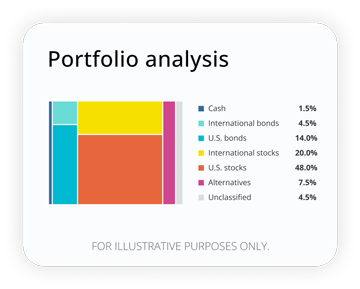
How well are your investments performing?
Analyze your portfolio in minutes and receive a target allocation for your goals.
1 IRS, “Instructions for Form 1099-DA (2025),” accessed January 2026.
2 CNN Business, “Invest in crypto? Here’s what to know about your 2025 taxes,” November 2025.
3 Federal Reserve Bank of St. Louis, “Cryptocurrency Ownership among U.S. Households,” March 2025.
4 IRS, “About Form 1099-B, Proceeds from Broker and Barter Exchange Transactions,” accessed January 2026.
5 IRS, “Instructions for Form 1099-DA (2025),” accessed January 2026.
6 IRS, “2025 Form 1099-DA,” accessed January 2025.
7 CNN Business, “Invest in crypto? Here’s what to know about your 2025 taxes,” November 2025.
8 CryptoNews via Yahoo Finance, “Bitcoin ETFs Absorb $697M in Largest Single-Day Inflow Since October,” January 2026.
9 Barron’s, “Bitcoin Price Falls. Cryptos Are Fizzling Again.” January 2026.
10 Yahoo Finance, “Stripe users can now pay with crypto through new Crypto.com partnership,” January 2026.
11 PayPal, “PayPal Drives Crypto Payments into the Mainstream, Reducing Costs and Expanding Global Commerce,” July 2025.
RO5116931-0126
 Get The Currency newsletter



The Currency editors
Staff contributors
The CurrencyTM writers and editors cover the latest financial news and insights shaping how we live, work, and play. The team provides accurate, data-driven, and timely content aimed at empowering financial freedom for all.
The content contained in this blog post is intended for general informational purposes only and is not meant to constitute legal, tax, accounting or investment advice. You should consult a qualified legal or tax professional regarding your specific situation. No part of this blog, nor the links contained therein is a solicitation or offer to sell securities. Compensation for freelance contributions not to exceed $1,250. Third-party data is obtained from sources believed to be reliable; however, Empower cannot guarantee the accuracy, timeliness, completeness or fitness of this data for any particular purpose. Third-party links are provided solely as a convenience and do not imply an affiliation, endorsement or approval by Empower of the contents on such third-party websites. This article is based on current events, research, and developments at the time of publication, which may change over time.
Certain sections of this blog may contain forward-looking statements that are based on our reasonable expectations, estimates, projections and assumptions. Past performance is not a guarantee of future return, nor is it indicative of future performance. Investing involves risk. The value of your investment will fluctuate and you may lose money.
Certified Financial Planner Board of Standards Inc. (CFP Board) owns the certification marks CFP®, CERTIFIED FINANCIAL PLANNER™, CFP® (with plaque design), and CFP® (with flame design) in the U.S., which it authorizes use of by individuals who successfully complete CFP Board's initial and ongoing certification requirements.