

Should you combine 401(k) accounts? 5 potential benefits of consolidation
Should you combine 401(k) accounts? 5 potential benefits of consolidation
You can have more control, save time, and could even lower fees by consolidating your 401(k) accounts
Should you combine 401(k) accounts? 5 potential benefits of consolidation
You can have more control, save time, and could even lower fees by consolidating your 401(k) accounts

03.26.2026
Key takeaways
- Consolidating 401(k) accounts can make it easier to manage your investments and keep track of your overall financial picture.
- Combining accounts may help reduce fees, simplify tax reporting, and streamline required minimum distributions (RMDs).
- Many investors choose to consolidate old 401(k)s into an IRA for greater flexibility, more investment options, and access to advice.
Managing multiple investment accounts across different financial institutions can come with challenges, including keeping track of your overall financial picture, staying on top of taxes and strategies, and navigating different rules and fees. Over time, you may accumulate several 401(k) accounts as you change jobs, particularly if you’re not sure what happens to your 401(k) when you leave. Consolidating 401(k) accounts can help simplify how you manage your money.
Carefully consider all your options, including tax implications, fees, and expenses, before moving money between accounts. Assess all features of current accounts before moving money.
What does it mean to consolidate a 401(k)?
Consolidating a 401(k) means combining one or more old workplace retirement accounts into a single account. While you may be eligible to leave your savings in a former employer’s 401(k) plan, you may also be able to roll over the 401(k) funds into their new plan or complete an individual retirement account (IRA) rollover. This process is often referred to as combining or consolidating 401(k) accounts into one account.
5 potential benefits of consolidating 401(k) accounts
Here are five benefits that can come from consolidating or combining your retirement accounts.
1. A clearer view of your retirement savings
Bringing your accounts together can be a helpful first step to get a clearer view of your finances, including whether your investments are diversified, whether you are maintaining your target asset allocation, and whether you’re on track with retirement savings goals.
Read more: Average asset allocation by age
2. Easier portfolio management
When you have multiple accounts across different financial institutions, it can be difficult to maintain a consistent investment strategy. With fewer accounts, it can be easier to rebalance your portfolio, avoid overlapping investments, and stay aligned with your risk tolerance. It can also make it easier to think through tax optimization strategies, such as how investments may be taxed over time and when to realize losses.
3. Potentially lower fees
In some cases, consolidating 401(k)s and other retirement accounts can help reduce fees by cutting down on multiple account charges, potentially lowering investment costs, and avoiding overlapping fees. One account with a larger balance may also qualify for lower fees or better pricing, depending on the provider. This may not apply when consolidating into an employer-sponsored plan, where fees are set by the plan.
4. Simplified required minimum distributions (RMDs)
Certain retirement accounts like 401(k)s and traditional IRAs require the account holder to take RMDs at age 73. At the same time, it’s important for people nearing or entering retirement to determine a sustainable withdrawal rate to help ensure their retirement savings last for their lifetime. With fewer accounts, it may be easier to evaluate and implement your withdrawal strategy to ensure you are meeting IRS rules and making effective decisions. RMDs are not required for Roth IRAs.
5. Less administrative hassle
The more accounts you have, the more logins, passwords, and administrative tasks there are to remember. By consolidating 401(k) accounts, you can take care of tasks like managing beneficiaries, reconciling balances, and updating account information in one place. Plus, it can also make tax time simpler, with fewer forms to review and include on your tax return.
Read more: How to roll over a 401(k)
Why investors may consider consolidating into an IRA
Rolling over a 401(k) into an IRA is a common choice. In fact, about 62% of traditional IRA–owning households have rollover assets from employer-sponsored retirement plans.1 Be sure to compare accounts fees, as IRAs can have higher fees that employer plans.
More investment choices and control
IRAs often offer a wider range of investment choices than workplace plans, which typically limit you to a pre-selected menu of funds, unless there is a brokerage option. This added flexibility can make it easier to build a portfolio that aligns with your goals. IRA investment choices may include stocks, bonds, mutual funds, ETFs, index funds, and in some cases, certificates of deposit.*
Tax advantages
When you roll over your 401(k) into an IRA, your money remains invested on a tax-advantaged basis, meaning you won't pay taxes at the time of a direct rollover. You have exactly 60 days from the day you receive a distribution of retirement money to deposit it into another eligible retirement account like an IRA in order to preserve its tax-advantaged status.
Potentially greater flexibility and access to advice
Consolidating your retirement savings into one account can provide access to a range of investments and can make it easier to work with a financial advisor to build a more personalized strategy. In some cases, having a higher balance in a single account may provide access to a broader range of services, tools, or support, depending on the provider. Many investors who choose to roll over their 401(k) take a full approach — one study found that 86% rolled over their entire account balance in their most recent rollover.2
Should you combine 401(k) accounts?
Whether you should combine your 401(k) accounts depends on your situation. Consolidating can make it easier to manage your investments, reduce fees, and stay aligned with your goals. However, it may make sense to keep your savings in a current plan in some cases. Be sure to compare all of your options carefully.
If you’re ready to move your savings, learn how to roll over a 401(k) and consolidate your accounts step by step.
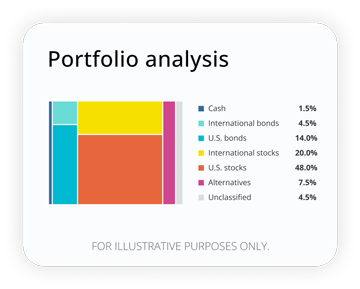
How well are your investments performing?
Analyze your portfolio in minutes and receive a target allocation for your goals.
* Exchange-traded funds (ETFs) are a type of exchange-traded investment product that must register as either an open-end investment company (generally known as “funds”) or a unit investment trust. ETFs are not mutual funds.
Unlike with mutual funds, individual shares of ETFs are not redeemable directly with the issuer. ETF shares are a collection of securities bought and sold at market price, which may be higher or lower than the net asset value. Investment returns will vary based on market conditions and volatility, so an investor’s shares, when redeemed or sold, may be worth more or less than their original cost. ETFs are subject to risks, including those of their underlying securities.
1 ICI Research Perspective, “The Role of IRAs in US Households’ Saving for Retirement, 2023,” February 2024.
2 Ibid.
RO5338895-0326
 Get The Currency newsletter


The Currency editors
Staff contributors
The CurrencyTM writers and editors cover the latest financial news and insights shaping how we live, work, and play. The team provides accurate, data-driven, and timely content aimed at empowering financial freedom for all.
The content contained in this blog post is intended for general informational purposes only and is not meant to constitute legal, tax, accounting or investment advice. You should consult a qualified legal or tax professional regarding your specific situation. No part of this blog, nor the links contained therein is a solicitation or offer to sell securities. Compensation for freelance contributions not to exceed $1,250. Third-party data is obtained from sources believed to be reliable; however, Empower cannot guarantee the accuracy, timeliness, completeness or fitness of this data for any particular purpose. Third-party links are provided solely as a convenience and do not imply an affiliation, endorsement or approval by Empower of the contents on such third-party websites. This article is based on current events, research, and developments at the time of publication, which may change over time.
Certain sections of this blog may contain forward-looking statements that are based on our reasonable expectations, estimates, projections and assumptions. Past performance is not a guarantee of future return, nor is it indicative of future performance. Investing involves risk. The value of your investment will fluctuate and you may lose money.
Certified Financial Planner Board of Standards Inc. (CFP Board) owns the certification marks CFP®, CERTIFIED FINANCIAL PLANNER™, CFP® (with plaque design), and CFP® (with flame design) in the U.S., which it authorizes use of by individuals who successfully complete CFP Board's initial and ongoing certification requirements.