

SIMPLE IRA: Understanding the benefits & basics
SIMPLE IRA: What It Is, How It Works, and 2026 Limits
A SIMPLE IRA gives small businesses a tax-advantaged way to offer retirement savings. Learn how it works, including 2026 limits and employer contributions
SIMPLE IRA: What It Is, How It Works, and 2026 Limits
A SIMPLE IRA gives small businesses a tax-advantaged way to offer retirement savings. Learn how it works, including 2026 limits and employer contributions

06.23.2026
Key takeaways
- SIMPLE IRAs are an option for self-employed individuals and small businesses (generally 100 or fewer employees) with no other retirement plan.
- Employers make tax-deductible contributions to employee plans, and employees can contribute up to $17,000 ($21,000 if older than age 50) in 2026.
- Pre-tax contributions grow tax-deferred, with lower limits than SEP or Solo 401(k) plans.
- There are restrictions on early withdrawals and rollovers within the first two years of participation.
Saving for retirement can become a bit more challenging when you’re self-employed. You typically don't have access to the employer sponsored 401(k) plans that come standard with most large companies. Instead, you’re often required to determine your own plan for retirement.
The federal government has retirement savings tools to help self-employed individuals have more options for retirement savings. One of these tools is the Savings Incentive Match Plan for Employees IRA, known most succinctly as the SIMPLE IRA.
Here’s how SIMPLE IRAs work, including 2026 contribution limits and withdrawal rules, tax advantages, and how they compare with SEP IRAs and 401(k)s.
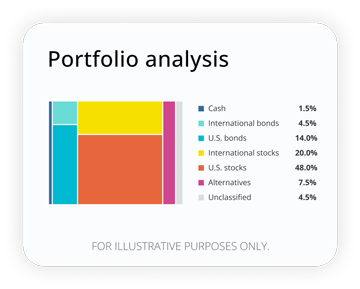
How well are your investments performing?
Analyze your portfolio in minutes and receive a target allocation for your goals.
What is a SIMPLE IRA?
A SIMPLE IRA is a retirement plan for small businesses and self-employed individuals that lets eligible employees contribute part of their pay to an IRA while the employer makes required contributions. SIMPLE IRA plans are generally available to employers with 100 or fewer employees and no other retirement plan.1
These plans are designed to be easy to set up and maintain, offering small businesses a cost-effective way to provide retirement benefits. SIMPLE IRAs include mandatory employer contributions through either matching or non-elective contributions, making them appealing for business owners and employees who want tax-advantaged savings for retirement.2
Who is eligible for a SIMPLE IRA plan?
As a business, to be eligible to establish a SIMPLE IRA you must:
- Have no more than 100 employees
- Not offer any other retirement plan, such as a 401(k), SEP IRA, or solo 401(k)
As a small-business employee, to be eligible to participate in a SIMPLE IRA you must:
- Have earned at least $5,000 during any two years before the current year3
- Expect to earn at least $5,000 during the current year
Employers may establish less restrictive eligibility requirements, but not more restrictive ones.4 For example, an employer could eliminate all compensation requirements for a SIMPLE IRA, but couldn’t limit eligibility to employees earning at least $10,000 in the current year.
How does a SIMPLE IRA work?
SIMPLE IRAs work similarly to other employer-sponsored retirement plans where employees can make pre-tax contributions to their accounts. Since contributions are pre-tax, they may help reduce a participant’s taxable income and tax burden each year they participate. Taxes are not due until funds are withdrawn in retirement.
Note: SIMPLE IRAs can only accept pre-tax contributions. The 2022 SECURE 2.0 Act introduced the option for SIMPLE Roth IRAs, which allow for after-tax contributions but must be allowed by the employer.
Required employer contributions
SIMPLE IRAs differ from other workplace retirement plans in an important way: Employers are required to contribute to their employees’ retirement accounts, either in the form of a matching or non-elective contribution.5 Here’s what those options look like:
- Matching contribution of up to 3% of an employee’s compensation
- Non-elective contribution of 2% of an employee’s compensation
These employer contributions may serve as an effective tool for attracting and retaining employees. Often, small businesses struggle to attract skilled employees because they can’t offer the benefits programs that larger companies can.6 The employer contributions offered under a SIMPLE IRA may help small business owners address this challenge.
2026 SIMPLE IRA contribution limits
As with other retirement plans, SIMPLE IRAs have a limit on how much employees and business owners can contribute. Employees can generally contribute up to $17,000 to their SIMPLE IRA in 2026, up from $16,500 for 2025.7 For companies with 25 or fewer employees, the limit is $18,100. There’s also a catch-up contribution allowed for employees aged 50 or more of $4,000 in 2026, up from $3,500 for 2025.8 For employees ages 60 to 63, the catch-up contribution amount is $5,250.
The contribution limits for SIMPLE IRAs are considerably lower than for other retirement plans. Although this type of plan can be a good option if you have employees and you want to contribute a small amount to their retirement, it may not necessarily be the best plan for business owners to save for their own retirement.
Read more: SIMPLE IRA contribution limits in 2026
SIMPLE IRA withdrawal rules and penalties
The IRS sets restrictions on when the money can be accessed without penalty. The money in a SIMPLE IRA is designed to remain in the account until the participant turns 59 ½. If you withdraw money earlier, you’ll be subject to a 10% early withdrawal penalty — and that’s on top of the regular income taxes you’ll owe.9 If you withdraw in the first two years of participation, you’ll incur a 25% penalty instead of the standard 10%.
SIMPLE IRA rollovers
You can rollover your SIMPLE IRA funds into another SIMPLE IRA account without restrictions when you leave your job. You can also roll the funds over into a retirement account other than a SIMPLE IRA, but only after two years of plan participation.10 Consider all your options and their features and fees before moving money between accounts.
Read more: SIMPLE IRA rollovers and withdrawals: 3 things advisors should know
Benefits of a SIMPLE IRA
SIMPLE IRAs come with several key benefits, including straightforward eligibility requirements, immediate vesting of employer contributions, and tax advantages for both employers and employees.
Benefits for employers
- Lower start-up and operating costs: SIMPLE IRAs have lower startup and ongoing costs than 401(k) plans, which can reduce the financial burden for small businesses.9
- Tax deduction for employer contributions: As an employer, your business will get a tax deduction for the money you contribute to your employees’ SIMPLE IRA accounts.12
- Easy implementation: SIMPLE IRAs have a streamlined administrative process that makes them more accessible to small businesses with limited resources.13
Benefits for employees
- Employer contributions: Employees may receive an employer contribution of either 2% or 3%, depending on the employee’s deferral.14
- Elective salary reduction: As with other workplace retirement plans, employees can have money taken from their paychecks to go into their retirement accounts.
- Tax-deferred contributions and growth: SIMPLE IRA contributions are pre-tax, and any growth is tax-deferred until the money is withdrawn from the account.15
- Inclusive eligibility requirements: SIMPLE IRAs have basic eligibility criteria, meaning most employees will usually qualify, and employers may be able to adjust these criteria even further.16
- Immediate vesting of employer contributions: All employer contributions are 100% vested for employees, which isn’t always the case with all workplace retirement plans.17
- Diverse investment choices: A SIMPLE IRA can be invested in a wide variety of securities, and each employee can direct their own investments.
Drawbacks of a SIMPLE IRA
Despite their advantages, SIMPLE IRAs also have some important drawbacks that must be considered before establishing or participating in.
- Lower contribution limits: SIMPLE IRAs have considerably lower contribution limits than other options for self-employed people, such as 401(k)s or SEP IRAs.18
- Participant loan restrictions: Unlike 401(k) plans, participants cannot borrow against their account balance with SIMPLE IRAs.19
- Tax penalties for early withdrawals: There’s an early withdrawal penalty of 10% for distributions before 59 ½, and 25% for distributions taken in the first two years of participation.20
- Rollover restrictions: SIMPLE IRAs are eligible for rollovers to other non-SIMPLE IRA accounts, but only after two years of participation in the plan. SIMPLE Roth IRAs are not transfer-eligible to qualified plans.21
SIMPLE IRA vs. other retirement plans
A SIMPLE IRA is one of a handful of retirement accounts available to self-employed individuals and small businesses. Sole proprietorships and other businesses with less than two employees may be able to establish a SIMPLE IRA plan, but there may be other options — such as a Simplified Employee Pension (SEP) or Solo 401(k) — that better fit their needs.22,23
SIMPLE IRA vs. Solo 401(k)
A solo 401(k) — also called the one-participant 401(k) — is a retirement plan available to self-employed individuals with no employees other than themselves and a spouse. A solo 401(k) is nearly identical to a regular 401(k) in terms of contribution limits and other rules.
The solo 401(k) may be a compelling option for business owners seeking higher contribution limits. Employees may contribute $24,500 in 2026. Those ages 50-59 can make an additional catch-up contribution of up to $8,000 and those ages 60-63 can make a catch-up contribution of up to $11,250. The employer can also contribute to the plan, with a total maximum contribution of $72,000 in 2026.
SIMPLE IRA vs. SEP IRA
A Simplified Employee Pension (SEP) IRA is a retirement plan designed for self-employed individuals with or without employees. In 2026, employers can contribute up to the lesser of $72,000 or 25% of compensation per eligible employee.
A SEP IRA is unique in that employees can’t contribute on their own behalf — only the business can contribute. And though the employer can decide for themselves how much to contribute each year, they must contribute the same percentage of compensation for each person. For example, if a business owner wants to contribute 25% for themselves, they must also contribute 25% for any employees they have.
SIMPLE IRA vs. Traditional IRA
A traditional IRA isn’t an employer-sponsored retirement plan, nor is it specifically designed for self-employed individuals. These IRAs can still be used by them, however.
A traditional IRA allows anyone with earned income to contribute up to $7,500 in 2026, with an additional $1,100 catch-up contribution available for those age 50 or above. Depending on the individual’s income and whether they have a retirement plan through an employer, the contributions may or may not be tax-deductible.
It’s worth noting that a traditional IRA can be used alongside another workplace retirement plan, and the contributions limits are entirely separate. If you have a SIMPLE IRA and max out your contributions, you can still max out contributions on a traditional or Roth IRA.
Read more: What is a traditional IRA and how does it work?
SIMPLE IRA vs. Roth IRA
A Roth IRA is similar to a traditional IRA but with a different tax advantage. Rather than having tax-deductible contributions, all Roth contributions are after-tax, meaning there’s no upfront tax benefit. However, your contributions typically offer tax-free growth potential in your account and qualified withdrawals are tax-free during retirement. Since your contributions were made with after-tax dollars, they can be withdrawn at any time.
Roth IRAs have the same contribution limits as traditional IRAs — $7,500 in 2026. Roth and traditional IRAs have a combined contribution limit, meaning if you contribute $7,500 to a traditional IRA, you can’t also contribute to a Roth IRA, and vice versa. You may split your contributions between the two, however.
Roth IRAs have income restrictions. If your income is above $168,000 as a single filer (or head of household); $252,000 if you file jointly; or $10,000 for married filing separately and lived with spouse, you are not currently able to use a Roth IRA.
A Roth IRA could be a useful tool to use alongside a SIMPLE IRA, since you would invest both pre- and after-tax dollars for retirement this way.
Read more: Roth 401(k) vs. Roth IRA
Is a SIMPLE IRA the right choice for you?
A SIMPLE IRA could be a good option for small business owners who want to save for their retirement while helping their employees do the same. It has advantages that include simple administration and low costs.
SIMPLE IRAs may not be right for everyone. Compared to other self-employed retirement accounts, SIMPLE IRAs have relatively low contribution limits. If you are a business owner with no employees, you might find a solo 401(k) or SEP IRA preferable to help to contribute large amounts to your retirement account.
If you’re an employee who has been offered a SIMPLE IRA through your employer, it may be worth participating. If your employer offers a matching contribution, you may want to contribute enough to take full advantage if your budget allows. And since you can use a SIMPLE IRA alongside other retirement accounts, you don’t necessarily have to choose only one.
Read more: Retirement savings: The saver’s credit
The bottom line
A SIMPLE IRA is one of several options that self-employed individuals can use to save for retirement. Whether it’s the right choice for you depends on your income, the number of employees you have, and more.
If you’re a business owner and are considering setting up a SIMPLE IRA for your business, consider consulting a financial or tax professional to help you determine whether a SIMPLE IRA is your best option or whether it’s worth considering something else, such as a solo 401(k) or a SEP IRA.
FAQs about SIMPLE IRA plans
What is the difference between a 401(k) and a SIMPLE IRA?
There are several differences between a 401(k) and a SIMPLE IRA. 401(k)s have considerably higher contribution limits. They also allow employers to contribute far more than a SIMPLE IRA does. However, 401(k)s may be more expensive and difficult to administer.
What are the disadvantages of a SIMPLE IRA?
The disadvantages of a SIMPLE IRA include their low contribution limits, which are lower than SEP and Solo 401(k) plans. Other downsides include restrictions on plan loans and early withdrawal penalties.
How much should I contribute to my SIMPLE IRA?
If you’re an employee, it’s worth contributing at least enough to your SIMPLE IRA to get your full employer match. If a SIMPLE IRA is your only retirement account, it’s wise to contribute as much as your budget will allow to help you invest for a more comfortable retirement.
1 Internal Revenue Service, “SIMPLE IRA plan,” August 26, 2025.
2 Internal Revenue Service, SIMPLE IRA plan FAQs,” November 16, 2025.
3 Internal Revenue Service, “SIMPLE IRA plan,” August 26, 2025.
4 Ibid.
5 U.S. Department of Labor, “SIMPLE IRA Plans for Small Businesses,” accessed February 2026.
6 Pew, “Reports Highlight Challenges Small Businesses Face in Offering Retirement Benefits,” July 2024.
7 Internal Revenue Service, “401(k) limit increases to $24,500 for 2026, IRA limit increases to $7,500,” November 13, 2025.
8 Ibid.
9 Internal Revenue Service, “SIMPLE IRA withdrawal and transfer rules,” November 16, 2025.
10 U.S. Department of Labor, “SIMPLE IRA Plans for Small Businesses,” accessed February 2026.
11 5 U.S. Department of Labor, “SIMPLE IRA Plans for Small Businesses,” accessed February 2026.
12 Ibid.
13 Ibid.
14 Internal Revenue Service, “SIMPLE IRA plan,” August 26, 2025.
15 Ibid.
16 Internal Revenue Service, “SIMPLE IRA plan FAQs,” November 16, 2025.
17 Department of Labor, “Simple IRA Plans for Small Businesses,” Accessed December 2024
18 Internal Revenue Service, “Retirement topics - SIMPLE IRA contribution limits,” August 26, 2025.
19 Internal Revenue Service, “Retirement plans FAQs regarding loans,” August 26, 2025.
20 Internal Revenue Service, “SIMPLE IRA withdrawal and transfer rules,” November 16, 2025.
21 Ibid.
22 Internal Revenue Service, “Simplified Employee Pension plan (SEP),” August 26, 2025. 2024
23 Internal Revenue Service, “One-participant 401(k) plans,” August 26, 2025.
RO5594291-0626
Glossary Definition
A SIMPLE IRA — short for Savings Incentive Match Plan for Employees IRA — is a retirement plan designed for small business owners and their employees to save for retirement.
Glossary Label
Simple IRA
 Be current.



The Currency editors
Staff contributors
The CurrencyTM writers and editors cover the latest financial news and insights shaping how we live, work, and play. The team provides accurate, data-driven, and timely content aimed at empowering financial freedom for all.
The content contained in this blog post is intended for general informational purposes only and is not meant to constitute legal, tax, accounting or investment advice. You should consult a qualified legal or tax professional regarding your specific situation. No part of this blog, nor the links contained therein is a solicitation or offer to sell securities. Compensation for freelance contributions not to exceed $1,250. Third-party data is obtained from sources believed to be reliable; however, Empower cannot guarantee the accuracy, timeliness, completeness or fitness of this data for any particular purpose. Third-party links are provided solely as a convenience and do not imply an affiliation, endorsement or approval by Empower of the contents on such third-party websites. This article is based on current events, research, and developments at the time of publication, which may change over time.
Certain sections of this blog may contain forward-looking statements that are based on our reasonable expectations, estimates, projections and assumptions. Past performance is not a guarantee of future return, nor is it indicative of future performance. Investing involves risk. The value of your investment will fluctuate and you may lose money.
Certified Financial Planner Board of Standards Inc. (CFP Board) owns the certification marks CFP®, CERTIFIED FINANCIAL PLANNER™, CFP® (with plaque design), and CFP® (with flame design) in the U.S., which it authorizes use of by individuals who successfully complete CFP Board's initial and ongoing certification requirements.