

What should I consider when picking my 401(k) investments? Get a Sense Check
What should I consider when picking my 401(k) investments? Get a Sense Check
In this edition of Sense Check, Empower’s Ryan Deakins explains how to pick 401(k) investments, breaking down strategy, fund options, and contribution approaches.
What should I consider when picking my 401(k) investments? Get a Sense Check
In this edition of Sense Check, Empower’s Ryan Deakins explains how to pick 401(k) investments, breaking down strategy, fund options, and contribution approaches.

09.18.2025

Listen
·What should I consider when picking my 401(k) investments? Get a Sense Check
Key takeaways
- Mutual funds are some of the most common investment types offered in a 401(k), giving investors access to dozens or even hundreds of securities.
- It’s generally recommended to contribute enough to your 401(k) account to get the full company match if available – investors who don’t do this could be leaving “free” money on the table.
- As with any investment, the first step is to know what your goals are and the level of risk you’re comfortable with.
Read on if you’re choosing your 401(k) investments for the first time or simply need a refresher on things to consider when selecting the investments in your 401(k).
Getting started with 401(k) investments often raises the same question: What am I supposed to pick? Faced with a long list of stock funds, bond funds, and target-date options, many people default to asking a friend or scrolling for ideas.
The reality is, there isn’t a single “right” answer. What matters is putting a disciplined plan in place. It’s not about trying to time the market or chase the hottest fund. It’s about knowing who you are, what you want, and then building an investment strategy around that.
The framework is simple: Know the options, set a strategy, stay disciplined, and make the most of employer benefits.
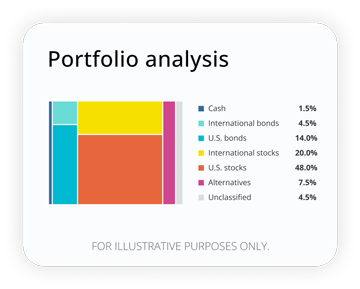
How well are your investments performing?
Analyze your portfolio in minutes and receive a target allocation for your goals.
401(k) investment options explained
Some of the most common investments in a 401(k) are mutual funds. These funds pool money from many investors and spread it across dozens or even hundreds of securities. In many plans, mutual funds make up the core menu, though some may also offer access to exchange-traded funds (ETFs).
Read more: How do I invest in mutual funds?
Within the standard fund lineup, options generally fall into a few main categories:
- Stock funds: These invest in companies of different sizes and geographies.
- Large-cap funds focus on larger established U.S. companies.
- Mid- and small-cap funds hold smaller firms with higher growth potential but more volatility.
- International funds provide exposure to markets outside the U.S.
- Value funds target companies considered undervalued relative to their fundamentals, often emphasizing stability and dividends. They can complement growth-oriented stock funds as part of a diversified mix.
- Growth funds typically invest in companies whose earnings are being reinvested to expand the business, rather than paid out as dividends. These funds aim for share price increases over time, which can mean more ups and downs compared with value funds.
- Bond funds: These invest in fixed-income securities such as government or corporate bonds. They tend to fluctuate less than stocks and are often used to help add stability to a portfolio, especially for investors approaching retirement.
- Target-date funds: These prepackaged portfolios automatically adjust the mix of stocks and bonds as the selected retirement year approaches — a process known as the glide path, where allocations gradually shift toward more conservative holdings. Target-date funds can be a convenient solution, though it’s worth checking how the glide path matches individual goals.
- Company stock: Some plans allow investment directly in employer shares. While this can feel rewarding, it can also create concentrated risk — both job security and retirement savings may be tied to the same company.
One of the guiding principles is diversification. Each of these fund types plays a different role and combining them spreads risk more effectively than relying on a single type of investment. Think of the options as tools in a toolbox: The real strength comes from how they’re used together.
401(k) investment strategy: goals and risk tolerance
Goals
The first thing to figure out is the “why.” Why invest in a 401(k) in the first place? It could be long-term retirement income, today’s tax benefits, or just knowing there’s a disciplined savings habit in place. Whatever the reason, the “why” sets the direction for everything else.
Risk tolerance
The next step is risk tolerance. That simply means how much market volatility you can handle without walking away from the plan. The risk–reward balance should line up with the “why,” and the key is to discipline that habit over time.
Time horizon
Age and time horizon play a big role. An aggressive 25-year-old can ride through periods when the market drops 50% or more. The risk level isn’t going to change much because there’s plenty of time to recover. But someone who is 50 and just starting to contribute to a 401(k) may need to bring risk down every few years, because there’s less time to make up losses.
Life changes
Life events change the picture, too. Getting married, having kids, or earning a higher income can all shift goals and call for a fresh look at the portfolio. Building checkpoints along the way makes sure the plan still fits.
Read more: Average 401(k) balance by age
How to consider 401(k) investments that fit your plan
Back to your 401(k) investment options. Once goals and risk tolerance are clear, the next step is to decide how to use the mix of stock funds, bond funds, target-date funds, and other choices available in your plan.
For someone just starting out, a target-date fund can be a straightforward option because it automatically adjusts over time. Those who prefer more control might combine large-cap, mid-cap, small-cap, and international stock funds with bond funds to create a diversified mix. Investors with a higher tolerance for risk may lean more heavily on equities, while those closer to retirement often shift toward bonds or more conservative allocations.
The anchor through all of this is discipline. Make it about habit, not about chasing performance or comparing results. A strategy that holds steady through both calm and volatile markets is the one that works over time.
Maximizing 401(k) contributions
One of the most important 401(k) strategies is also the simplest: Contribute enough to get the full employer match. A company match is part of your compensation package and leaving it on the table is essentially giving back part of a paycheck.
Read more: What is 401(k) matching and how does it work?
Tax advantages are another key benefit of a 401(k) plan. Contributing on a pre-tax basis reduces taxable income today, while investment growth potentially compounds over time without immediate tax drag. For higher earners, that combination of current-year savings and long-term growth potential can be especially powerful.
Building consistency with 401(k) contributions
Increasing contributions gradually makes the process even more effective. Many plans allow automatic escalation, raising contributions by 1% each year. Because raises often outpace that increase, most people hardly notice the difference in take-home pay, while retirement savings increase.
A 401(k) also builds in discipline by making saving automatic. Even if day-to-day spending varies, contributions continue in the background, helping to ensure consistent progress. That structure means thousands of dollars can be invested each year without having to actively think about it.
Read more: What percentage should I contribute to my 401(k)?
FAQs about 401(k) investments
Should I pick a target-date fund or build my own mix?
Target-date funds may be a good option for new investors or those looking for a hands-off approach, but building a mix allows more control for seasoned investors.
How often should I rebalance my portfolio?
Generally, you should consider reviewing and potentially rebalancing your portfolio at least once a year, after significant life changes, or your financial goals change.
What’s the biggest mistake people make when it comes to 401(k) investments?
The biggest mistake people often make when it comes to investing is making reactionary decisions due to market downturns or chasing last year’s winning areas instead of sticking to their plan.
Investing involves risk, including possible loss of principal.
Asset allocation, diversification, or rebalancing does not ensure a profit or protect against loss.
RO4828288 -0925
 Get The Currency newsletter



Ryan Deakins
Contributor
Ryan Deakins is a Senior Financial Professional at Empower. He provides proactive, holistic financial guidance across a wide range of topics including investment management, financial planning, and more.
The content contained in this blog post is intended for general informational purposes only and is not meant to constitute legal, tax, accounting or investment advice. You should consult a qualified legal or tax professional regarding your specific situation. No part of this blog, nor the links contained therein is a solicitation or offer to sell securities. Compensation for freelance contributions not to exceed $1,250. Third-party data is obtained from sources believed to be reliable; however, Empower cannot guarantee the accuracy, timeliness, completeness or fitness of this data for any particular purpose. Third-party links are provided solely as a convenience and do not imply an affiliation, endorsement or approval by Empower of the contents on such third-party websites. This article is based on current events, research, and developments at the time of publication, which may change over time.
Certain sections of this blog may contain forward-looking statements that are based on our reasonable expectations, estimates, projections and assumptions. Past performance is not a guarantee of future return, nor is it indicative of future performance. Investing involves risk. The value of your investment will fluctuate and you may lose money.
Certified Financial Planner Board of Standards Inc. (CFP Board) owns the certification marks CFP®, CERTIFIED FINANCIAL PLANNER™, CFP® (with plaque design), and CFP® (with flame design) in the U.S., which it authorizes use of by individuals who successfully complete CFP Board's initial and ongoing certification requirements.