

Don’t need the RMD? Tax-smart strategies for Required Minimum Distributions
Don’t need the RMD? Tax-smart strategies for Required Minimum Distributions
Having a plan for RMDs can help minimize tax burden and position loved ones to receive potential future benefits
Don’t need the RMD? Tax-smart strategies for Required Minimum Distributions
Having a plan for RMDs can help minimize tax burden and position loved ones to receive potential future benefits

07.31.2025

Listen
·Don’t need the RMD? Tax-smart strategies for Required Minimum Distributions
Key takeaways
RMDs from certain pre-tax retirement accounts are mandatory starting at age 73
Qualified Charitable Distributions can reduce taxable income from RMDs, and IRA owners can transfer up to $100,000 to charity each year tax-free
Unplanned medical expenses are common in retirement years, but 37% of Americans say they can’t afford a $400 emergency expense
Required Minimum Distributions (RMDs) can come with some tax implications, but there are options to help ease the tax burden for those who don't have an immediate need for the surplus cash.
As the name suggests, RMDs are a mandatory withdrawal: Under IRS rules, owners of certain tax-deferred retirement accounts must withdraw a minimum amount of money each year beginning at age 73. The amount of an RMD varies by individual, with the calculation based on the balance of the account on December 31 of the prior year and a life expectancy factor established by the IRS.1
What about those who are in a financial position where they don’t need their RMDs for living expenses or otherwise? Whether retirees or beneficiaries of inherited retirement accounts receiving RMDs — the requirement holds regardless of need, or what’s happening in the market. And since some or all of a RMD may be considered taxable income, the distribution could even end up pushing an account holder into a different tax bracket.
With that in mind, those who don’t need their RMDs can consider several options for using the funds that can be tax-efficient — and potentially could outpace inflation and support overall financial goals.
Read more: Required minimum distributions: The deal on RMDs
Donate to charity with an RMD
Qualified Charitable Distributions (QCDs) can be a great way to reduce the taxable income from RMDs and fulfill philanthropic goals at the same time.
The IRS allows IRA owners to transfer up to $100,000 to charity annually tax-free, beginning at age 70 ½ — and donations to an eligible charitable organization can count towards the account owner’s RMD requirement once they reach age 73.2 However, to ensure the RMD remains tax-free, the QCD must be paid directly from the IRA to the charity (if an account holder receives the RMD and then uses it to make a donation, it’s no longer considered a QCD). Since the gift is not taxable for the receiving charity either, QCDs may even enable IRA owners to give more to their favorite causes than they otherwise could through cash or other asset donations. There is no need to itemize deductions on income tax returns in order to take QCDs, but for the tax break, QCDs need to be reported.3
Read more: Retirement income strategies: Get the most out of your retirement
Fund a 529 plan with an RMD
Investing unneeded distributions in a college savings account for a loved one could create a favorable tax scenario for them in the future. While the initial RMD is considered taxable income for the account holder, proceeds that are contributed to a 529 plan and the subsequent growth of those funds may be shielded from taxes, providing withdrawals are for qualified educational expenses. And with the sweeping rule changes to 529 programs included in the Big Beautiful Bill Act, these plans may give education savers more flexibility than ever to spend on a range of costs, from college and K-12 tuition to books and test fees.
Read more: The big changes to 529s in the 2025 spending bill
Purchase life insurance with an RMD
Using unneeded RMDs to buy life insurance can help create wealth for heirs. The RMD itself is taxable to the account holder, as with the 529 option, but redirecting the after-tax funds to purchase and pay premiums on an insurance policy can be a tax-efficient strategy for transferring wealth to beneficiaries. In some cases, the return on an insurance policy might result in a larger inheritance than if the funds were in other types of investments. Proceeds from life insurance typically are paid as a lump-sum benefit, and generally are not considered taxable income for the beneficiary.4
Read more: Term life vs. whole life insurance: What's the difference?
Build up emergency savings
Earmarking surplus cash from RMDs to cover emergencies can be a good way to help ensure these outlays don’t derail retirement budgets. It’s not unusual for unplanned medical bills and health-related expenses to arise during golden years, yet more than 1 in 5 (21%) Americans do not have money set aside for unexpected financial events and almost 2 in 5 (37%) say they can’t afford an emergency expense over $400.
Read more: Health insurance for early retirees: 8 options to consider when retiring before 65
Convert RMDs to a Roth
While the IRS does not allow RMDs to be converted to Roth IRAs, proactively converting funds from a tax-exempt account to a Roth IRA beginning at age 59½ may be an option to help get ahead of future tax hits when the time comes to take RMDs. Since taxes are paid up front with Roth accounts, taxable income will increase for the year of the conversion, but future Roth earnings will not be taxable. There are contribution limits to keep in mind when taking advantage of this type of account.
Read more: In-plan Roth conversion: How it works, benefits, taxes
Reinvest RMDs
RMDs can also be reinvested in non-retirement vehicles such as stocks that generate dividends, ETFs, bonds. and mutual funds, or even real estate investments. While these types of investments generally generate taxable income, the flipside is that they can offer liquidity, potential for ongoing growth, and greater flexibility and control over when to withdraw funds for optimal tax-efficiency. Tax rates for these investments may differ too.
Ultimately, deciding what to do with unneeded RMDs depends on individual circumstances — but having a well-planned withdrawal strategy in place that includes any of these options may help to avoid triggering unwanted tax implications.
Read more: ETFs & mutual funds: Comparing your options
FAQs
What is an RMD?
The IRS requires that when you reach age 73 you begin withdrawing a minimum amount of money from certain tax-advantaged retirement plans each year. These are known as Required Minimum Distributions (RMDs).
Do I have to pay taxes on an RMD?
Yes, pre-tax amounts withdrawn to satisfy the RMD requirements are taxable income. However, RMDs donated directly to charity as Qualified Charitable Distributions (QCDs) can be tax-free as long as they are paid directly from the retirement account to the charity and they are reported properly on the account owner’s tax returns.
Do I have to take an RMD?
Yes, RMDs are mandatory, regardless of need, for both owners of certain retirement accounts and beneficiaries of inherited retirement accounts receiving RMDs.
Can I roll over RMDs to a Roth IRA?
No, you can’t directly roll over RMDs to a Roth IRA. However, the proceeds from RMDs can be contributed to a Roth IRA (subject to Roth IRA contribution limits), and future earnings in the Roth will not be taxable.
What can I do with my RMD?
If you do not need your RMD to cover the costs of daily living, or it's not earmarked for another expense, RMDs can be used in several tax-efficient ways. For example, making charitable donations through QCDs can reduce your taxable income, while investing in a 529 plan or insurance can be a tax-smart strategy for your beneficiaries.
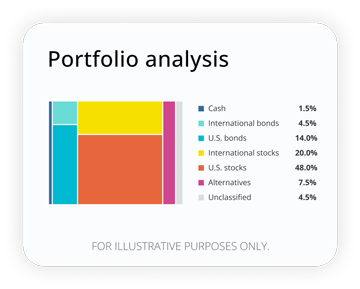
How well are your investments performing?
Analyze your portfolio in minutes and receive a target allocation for your goals.
1 Internal Revenue Service, “Distributions from Individual Retirement Arrangements (IRAs),” March 20, 2025.
2 Internal Revenue Service, “Qualified charitable distributions allow eligible IRA owners up to $100,000 in tax-free gifts to charity,” May 29, 2025.
3 Ibid.
4 Internal Revenue Service, “Life insurance & disability insurance proceeds,” February 7, 2025.
RO4708003-0725
 Get The Currency newsletter



The Currency editors
Staff contributors
The CurrencyTM writers and editors cover the latest financial news and insights shaping how we live, work, and play. The team provides accurate, data-driven, and timely content aimed at empowering financial freedom for all.
The content contained in this blog post is intended for general informational purposes only and is not meant to constitute legal, tax, accounting or investment advice. You should consult a qualified legal or tax professional regarding your specific situation. No part of this blog, nor the links contained therein is a solicitation or offer to sell securities. Compensation for freelance contributions not to exceed $1,250. Third-party data is obtained from sources believed to be reliable; however, Empower cannot guarantee the accuracy, timeliness, completeness or fitness of this data for any particular purpose. Third-party links are provided solely as a convenience and do not imply an affiliation, endorsement or approval by Empower of the contents on such third-party websites. This article is based on current events, research, and developments at the time of publication, which may change over time.
Certain sections of this blog may contain forward-looking statements that are based on our reasonable expectations, estimates, projections and assumptions. Past performance is not a guarantee of future return, nor is it indicative of future performance. Investing involves risk. The value of your investment will fluctuate and you may lose money.
Certified Financial Planner Board of Standards Inc. (CFP Board) owns the certification marks CFP®, CERTIFIED FINANCIAL PLANNER™, CFP® (with plaque design), and CFP® (with flame design) in the U.S., which it authorizes use of by individuals who successfully complete CFP Board's initial and ongoing certification requirements.