

Getting started with finances living on your own
Getting started with finances living on your own
Living alone comes with more financial responsibility. From housing and utilities to groceries and furnishings, a realistic budget can help make solo living more manageable.
Getting started with finances living on your own
Living alone comes with more financial responsibility. From housing and utilities to groceries and furnishings, a realistic budget can help make solo living more manageable.

06.02.2026
Key takeaways
- Not being able to split costs can be a big transition for those coming from shared homes.
- Creating a budget for daily essentials can help track spending.
- Waiting on nonessential purchases can provide flexibility while adjusting to new monthly expenses.
Getting your first place without roommates or family can be a satisfying milestone, but also a balancing act when it comes to your finances.
Nearly 30% of American households had only one person as of 2024. Top metro areas for solo living included St. Louis, Cleveland, Atlanta, and Washington D.C.1
With 59% of Gen Z Americans planning to move in 2026, that number could grow. Getting a good system in place can make the transition to solo living easier for you and your money.
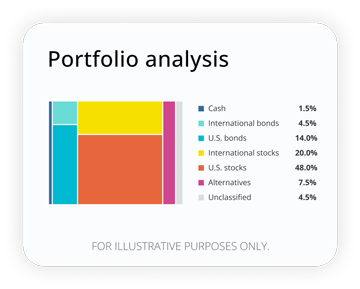
How well are your investments performing?
Analyze your portfolio in minutes and receive a target allocation for your goals.
Understand the true cost of housing
One of the biggest changes with living on your own is paying for all the household costs yourself instead of splitting them with others.
Prioritize rent or mortgage payments
Make sure you know when your housing payments are due and what you can do to avoid additional fees (such as for late payments or bank overdrafts). Checking your lease or mortgage documents can help, and you should know how to contact your landlord or financial institution with more questions.
Making on-time, in-full payments can also help build your credit score, which become increasingly important in your finances should you apply for financing like a car loan, student loan, or mortgage.
Read more: What is the average credit score? See how you compare
Stay smart about utilities
Another aspect of solo living is absorbing the cost of all the essential services at home. The U.S. has seen a surge in the price of electricity recently, with an 8.5% year-over-year bump expected for this summer compared to 2025.
Whether you rent or own your place, you can identify some basic improvements yourself, which could help reduce overall energy usage:2
- Lighting: Energy used for lights makes up around 10% of your power bill. Consider swapping older bulbs and fixtures with light-emitting diodes (LEDs), and installing smart bulbs or dimmer switches to more easily adjust lighting needs.
- Heating and cooling: Beating the heat and cold can be a year-round battle depending on where you live, and household HVAC systems can cost an average of $7,500 to replace. Keeping up with periodic maintenance for filters, fans and other components could avoid pricier bills down the line.3
- Air leaks: Keep the temperature steady (and get more value from heating and cooling costs) by identifying and sealing any places where air may be leaking in or out of your home. Weatherstripping or caulk can be low-cost ways to seal up leaks.
It’s costing more to stay online in today’s connected world. Internet service is 2.3% more expensive than last year, with people paying an average of $78 a month for access.4,5 Checking with providers to see if you can bundle internet with other services like cable TV or wireless phone service could help reduce overall costs and keep bills consolidated.
Set a budget for groceries and essential spending
Beyond the fixed expenses of housing and utilities, creating a budget can help you visualize and better understand day-to-day spending. While you won’t be sharing groceries with roommates or family, you’ll be the only one paying for them.
The 50-30-20 budget is a popular percentage-based system, though you could also target fixed amounts (a flat $300 on groceries, for example) if that’s easier to get started. It’s important to establish a baseline budget and try staying within those limits for a couple of months, and then adjust accordingly if needed.
Transportation is another key factor when living on your own. Depending on where your new place is, you may have more public transit or biking options that can reduce transportation costs. On the other hand, you may find yourself driving more and needing to purchase a vehicle, which could increase your expenses.
Getting spending notifications from credit card providers, banks, and others can help you keep track of how well you’re sticking within your budget — and protect against potential fraudulent transactions not made by you. Reminders about upcoming payments for existing loans should also be included.
Empower’s free budget calculator can show how your overall spending power is impacted when adjusting individual costs.
Pause on the extras (for a bit)
The excitement of living on your own shouldn’t overshadow the reality of your finances, so you should give your budget time to breathe (and your wallet a break).
You may need to get some basic pieces to furnish your home, whether it’s a bigger bed or a couch that makes better use of your space. Set aside some funds in your budget for these as part of your move-in costs, though use caution on additional décor.
Furniture prices have seen some relief, now rising slower than overall inflation. A new neighborhood could present opportunities for deals such as local garage sales, thrifting, or social media listings nearby, potentially saving on furniture transportation costs. Finding pre-owned dishes and flatware in good condition could be a saving move compared to buying brand-new ones, which have seen a 15.4% price bump since last year.
You can hit pause on big TVs or other major electronics purchases as you settle into your place and see how your home routine develops. Someone who enjoys streaming on a laptop in bed may not need to splurge on a new living room TV, while others who end up hosting guests could need more gadgets for entertaining.
Getting the keys to financial independence
Having a place of your own can be an important step toward being financially independent. To set up a resilient budget, give yourself a few months of solo living to build confidence in your finances and spending boundaries. Taking time to establish financial stability and holding off on discretionary spending can pay off in the long run.
1 The New York Times, “More People Are Living Alone. Here’s Where They’re Doing It.” March 2026.
2 U.S. Department of Energy, “Do-It-Yourself Home Energy Assessments,” accessed May 2026.
3 Angi, “How Much Does HVAC Replacement Cost? [2026 Data],” accessed May 2026.
4 U.S. Bureau of Labor Statistics, “Table 2. Consumer Price Index for All Urban Consumers (CPI-U): U.S. city average, by detailed expenditure category, April 2026,” accessed May 2026.
5 CNET, “Americans Are Paying $78 Monthly for Internet on Average: Here’s What to Do if Your Bill Is Too High,” July 2025.
RO5540903-0526
 Get The Currency newsletter

The Currency editors
Staff contributors
The CurrencyTM writers and editors cover the latest financial news and insights shaping how we live, work, and play. The team provides accurate, data-driven, and timely content aimed at empowering financial freedom for all.
The content contained in this blog post is intended for general informational purposes only and is not meant to constitute legal, tax, accounting or investment advice. You should consult a qualified legal or tax professional regarding your specific situation. No part of this blog, nor the links contained therein is a solicitation or offer to sell securities. Compensation for freelance contributions not to exceed $1,250. Third-party data is obtained from sources believed to be reliable; however, Empower cannot guarantee the accuracy, timeliness, completeness or fitness of this data for any particular purpose. Third-party links are provided solely as a convenience and do not imply an affiliation, endorsement or approval by Empower of the contents on such third-party websites. This article is based on current events, research, and developments at the time of publication, which may change over time.
Certain sections of this blog may contain forward-looking statements that are based on our reasonable expectations, estimates, projections and assumptions. Past performance is not a guarantee of future return, nor is it indicative of future performance. Investing involves risk. The value of your investment will fluctuate and you may lose money.
Certified Financial Planner Board of Standards Inc. (CFP Board) owns the certification marks CFP®, CERTIFIED FINANCIAL PLANNER™, CFP® (with plaque design), and CFP® (with flame design) in the U.S., which it authorizes use of by individuals who successfully complete CFP Board's initial and ongoing certification requirements.