

Custodial Roth IRA: Planning for your child’s future
Learn how parents can save a child’s earned income with flexible withdrawals and the potential for growth and long-term compounding
Custodial Roth IRA: Planning for your child’s future
Learn how parents can save a child’s earned income with flexible withdrawals and the potential for growth and long-term compounding

01.21.2026
Key takeaways
- A custodial Roth IRA allows after-tax contributions for a child, with the potential for investment growth and qualified withdrawals that are tax-free**
- Eligibility is based on the child’s income, not the custodian’s
- Contributions can be withdrawn at any time without taxes or penalties, offering flexibility beyond traditional retirement accounts
- Starting early can amplify long-term compounding, potentially supporting education, homeownership, or retirement decades later.
A custodial Roth IRA is a retirement account opened by an adult for a minor who has earned income. Contributions are tax deferred and can be withdrawn without penalties, while any earnings follow Roth IRA rules. Starting contributions early can support long-term wealth building and financial education.
When people have children, they often immediately start thinking of how they can set those children up for financial success.
Whether you’re saving for your child’s college education or simply building them a nest egg for the future, starting early is key. It’s also important to choose the right account, and with so many options available, from savings accounts to UTMA/UGMA accounts and more, it can be challenging to decide on the best option.
One option to help you save for your child’s future is a custodial Roth IRA. This account offers the ability to save for your child’s future, but with greater tax benefits than many other accounts offer. Keep reading to learn more about custodial Roth IRAs and how you can use one to prepare for your child’s future.
What is a custodial Roth IRA?
A custodial Roth IRA combines two beneficial types of accounts: custodial accounts and Roth IRAs.
A custodial account is one that an adult — typically a parent or grandparent — creates on behalf of a minor child. Each deposit into the account is an irrevocable gift to the child.1 While the child is still a minor, the custodian controls the account and manages the investments in the best interests of the child.
Once the child reaches the age of majority — typically age 18, but 21 in some states — they can take control of the account. At that point, the beneficiary of the account can use it for any purpose.2
A Roth IRA is a specific type of retirement account. It allows investors to make after-tax retirement contributions and then enjoy tax-free growth potential and withdrawals.
A custodial Roth IRA offers plenty of benefits, including tax-free investment growth potential and the ability to spend the money for nearly any purpose, including paying for higher education or saving it for retirement.
Read more: How parents are teaching kids about money
Benefits of a custodial Roth IRA
Custodial Roth IRAs have several important benefits that may make them a great choice for parents who want to save for their child’s future.
Tax advantages
Roth IRAs have some major tax advantages. As we’ve mentioned, contributions to a Roth IRA are made after taxes. Although there’s no tax benefit on the front end, you can get one after the fact. In other words, you can withdraw the funds tax-free later on. Additionally, any growth in the account can be tax-free — there are no taxes on capital gains, dividends, interest, or any other earnings with a qualified withdrawal.
These tax benefits can save your child a lot of money later on. Imagine you use a custodial Roth IRA to save for your child’s future and manage to grow it to $100,000. Using a Roth IRA, your child gets to keep that full $100,000. But with another type of account, they could lose thousands to taxes.
Long-term wealth building
Starting to save for your child while they’re young allows you to take advantage of compound interest that will have an incredible impact on their long-term wealth.
Suppose your child starts saving for retirement at the age of 25, saving $250 per month for 40 years. Assuming a 5% annual return, they could potentially save more than $364,000. But what if you started saving $250 per month for them earlier — let’s say starting at age 15? That extra decade of compound earnings could result in savings of about $630,000, almost double in this hypothetical scenario.* The longer the money has to compound, the more exponential the growth can be.
Read more: How to help your kids build wealth
Financial education and responsibility
When it comes to financial education, there’s a lot you can do as a parent. Opening a custodial Roth IRA for your child can help you teach them about financial responsibility. You can teach them the importance of putting some of their money into savings. Additionally, you can teach them how investing works and the power of compound interest.
Read more: Why it's important to talk about money with your kids
Gift and inheritance planning
A custodial Roth IRA can help you with gift and inheritance planning in a couple of different ways.
First, contributing to a custodial account for your child allows you to start passing down some of your money when they’re young rather than waiting for them to receive an inheritance when you pass away. After all, the money is likely more beneficial to them earlier in life, when they have little money and some major expenses, rather than later in life, when they’ve probably had a chance to grow a nest egg of their own.
Contributing to a custodial Roth IRA can also help you manage your gift and estate tax liabilities. The IRS imposes taxes on gifts and estates above and beyond a certain dollar amount.3,4 By gifting your child some money each year, you may reduce the risk of having to pay gift or estate taxes later on.
Contributions can be withdrawn at any time
Unlike many tax-advantaged retirement accounts, you can access the money in a Roth IRA early. Though any investment earnings will still be subject to withdrawal rules, the original contributions can be withdrawn at any time tax-free and penalty-free.
In a perfect world, we might never have to withdraw money from our retirement accounts early. But a custodial Roth IRA presents a unique opportunity to save for your child in a tax-advantaged way while allowing them to use the money for short-term goals. Additionally, even if your child doesn’t choose to access the money for earlier expenses, they could have that cash available in case of an emergency.
The money can be used for more than retirement
As mentioned, contributions in a Roth IRA can be withdrawn at any time tax-free or penalty-free. As a result, your child can use the money for more than just retirement. They can access those contributions at any time to pay for large goals, such as going to college, buying a home, starting a business, or traveling the world.
There are also some exceptions to the restrictions on Roth IRA earnings withdrawals. For example, your child can withdraw up to $10,000 of earnings to buy a home with no taxes or penalties.5 They can also use their earnings to pay for higher education without any early withdrawal penalties (though they’ll be subject to income taxes).6
Custodial Roth IRA rules
If you’re considering opening a custodial Roth IRA for your child, there are a few rules to consider to help you maximize the tax benefits and avoid penalties.
Eligibility criteria
To be eligible to contribute to a Roth IRA, the account owner or beneficiary must have earned income, but that income can’t exceed a certain limit.
Custodial Roth IRA eligibility is based on your child’s income, not yours. For you to open and contribute to a custodial Roth IRA on behalf of your child, your child must have earned income of their own, either from a job or another source.
There’s also an income limit for Roth IRA contributions. In 2026, a single person can’t contribute to a Roth IRA if they earn more than $168,000. However, given your child’s minor status, it’s unlikely that would be the case.
Contribution limits
The most you can contribute to a custodial Roth IRA in 2026 is the lesser of 100% of your child’s earned income or $7,500 (up from $7,000 in 2025).
That income can come from sources such as:7
- Wages
- Salaries
- Commissions
- Tips
- Bonuses
- Self-employment
For example, if your child earns $4,000 at a part-time job, that’s the maximum you can contribute to their Roth IRA. You won’t be able to take advantage of the full $7,000 contribution limit.
Read more: Roth IRA contribution and income limits for 2025 and 2026
Withdrawal rules
We’ve already mentioned that Roth IRA contributions can be withdrawn at any time without taxes or penalties. But that doesn’t apply to Roth IRA earnings. To make tax-free and penalty-free withdrawals of Roth IRA earnings, you must meet the following requirements:
- It’s been at least five years since the year of your first Roth IRA contribution
- One of the following situations applies:
- You’ve reached age 59½
- You’re disabled
- You’re the beneficiary of a Roth IRA, and the account owner has passed away
- You’re withdrawing up to $10,000 for the purchase of a first home.
Assuming none of these are true for your child, any withdrawals of Roth IRA earnings will be subject to income taxes, as well as a 10% early withdrawal penalty.
The role of the custodian
A custodial Roth IRA is unique in that the person who will benefit from the account isn’t the person who owns it. Because you must be at least 18 years old to open an investment account, a child requires an adult to open one on their behalf. In this case, that adult is known as the custodian.8
As long as you’re the custodian of your child’s custodial Roth IRA, you’re tasked with managing the account and directing the investments in the best interests of the child. But just because you manage the account doesn’t mean you have access to those funds. The money in your child’s custodial Roth IRA belongs to them.
Transition to full ownership
Once your child reaches the age of majority in your state, they’ll take control of their own Roth IRA. The good news is your child could then learn to manage their own investments and can access the money in a responsible way to pay for financial goals and expenses.
On the other hand, your child has total access to the money, and there’s no requirement that they use the money responsibly. You may want to prepare your child for the responsibility of controlling a large sum of money by instilling financial education early and often.
Setting up a custodial Roth IRA
Setting up a custodial Roth IRA is a relatively easy process. Here’s a step-by-step guide:
- Make sure your child has income: Your child must have earned income for you to contribute to a Roth IRA on their behalf. Make sure your child reaches this requirement before you open an account and start contributing.
- Choose an investment firm: There are many firms that offer custodial Roth IRAs. Research your options to find the best fit. It may be easiest to use the same firm that holds your own investment accounts.
- Open your account: To open your child’s custodial Roth IRA, you’ll have to provide information about both your child and the custodian, including Social Security numbers, names and contact information, birthdates, and more.
- Fund the account: Once the account is open, you can start making contributions. You can set up automatic contributions to ensure consistency or wait until the end of the year so you know the maximum you can contribute based on your child’s income.
- Maintain detailed records: Make sure to maintain detailed records throughout the year, especially if your child doesn’t file their own tax returns. You’ll want detailed records of their earned income, as well as documentation related to the account.
Maximizing the benefits
As a custodian, there are plenty of things you can do to maximize the benefits of a custodial Roth IRA to set your child up financially for the future.
Make regular contributions
Consistency is key when it comes to long-term investing. If you’re contributing to your child’s custodial Roth IRA, consider setting up recurring automatic contributions to ensure they happen each month. You can also encourage your child to make regular contributions from their own income.
Just remember that contributions to the account can’t exceed your child’s earned income for the year. Reassess income and contributions regularly to ensure you aren’t over-contributing.
Selecting investments
As the custodian, it’s your responsibility to choose investments within the custodial Roth IRA. Aim for a well-diversified portfolio that has opportunities for both growth and risk management. The goal is long-term growth, not quick wins.
Additionally, consider involving your child in some of the investment selection. Though mutual funds and exchange-traded funds can be one way to build a diversified portfolio, you may consider purchasing a few individual stocks for companies that interest or excite your child to help get them interested in investing.
As your child gets older, you can open the line of communication even more about what investments are in their Roth IRA and why.
Read more: How do I invest in mutual funds? Get a Sense Check
Tax implications and reporting
Because Roth IRA contributions aren’t tax-deductible, there are no upfront benefits, nor are there any reporting requirements. However, your child may be subject to income taxes and penalty taxes if any earnings are withdrawn without certain requirements being met.
Transitioning account ownership to the child
When your child reaches the age of majority in your state — usually that’s 18 — ownership of the custodial Roth IRA will transition to your child. You can prepare for this transition ahead of time by involving your child in the management of the Roth IRA before that time. That way, you can feel confident they’ll be able to manage the account responsibly.
Depending on your investment firm, your child may also need to open a new Roth IRA and transfer the assets into that account rather than continue to maintain the custodial account.
Monitoring the account
Once you’ve contributed to the custodial Roth IRA and chosen the investments, your work isn’t quite done. You should continue monitoring the account to ensure the investment strategy is still best suited for your financial goals for your child.
Final thoughts
A custodial Roth IRA may help you save for your child’s future starting from the time they earn their own money. Roth IRAs can have tax advantages, including both potential tax-free growth and potential tax-free withdrawals, as well as the ability to access contributions at any time.
Just as importantly as setting your children up for success, a custodial Roth IRA can be an opportunity to instill financial literacy that will benefit them their entire lives.***
*FOR ILLUSTRATIVE PURPOSES ONLY. This hypothetical illustration does not reflect a particular investment and is not a guarantee of future results. It assumes a 10% annual rate of return, reinvestment of earnings, and no withdrawals. Rates of return may vary. The illustration does not reflect fees, which could change the outcomes provided.
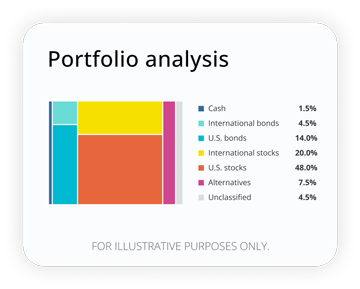
How well are your investments performing?
Analyze your portfolio in minutes and receive a target allocation for your goals.
1 IRS, “Roth Individual Retirement Custodial Account,” accessed January 2025.
2 Social Security Administration, “SI 01120.205 Uniform Transfers to Minors Act,” Accessed January 2026.
3 IRS, “Frequently Asked Questions on Gift Taxes,” December 31, 2025.
4 IRS, “Estate Tax,” December 22, 2025.
5 IRS, “Retirement topics - Exceptions to tax on early distributions,” December 11, 2025.
6 Ibid.
7 IRS. “Topic No. 451, Individual Retirement Arrangements (IRAs).” October 3, 2025.
8 Social Security Administration, “SI 01120.205 Uniform Transfers to Minors Act,” Accessed January 2026.
* A withdrawal from a Roth account is not subject to federal taxation as long as it is qualified as defined under IRS regulations. However, state and local taxes may still apply.
Any earnings on Roth contributions will be taxed unless a withdrawal is a qualified distribution as defined by the IRS. For a withdrawal to be considered a qualified distribution, Roth contributions must have been in the account for at least five years, and the money withdrawn after age 59½, death, or disability. Current rules are subject to change.
** Exchange-traded funds (ETFs) are a type of exchange-traded investment product that must register as either an open-end investment company (generally known as “funds”) or a unit investment trust. ETFs are not mutual funds.
Unlike with mutual funds, individual shares of ETFs are not redeemable directly with the issuer. ETF shares are a collection of securities bought and sold at market price, which may be higher or lower than the net asset value. Investment returns will vary based on market conditions and volatility, so an investor’s shares, when redeemed or sold, may be worth more or less than their original cost. ETFs are subject to risks, including those of their underlying securities.
RO5126369-0126
 Get The Currency newsletter



The Currency editors
Staff contributors
The CurrencyTM writers and editors cover the latest financial news and insights shaping how we live, work, and play. The team provides accurate, data-driven, and timely content aimed at empowering financial freedom for all.
The content contained in this blog post is intended for general informational purposes only and is not meant to constitute legal, tax, accounting or investment advice. You should consult a qualified legal or tax professional regarding your specific situation. No part of this blog, nor the links contained therein is a solicitation or offer to sell securities. Compensation for freelance contributions not to exceed $1,250. Third-party data is obtained from sources believed to be reliable; however, Empower cannot guarantee the accuracy, timeliness, completeness or fitness of this data for any particular purpose. Third-party links are provided solely as a convenience and do not imply an affiliation, endorsement or approval by Empower of the contents on such third-party websites. This article is based on current events, research, and developments at the time of publication, which may change over time.
Certain sections of this blog may contain forward-looking statements that are based on our reasonable expectations, estimates, projections and assumptions. Past performance is not a guarantee of future return, nor is it indicative of future performance. Investing involves risk. The value of your investment will fluctuate and you may lose money.
Certified Financial Planner Board of Standards Inc. (CFP Board) owns the certification marks CFP®, CERTIFIED FINANCIAL PLANNER™, CFP® (with plaque design), and CFP® (with flame design) in the U.S., which it authorizes use of by individuals who successfully complete CFP Board's initial and ongoing certification requirements.