

Roth 401(k) vs. Roth IRA: Key differences
Roth 401(k) vs. Roth IRA: Key differences
Roth accounts use after-tax dollars to fund retirement, but 401(k) and IRA options differ in income limits, contribution caps, and investment flexibility
Roth 401(k) vs. Roth IRA: Key differences
Roth accounts use after-tax dollars to fund retirement, but 401(k) and IRA options differ in income limits, contribution caps, and investment flexibility

12.04.2025
Key takeaways
- Higher contribution limits and no income restrictions can make Roth 401(k)s attractive to savers
- High earners may not qualify for Roth IRA contributions, depending on their taxable income
- Both Roth 401(k) and Roth IRA accounts allow for tax-free growth potential and qualified withdrawals*
Roth retirement savings accounts let people use after-tax dollars to save. There can also be flexibility in withdrawing contributions, though consider the rules before jumping in.
Importance of retirement savings
When you’re saving for retirement, one of the most important decisions you’ll have to make is the best type of account to use. Roth accounts are becoming increasingly popular for retirement savings because they offer tax-free investment growth potential and qualified withdrawals.
A withdrawal from a Roth account is not subject to federal taxation as long as it is qualified as defined under IRS regulations. However, state and local taxes may still apply.
There are two major types of Roth accounts: the Roth 401(k) and the Roth IRA. These two accounts have some key similarities, including their tax advantages. However, they also differ when it comes to their contribution limits, investment options, withdrawal rules, and more.
If you’re considering a Roth 401(k) vs a Roth IRA, it’s important to weigh the pros and cons to determine which works best for your situation — and you may even decide to use both.
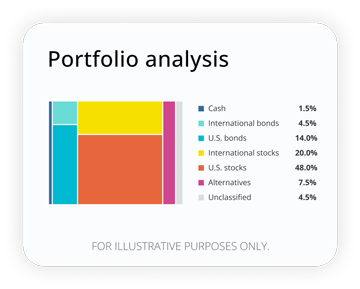
How well are your investments performing?
Analyze your portfolio in minutes and receive a target allocation for your goals.
What is a Roth 401(k)?
A Roth is a feature of many 401(k) and similar employer-sponsored retirement plans. Roth contributions are made on an after-tax basis, and any investment earnings on Roth contributions are tax-free subject to various requirements.
The Roth 401(k) was introduced in 2006 to give Americans a new type of retirement savings vehicle to complement the popular Roth IRA, which was introduced in 1997. Roth IRAs and Roth 401(k)s are similar, but there are significant differences.
Employer contributions and matches in Roth 401(k)
If your employer offers a Roth 401(k) as part of their retirement benefits, they may also opt to make matching contributions on your designated contributions.
If the employee opts to receive the employer match in their Roth 401(k), the contribution will be taxable. If the employer contribution is made into a traditional 401(k) account, then it is made on a pre-tax basis – the investment has the potential to grow tax free until you withdraw the money and pay income taxes in retirement.
Read more: What is 401(k) matching and how does it work?
What is a Roth IRA?
A Roth IRA is an individual retirement account that individuals can open separately from their employer-sponsored plan. It can be used either separately or with a workplace retirement plan like a 401(k), 403(b), or 457(b).
The Roth IRA is specifically designed for low- and middle-income workers. Income limits prevent higher earners from taking full advantage. As of July 2025, Roth IRAs account for a third of Gen Z’s retirement savings and around a quarter of Millennials’ balances.
Read more: What is a Roth IRA?
Roth 401(k) vs. Roth IRA: How are they similar?
The Roth 401(k) and Roth IRA have several key similarities, especially when it comes to their tax advantages.
After-tax contributions
Both Roth 401(k)s and Roth IRAs require after-tax contributions. This is a significant difference from the pre-tax contributions that investors typically make to traditional 401(k)s and IRAs. With a Roth account, you can’t deduct your contributions from your annual tax return, nor are they withheld from your paycheck pre-tax.
In the short term, this lack of upfront tax advantage can be impactful. Depending on someone’s income and contribution amount, it may significantly increase how much they pay in current annual income tax. On the other hand, a traditional IRA account allows for the deduction of contributions on a tax return, which can help reduce the amount due in current annual income tax.
Read more: What’s the difference between after-tax contributions to a 401(k) vs Roth 401(k)?
Tax-free growth potential and withdrawals
Though both types of Roth accounts require after-tax contributions, they also allow for tax-free growth potential and qualified withdrawals. You won’t pay income taxes on any investment earnings in the account with a qualified withdrawal.
Additionally, you can withdraw money from both accounts income tax-free after you turn 59 ½ if the withdrawal is qualified. Practically, this can mean favorable tax treatment in retirement since you won’t have to pay taxes on the distributions.
Required minimum distributions (RMDs)
RMDs are distributions that the IRS requires people to take from their retirement accounts once they reach age 73 (or 72, for those who reached that age before December 31, 2022). If you don’t withdraw the full required amount, a tax penalty can apply.
Previously, RMDs applied to all 401(k)s, including Roth accounts. They also applied to traditional IRAs, though not Roth IRAs. However, for tax years 2024 and later, RMDs no longer apply to any Roth accounts, including both IRAs and 401(k)s.
Read more: Required minimum distributions: The deal on RMDs
Roth 401(k) vs. Roth IRA: How are they different?
Roth 401(k)s and Roth IRAs also have some important differences. It’s important to understand these differences when weighing a Roth IRA vs a Roth (401k) and to help ensure you don’t get hit with tax penalties.
Annual contribution limits
One of the biggest differences between the Roth 401(k) and Roth IRA is their annual contribution limits. In 2026, you can contribute up to $24,500 per year (up from $23,500 in 2025) — and a catch-up contribution of $8,000 per year if you’re aged 50 or over (compared with $7,500 in 2025) — to a Roth 401(k). Starting in 2025 and continuing into 2026, there’s an additional offering for savers ages 60-63 of $11,250 in catch-up contributions. However, the annual contribution limit for Roth IRAs in 2026 is much lower: just $7,500 per year, or $8,600 if you’re 50 years of age or over. That’s up slightly from 2025 limits of $7,000 and $8,000, respectively.1
Another update for 2026 applies to employees who made Social Security wages above $150,000 in the prior year. When these high earners make catch-up contributions to their 401(k), those must now be made on a Roth basis.2
Eligibility criteria
Another big difference between the Roth 401(k) and the Roth IRA is the eligibility criteria. If you make too much money, you can’t open or contribute to a Roth IRA. More specifically, for tax year 2026, you are not eligible for a Roth IRA if your modified adjusted gross income (MAGI) is:3
- $168,000 or more if you are single or head of household
- $252,000 or more for married couples filing jointly
With Roth 401(k)s, the only eligibility criteria are that your employer offers this option.
Early withdrawal exceptions and penalties
A final key difference between the Roth 401(k) and Roth IRA is their withdrawal rules. You can only withdraw from your Roth 401(k) once you’ve reached age 59 ½ and it has been at least five years since your first deposit. Withdrawals can be made without penalty if you become disabled, or if done by a beneficiary after your death. This rule applies to both your contributions and any earnings. Any withdrawals that don’t meet these requirements will result in tax penalties.
In a Roth IRA, the withdrawal rules for your earnings are the same as the rules for a Roth 401(k). However, you can withdraw your contributions tax-free and penalty-free at any time.
For both account types, there are also exceptions when the IRS allows you to withdraw from your account with no tax penalty. Those exceptions include the birth or adoption of a child, a permanent disability, a personal or family emergency, and more.4
Accessibility of Roth IRA and Roth 401(k)
Provided you meet the eligibility guidelines outlined above, you can open a Roth IRA independently of your employer at a financial institution of your choice. With a Roth IRA, you have the flexibility to choose your own investments from the options available to you via your financial institution. This gives you the flexibility to take full control of your own investments.
On the flip side, you can only save through a Roth 401(k) if your employer offers this type of plan. With a Roth 401(k), you may only select from the investments your employer includes as part of its plan offering. As a result, Roth 401(k)s may offer less flexibility compared to Roth IRAs.
Self-employed individuals have the option of opening a small-business retirement plan, such as a solo 401(k), to access Roth benefits.
Pros and cons of a Roth 401(k)
Pros
- Higher contribution limits: In 2026, the contribution limit is $24,500, with an additional catch-up contribution allowed for those ages 50 and over at $8,600. For those between ages 60 and 63, that catch-up amount is boosted to $11,250.
- Possibility of an employer match: Many companies offer 401(k) matching contributions, which are essentially free money.
- No income limits: Unlike Roth IRAs, Roth 401(k)s don’t have income limits.
Cons
- Fewer investment options: Most employer plans offer a limited menu of investment options, leaving you with fewer options than a Roth IRA.
Pros and cons of a Roth IRA
Pros
- Wider range of investment options: Roth IRAs can offer a wider range of investment options than 401(k)s — there’s flexibility in choosing an account that offers the investments you want.
- More flexible distribution rules: Roth IRAs have more flexible distribution rules, including allowing you to access your contributions at any time penalty-free.
Read more: The advantages of an IRA
Cons
- Lower contribution limits: The contribution limits of Roth IRAs are considerably lower than those of Roth 401(k)s.
- Income limit for contributions: Roth IRAs have income limits that prevent most high earners from contributing, unless they meet certain exceptions.
- No possibility of employer match: Unlike a Roth 401(k), a Roth IRA is a personal account that doesn’t leave the possibility of an employer match.
Choosing between a Roth 401(k) and a Roth IRA
As with any financial planning, there’s not a one-size-fits-all answer to the question of whether a Roth 401(k) or Roth IRA is right for you. One way to help figure out which account makes more sense for you is to talk to a financial professional about your specific situation, but here are a few scenarios to help guide your conversation.
Roth 401(k) scenarios
A Roth 401(k) might be a good choice if you:
- Earn too much money to open and contribute to a Roth IRA
- Want to take advantage of an employer match
- Want to contribute as much money as possible to the plan account
- Appreciate the ease of signing up through work and having contributions automatically deducted from your pay each pay period
Roth IRA scenarios
A Roth IRA might be a good choice if you:
- Want access to a wider range of investment options
- Want to be able to withdraw contributions tax and penalty-free before you turn 59½
- Work for an employer that doesn’t offer a Roth option in its 401(k)
Can I have a Roth 401(k) and a Roth IRA?
The good news is you don’t have to choose between a Roth 401(k) and a Roth IRA — you can have both. If you receive a Roth 401(k) through your employer, consider contributing enough to receive your employer match.
Once you’ve earned your entire matching contribution for your Roth 401(k), you may want to consider contributing to a Roth IRA. Because of its more flexible distribution rules and variety of investment options, investors may prefer it to a Roth 401(k).
Read more: Can I contribute to a 401(k) and an IRA?
Next steps
Roth 401(k)s and Roth IRAs can both be good options for retirement savers. The answer to which account is the better option will depend on your unique situation. It’s a good idea to talk to a financial professional to weigh the pros and cons of Roth IRAs vs Roth 401(k)s to determine the best choice.
Additionally, to get a complete picture of your retirement readiness, you can use Empower’s free online financial tools. These tools can help you form a personalized retirement plan and see how likely you are to meet your goals.
* Any earnings on Roth contributions will be taxed unless a withdrawal is a qualified distribution as defined by the IRS. For a withdrawal to be considered a qualified distribution, Roth contributions must have been in the account for at least five years, and the money withdrawn after age 59½, death, or disability. Current rules are subject to change.
1 IRS, “401(k) limit increases to $24,500 for 2026, IRA limit increases to $7,500,” November 2025.
2 IRS, “2026 Amounts Relating to Retirement Plans and IRAs, as Adjusted for Changes in Cost-of-Living,” accessed December 2025.
3 IRS, “401(k) limit increases to $24,500 for 2026, IRA limit increases to $7,500,” November 2025.
4 IRS, “Retirement topics: Exceptions to tax on early distributions,” accessed November 2025.
RO5020839-1125
 Get The Currency newsletter



The Currency editors
Staff contributors
The CurrencyTM writers and editors cover the latest financial news and insights shaping how we live, work, and play. The team provides accurate, data-driven, and timely content aimed at empowering financial freedom for all.
The content contained in this blog post is intended for general informational purposes only and is not meant to constitute legal, tax, accounting or investment advice. You should consult a qualified legal or tax professional regarding your specific situation. No part of this blog, nor the links contained therein is a solicitation or offer to sell securities. Compensation for freelance contributions not to exceed $1,250. Third-party data is obtained from sources believed to be reliable; however, Empower cannot guarantee the accuracy, timeliness, completeness or fitness of this data for any particular purpose. Third-party links are provided solely as a convenience and do not imply an affiliation, endorsement or approval by Empower of the contents on such third-party websites. This article is based on current events, research, and developments at the time of publication, which may change over time.
Certain sections of this blog may contain forward-looking statements that are based on our reasonable expectations, estimates, projections and assumptions. Past performance is not a guarantee of future return, nor is it indicative of future performance. Investing involves risk. The value of your investment will fluctuate and you may lose money.
Certified Financial Planner Board of Standards Inc. (CFP Board) owns the certification marks CFP®, CERTIFIED FINANCIAL PLANNER™, CFP® (with plaque design), and CFP® (with flame design) in the U.S., which it authorizes use of by individuals who successfully complete CFP Board's initial and ongoing certification requirements.