

College fund for a baby: 5 ways new parents can start saving
College fund for a baby: 5 ways new parents can start saving
You don’t need to wait to start saving for college; tax-advantaged accounts and saving strategies can start in the infant years
College fund for a baby: 5 ways new parents can start saving
You don’t need to wait to start saving for college; tax-advantaged accounts and saving strategies can start in the infant years

11.23.2026
Key takeaways
- Starting a college fund when a child is young gives savings more time for potential investment growth.
- Parents can redirect money saved on baby essentials and gift cards toward a child's education fund.
- A 529 plan offers tax advantages for education savings, with options for unused funds if plans change.
Parents want to set up their kids for success — including financially — but how should they get started when welcoming a new baby?
Saving for education can be among the top money priorities for families, and the difference between what people have saved and what college costs can be a big gap to fill: From 2025-2026, families borrowed $105 billion in federal and nonfederal loans for higher education.1
Getting started early could make a big difference to allow savings more time for potential growth. Here are some creative strategies to set up a college fund for a baby.
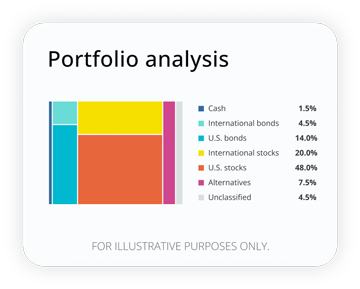
How well are your investments performing?
Analyze your portfolio in minutes and receive a target allocation for your goals.
1. Return extra gifts and lower the cost of baby expenses
To get off on the right foot with saving, take a close look at your family’s current and future spending.
Not counting a baby’s ongoing costs like childcare, health insurance, and food, initial baby gear purchases — such as a stroller, car seat, crib, and toys — can total around $3,000.2 In a survey of pregnant women and mothers of young babies, more than three in five said they expect to buy most baby gear on their own.3
If you’re among the expectant parents who receive generous gifts that don’t quite fit your style — or if you already have the items — check to see what can be returned or exchanged for essentials like baby food or diapers.
“Big-box” retailers that sell a broad range of products — think Target, Amazon, and Walmart — are among the top 10 U.S. retailers by sales, according to the National Retail Federation. Depending on where the gift was purchased, you may be able to return it for something that better fits your needs.
Extra baby clothes could be exchanged for boxes of diapers or cans of formula, depending on what the store offers and its return policies. The rising cost of baby essentials has been taking a bite out of budgets, with prices for baby food and formula up 5.1% in October.4
This strategy also works for holiday and birthday presents after a baby is born. If a family member buys several pairs of shoes for your growing child, returning some of those items may be enough to cover some of the baby’s other needs as they grow.
Besides saving you the time and hassle of buying new shoe sizes, their generous present can also be a way to reduce your household spending on baby shoes for a bit.
Want an extra savings boost? Instead of putting that money toward other expenses, earmark the dollars you would have used for baby shoes for baby’s college fund.
2. A Social Security number is a key starting point
After your baby is born, you’ll receive their U.S. Social Security number and card in the mail, within an average of two weeks after the paperwork has been submitted.5 This personal information is essential to claim or open several tax-advantaged accounts that can benefit kids.
At this point, parents can start considering how to start their baby’s college fund.
With a baby still so young, it can be difficult for loved ones to think ahead to college. For parents, grandparents, or other family members who desire flexibility for the child’s savings in the meantime, a couple of options include:
- Custodial UTMA and UGMA accounts: Established under the Uniform Transfers to Minors Act (UTMA) and Uniform Gifts to Minors Act (UGMA), these accounts allow adults to save and invest money as a custodian for a child while they're still a minor. The adult who opens the account oversees investments, deposits, and withdrawals until the child reaches the age of majority — usually between 18-21 years old, depending on account requirements and state law where the minor lives. Money in these accounts legally belongs to the child and must be used for the child’s benefit.
- Trump Accounts: Newborns will automatically be enrolled in a Trump Account, a special type of individual retirement account from the U.S. Treasury. But it’s up to parents to claim the account once it’s created. Babies born before Dec. 31, 2028, are also eligible for $1,000 in federal seed money to get started on saving — if parents make an election for the one-time contribution. From there, annual contribution limits apply to Trump Accounts, and withdrawal rules are like those of a traditional IRA.
Read more: Trump Accounts vs. custodial accounts: Key differences
3. 529 accounts stand out for education savings
For parents who want an account that’s designed for their child’s college savings, a 529 plan may fit the bill. 529 accounts let savers contribute after-tax dollars, invest the money for potential growth, and take tax-free withdrawals for eligible education expenses. An adult would open the account for the baby, with the child as the named beneficiary.
Costs that qualify to be reimbursed using 529 money include college tuition, supplies, meal plans, and housing. Up to $20,000 per year can also be used on K-12 expenses, for families that decide to tap the money sooner in a child’s educational journey.
Another feature of many 529 plans is the ability for others besides the account holder to contribute to the account. These 529 gifting options can be shared with family and friends prior to a child’s milestones like a birthday or graduation, to encourage direct deposits to benefit their education.
For grandparents who establish a 529 account with a grandchild as the beneficiary, current federal financial aid rules generally exclude those account assets from FAFSA calculations. This grandparent “loophole” can help families prioritize both tax savings and financial aid eligibility, while the 529 money is available for other educational costs that aren’t already covered.
Read more: What is the 529 grandparent “loophole”?
4. Turn monetary gifts into contributions
As family and friends aren’t sure what to give growing kids for birthdays or holidays, parents could see an uptick in gift cards in their wallets. Gift cards can be customized for both the giver’s budget and the child’s interests and have been popular for years, with the market expected to surpass $246 billion in 2026.6 But those gifts can accumulate in drawers and other places throughout the year — and sometimes be forgotten. Americans on average hold $244 in unused gift cards.7
One creative strategy ensures that gift cards get spent — and that you can put some funds toward your child’s college fund at the same time.
Try this: The next time a flurry of gift cards arrives, take care to sort them accordingly and write down the amounts received and where they can be used. For every gift card your child has, keep the card in a safe place for yourself to spend — such as for everyday expenses or discretionary spending — but then make an equivalent dollar contribution to their college fund. In turn, you’re also honoring the intent of the gift — to benefit your child.
These amounts diverted to long-term savings can add up over time: A kid’s birthday gift can cost $83.03, while a holiday present is worth $64.10 on average, according to Empower data.
Each parent can give up to $19,000 a year to an individual without hitting the gift tax threshold, which means you can avoid filing a federal gift tax return.
Once your child is old enough to understand how gift-giving works, they can have more input on how they want to spend their gifts. Intentionally leaving some amount aside for savings is among the smart money lessons for kids to learn from an early age.
5. What happens if education needs change?
The higher-education landscape frequently changes, with three-year degrees among the latest developments.8 If students can lower their costs by having one fewer year of expenses, what does that mean for savings they’ve accumulated?
529 plans offer flexibility for families whose have funds that exceed the child’s educational costs. Families have options to retain the tax advantages of a 529 and shift the money into fulfilling certain other goals without triggering penalties.
One option is rolling unused 529 funds into a Roth IRA to give an older child a head start on retirement savings. Up to $35,000 can be rolled over into a Roth IRA during the beneficiary’s lifetime if the account has been open at least 15 years — subject to additional requirements. This makes opening a 529 account for a baby or during a child’s younger years potentially advantageous.
Earlier contributions would have more time to qualify because funds eligible for a Roth IRA rollover must be held in the 529 account for at least five years. The Roth IRA must be for the same beneficiary child, allowing their excess education savings to move to being used for retirement.
Nonqualified withdrawals from a 529 plan may subject the earnings portion of the distribution to federal income tax and an additional 10% federal tax penalty, unless an exception applies.
Starting to save early
By making the most of baby gifts or setting aside gift card money for future educational expenses, building a college fund can start with small financial decisions in a child's earliest years.
Managing finances is a learning experience on its own, and starting a college fund for a baby can be less of a hassle when time is on your side. Getting into the habit of making timely contributions to whichever account fits your family’s needs could give space for your savings tactics to evolve.
Investments in a 529 plan are subject to market risk, including possible loss of principal. Tax benefits depend on meeting applicable requirements, and state tax treatment may vary. Before investing, consider the plan's investment objectives, risks, fees, expenses, and any state-specific benefits.
1 College Board, “Trends in College Pricing and Student Aid 2026,” accessed November 2026.
2 WebMD, “What It Costs to Have and Raise a Baby,” accessed November 2026.
3 USA Today, “Traditional baby registries becoming a thing of the past, survey finds,” July 2026.
4 Bloomberg, “US Parents Face Record Surge in Baby Food and Formula Costs,” November 2026.
5 Social Security Administration, “How long does it take to get my child's Social Security number?” October 2026.
6 Research and Markets, “United States Gift Card Business and Investment Report 2026: A 320+ Billion Market by 2030 Featuring Walmart, Amazon, Costco, Home Depot, Target, Apple, CVS, Sycamore Partners, Kroger, Publix,” February 2026.
7 6abc, “National Gift Card Day: Tips to cash in on unused gift cards,” January 2026.
8 The Wall Street Journal, “The Latest Way to Make College More Affordable: Shorter Degrees,” November 2026.
RO6136390-1126
 Get The Currency newsletter



The content contained in this blog post is intended for general informational purposes only and is not meant to constitute legal, tax, accounting or investment advice. You should consult a qualified legal or tax professional regarding your specific situation. No part of this blog, nor the links contained therein is a solicitation or offer to sell securities. Compensation for freelance contributions not to exceed $1,250. Third-party data is obtained from sources believed to be reliable; however, Empower cannot guarantee the accuracy, timeliness, completeness or fitness of this data for any particular purpose. Third-party links are provided solely as a convenience and do not imply an affiliation, endorsement or approval by Empower of the contents on such third-party websites. This article is based on current events, research, and developments at the time of publication, which may change over time.
Certain sections of this blog may contain forward-looking statements that are based on our reasonable expectations, estimates, projections and assumptions. Past performance is not a guarantee of future return, nor is it indicative of future performance. Investing involves risk. The value of your investment will fluctuate and you may lose money.
Certified Financial Planner Board of Standards Inc. (CFP Board) owns the certification marks CFP®, CERTIFIED FINANCIAL PLANNER™, CFP® (with plaque design), and CFP® (with flame design) in the U.S., which it authorizes use of by individuals who successfully complete CFP Board's initial and ongoing certification requirements.