

Retirement savings are drifting across old jobs
Retirement savings are drifting across old jobs
New Empower research shows how old 401(k)s can fall off the radar. Here’s what’s driving the trend and how to keep track
Retirement savings are drifting across old jobs
New Empower research shows how old 401(k)s can fall off the radar. Here’s what’s driving the trend and how to keep track

10.19.2026
Key takeaways
- Empower research reveals 34% of Americans may have lost track of old retirement savings, rising to 50% of Gen Z and 45% of Millennials.
- More than half of those surveyed have changed employers at least three times, creating more accounts to track.
- Former employers, government databases, and other resources can help locate an old 401(k).
Changing jobs has become a routine part of American working life, but retirement savings don't always travel as neatly as workers do.
More than 1 in 3 Americans (34%) say they may have lost track of retirement savings from an old employer, according to a new Empower study, “The Retirement Drift.” Nearly 2 in 5 (39%) have retirement savings spread out from different employers, often a first step in losing track.
Across the broader U.S. workforce, the sums involved can be substantial. Approximately 32 million 401(k) accounts holding some $2.1 trillion in assets had been forgotten as of July 2025, according to one estimate.1
Here’s a closer look at why retirement accounts can get left behind — and the steps you can take to find old savings and consider your options.
How well are your investments performing?
Analyze your portfolio in minutes and receive a target allocation for your goals.
Retirement drift starts early
Retirement savings can start drifting early in a career. Some 50% of Gen Z and 45% of Millennials say they may have lost track of retirement savings from a previous employer, according to Empower’s study. That compares with 30% of Gen X and 14% of Baby Boomers.
In fact, 57% of Gen Z and 45% of Millennials aren’t confident they could locate all their retirement savings today.
Regardless of age, keeping tabs on old retirement accounts often competes with other financial priorities, such as paying monthly bills or meeting other savings goals. Managing retirement savings falls to the bottom of the financial to-do list for 54% of those surveyed.
More moves, more accounts to track
The scale of workplace retirement savings is substantial: About 70 million Americans actively participate in 401(k) plans, which held approximately $10.8 trillion in assets as of June 2026, according to the Investment Company Institute.2
Keeping track can become more complicated as workers change employers throughout their careers. More than half of Americans surveyed by Empower (53%) have changed employers three or more times, while 27% have made at least five moves.
Over time, former employers may change plan administrators, companies can merge or close, and workers themselves may move, change contact information, or simply forget about an old account.
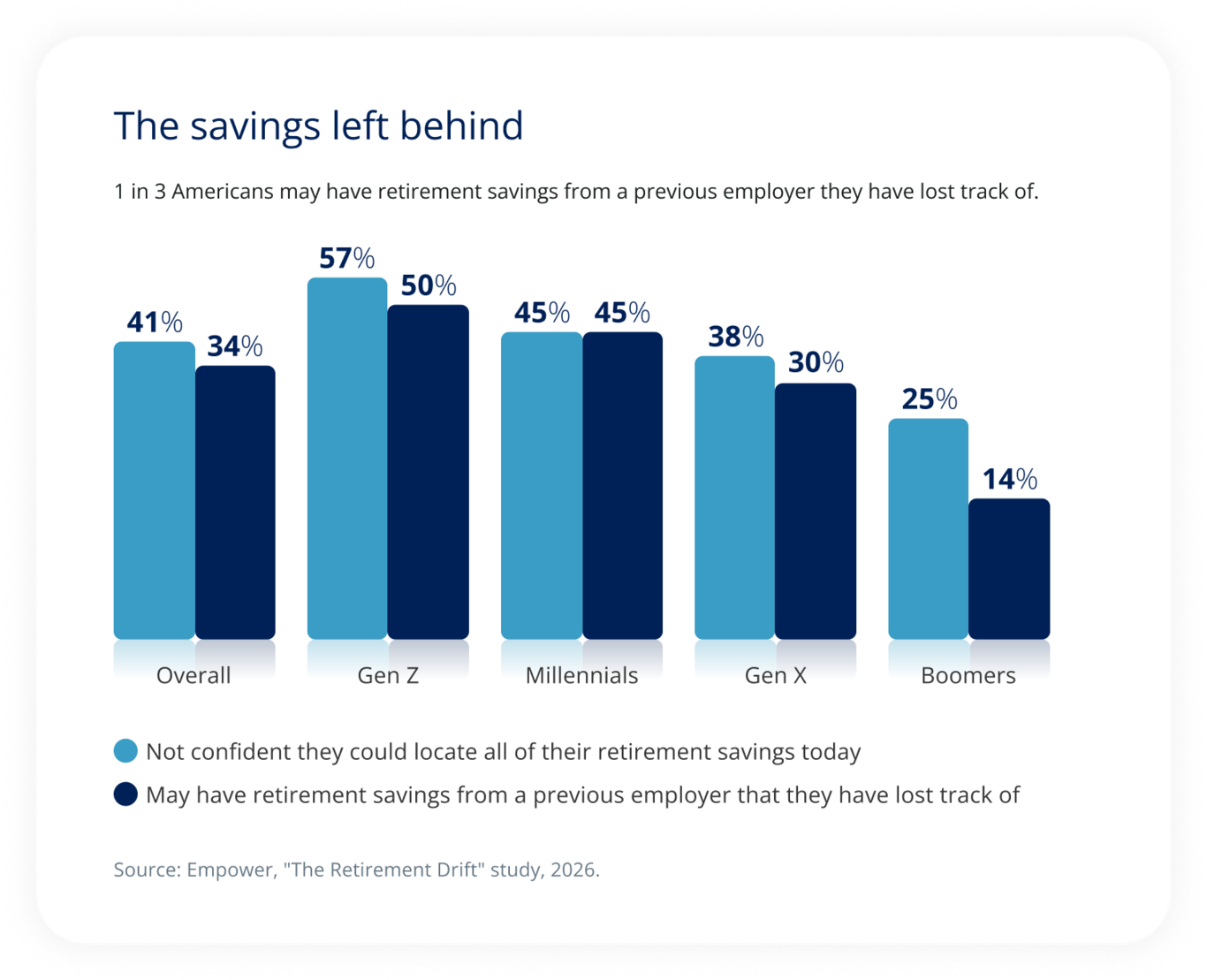
The chart compares Americans' ability to keep track of retirement savings overall and by generation. Two measures are shown: those who are not confident they could locate all of their retirement savings today, and those who may have retirement savings from a previous employer that they have lost track of.
Overall, 41% are not confident they could locate all of their retirement savings, while 34% may have lost track of retirement savings from a previous employer.
Gen Z reports the highest rates: 57% are not confident they could locate all their retirement savings, and 50% may have lost track of savings from a previous employer. Among Millennials, both measures are 45%. For Gen X, the figures are 38% and 30%, respectively. Boomers report the lowest rates, at 25% and 14%.
Key takeaway: Difficulty keeping track of retirement savings is more prevalent among younger generations. Overall, about one in three Americans may have retirement savings from a previous employer that they have lost track of.
Source: Empower, The Retirement Drift study, 2026.
How to find an old 401(k)
If an old 401(k) has fallen off your radar, you should know that the money is not lost. There are several ways to track it down and determine what options are available to you.
Contact your old company: You can often start with your former employer. The human resources department can help determine whether you still have a 401(k) account and identify the company that administers the plan.
Check your own records: Old account statements, tax documents and other records may identify the plan administrator and account information. Even with just the name of a plan administrator, you can reach out and share pertinent details — such as your former employer and personal information — to potentially get access to an old account.
Smaller balance? If your balance was under $7,000, you can check if your former and new employers’ plan administrators participate in the Portability Services Network. The industry-led consortium and digital network automatically transfers smaller accounts to your new employer’s plan, if both plan administrators participate.3
Federal database: The Department of Labor’s Retirement Savings Lost and Found database allows workers to search for retirement plans associated with former private-sector employers.4 The DOL also maintains an Abandoned Plan Program for plans that no longer have a sponsor or administrator.5
State resources: State unclaimed-property databases are another place to look for retirement money that may have been turned over to a state. Searches are typically available through the state agency responsible for unclaimed property.
More places to check: The private National Registry of Unclaimed Retirement Benefits lets workers search for retirement plan account balances left unclaimed by former participants.6 The federal Pension Benefit Guaranty Corporation also offers a search tool for benefits from certain terminated retirement plans.7
Third-party help: If your searches come up empty, or if you don't have time to look for yourself, a financial professional can help track down an account based on information you can provide about your former employer(s) and retirement plan(s).
You found an old 401(k). Now what?
Finding an old account solves one problem but figuring out what to do with the money can present another. A 2024 study by the Government Accountability Office found that 82% of 401(k) participants weren’t aware of all the distribution options available to them after leaving an employer.8
Empower’s “Retirement Drift” study points to a similar need for guidance: 66% of those surveyed wish someone had explained their retirement savings options when they switched employers. A financial advisor can help you weigh the tax, investment, and other considerations that may apply to your situation.
Once you’ve located an old account, you generally have several paths to consider:
- Leave money in your old plan. Many plans allow former employees to leave funds in their account if it contains more than $7,000, in line with the SECURE 2.0 Act. If there’s between $1,000 and $7,000, the plan sponsor may automatically roll the account to an IRA in the former employee’s name, or if the account balance is less than $1,000, they may issue the former employee a check and close the account.
- Roll funds to an individual retirement account (IRA). You’ll need to open a new IRA if you don’t currently have one. If you have an existing IRA, you can roll your 401(k) money over into it.
- Roll into your new employer’s plan. If your new employer offers a retirement plan, such as a 401(k), this might be a good option because it will enable you to keep your retirement savings all in one place.
- Cash out all of your 401(k). Here, you’ll take a taxable lump-sum distribution from your old 401(k) account. If you’re younger than age 59½, you’ll potentially have to pay an additional 10% tax penalty.
- Cash out a portion of your 401(k). Alternatively, you could distribute some of your 401(k) money, pay the taxes and penalties that are due, and roll over the rest into an IRA or your new employer’s retirement plan. Portions of your 401(k) invested in company stock may be subject to Net Unrealized Appreciation rules, which can potentially lower taxes on distributions.
From drift to direction
Each option comes with different considerations, including taxes, fees, investment choices, and features unique to each type of account. The right approach can depend on plan rules, your financial situation, and other individual factors.
The Currency’s guide to 401(k) rollovers takes a closer look at the choices and considerations you may have when leaving an employer. You can also check the how to roll over a 401(k) guide to walk through the steps involved when moving retirement savings. If you’re unsure about choices or executing a move, it may be beneficial to work with a financial professional.
Whatever direction you ultimately choose, finding an old account puts those savings back in your sights — and can bring retirement drift under control.
Empower’s “The Retirement Drift” study is based on online survey responses from 2,005 Americans ages 18+ fielded by an independent third-party panel provider from July 30-August 1, 2026. The survey is weighted to be nationally representative of U.S. adults.
1 MarketWatch, “Americans have $2.1 trillion in forgotten retirement savings. Here’s how to find out if you’re missing a 401(k),” June 2026.
2 Investment Company Institute, “Release: Quarterly Retirement Market Data, Second Quarter 2026,” September 2026.
3 Portability Services Network, “About PSN,” accessed September 2026.
4 Department of Labor, “Retirement Savings Lost and Found Database,” accessed September 2026.
5 PBCG, “Find your retirement benefits - Missing Participants Program, accessed September 2026.
6 NRURB, “About the National Registry,” accessed September 2026.
7 PBCG, “Find your retirement benefits - Missing Participants Program,” accessed September 2026.
8 GAO, “401(K) plans: Additional Federal Actions Would Help Participants Track and Consolidate Their Retirement Savings,” January 2024.
RO5964101-0926
 Get The Currency newsletter



The Currency editors
Staff contributors
The CurrencyTM writers and editors cover the latest financial news and insights shaping how we live, work, and play. The team provides accurate, data-driven, and timely content aimed at empowering financial freedom for all.
The content contained in this blog post is intended for general informational purposes only and is not meant to constitute legal, tax, accounting or investment advice. You should consult a qualified legal or tax professional regarding your specific situation. No part of this blog, nor the links contained therein is a solicitation or offer to sell securities. Compensation for freelance contributions not to exceed $1,250. Third-party data is obtained from sources believed to be reliable; however, Empower cannot guarantee the accuracy, timeliness, completeness or fitness of this data for any particular purpose. Third-party links are provided solely as a convenience and do not imply an affiliation, endorsement or approval by Empower of the contents on such third-party websites. This article is based on current events, research, and developments at the time of publication, which may change over time.
Certain sections of this blog may contain forward-looking statements that are based on our reasonable expectations, estimates, projections and assumptions. Past performance is not a guarantee of future return, nor is it indicative of future performance. Investing involves risk. The value of your investment will fluctuate and you may lose money.
Certified Financial Planner Board of Standards Inc. (CFP Board) owns the certification marks CFP®, CERTIFIED FINANCIAL PLANNER™, CFP® (with plaque design), and CFP® (with flame design) in the U.S., which it authorizes use of by individuals who successfully complete CFP Board's initial and ongoing certification requirements.