

What are UTMA and UGMA accounts?
What are UTMA and UGMA accounts?
Understanding the pros and cons of custodial accounts, how they’re taxed, and when they make sense
What are UTMA and UGMA accounts?
Understanding the pros and cons of custodial accounts, how they’re taxed, and when they make sense

08.04.2026
Key takeaways
- Custodial accounts offer a flexible way to invest for a child's future that goes beyond education savings.
- Custodial accounts can impact taxes and reduce eligibility for need-based financial aid, so it's important to understand the tradeoffs.
- Once money is contributed to a custodial account, it belongs to the child and can't be taken back or transferred to someone else.
When you want to give a child a financial head start, a custodial account can be a useful option.
The Uniform Transfers to Minors Act (UTMA) and Uniform Gifts to Minors Act (UGMA) are laws that allow adults to save and invest money for a child in a custodial account while they're still a minor. UTMA and UGMA accounts can be appealing because the money can eventually be used for just about anything — from education to buying a first home.
Here's what to know before opening one.
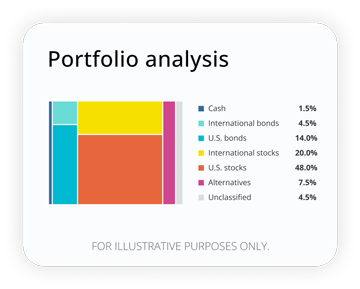
How well are your investments performing?
Analyze your portfolio in minutes and receive a target allocation for your goals.
What are UTMA and UGMA accounts?
A UTMA or UGMA account is opened by an adult — often a parent, grandparent, or other family member — for the benefit of a child. The adult acts as the account's custodian, managing the money and investments until the child reaches the age of majority, which typically is between ages 18 and 21, depending on the type of account and specific state law where the minor resides.1
The two account types are very similar, with one key difference.2 UGMA accounts generally hold cash or investments like stocks, bonds, and mutual funds. UTMA accounts can hold these financial assets as well as tangible property such as real estate or artwork.* Once the custodianship terminates, the beneficiary generally gains control of the assets and may use them differently from what the original donor intended.
Any money you contribute is considered an irrevocable gift.3 While there are no contribution limits for custodial accounts, contributing more than the 2026 IRS $19,000 annual gift threshold (or $38,000 for married couples per donor, per recipient) will require a gift tax return.4
Once in the account, the money legally belongs to the child and must be used for the child’s benefit. A custodian generally can execute transactions and withdraw or transfer assets, but only for the minor’s benefit.
Read more: Custodial Roth IRA: Planning for your child’s future
Potential benefits of a custodial account
Flexibility is one reason many families choose custodial accounts. The money in a UTMA or UGMA account eventually can be used for almost anything — from paying for college to buying a car, starting a business, or even making a down payment on a home.
Other advantages include:
- A wide range of investment options, including stocks, ETFs, mutual funds, and bonds.
- Anyone can contribute on behalf of the child
- No annual contribution limits (but gifts exceeding the IRS threshold may have federal gift tax implications as mentioned above).
- Easy account setup through many brokerage firms.
Could a custodial account affect financial aid?
It's important to understand how a custodial account could come into play if your child plans to attend college and apply for need-based financial aid.
Because the custodial account assets belong to the child, they're generally treated less favorably in the federal financial aid formula than assets owned by a parent, such as a 529 plan. In fact, a custodial account could potentially reduce eligibility for need-based aid by 20% of the asset value — significantly more than a parent-owned 529 plan, which might reduce aid by up to 5.64% of the asset value.5 The effect on an actual financial-aid award depends on the applicant’s full financial circumstances, applicable exemptions, and the school’s methodology.
Financial aid rules can change over time, so it's a good idea to review the latest guidance if college funding is one of your savings goals.
Read more: FAFSA changes: What to know about student aid as fall enrollment opens
How custodial accounts are generally taxed
UTMA and UGMA custodial accounts don’t offer the same tax advantages as some other savings options, such as 529 plans or custodial Roth IRA accounts.
Investment earnings — including interest, dividends, and capital gains — are generally taxed in the child's name under the IRS's "kiddie tax" rules.6 Each year, up to $1,350 of a child's unearned income may be tax-free, and the next $1,350 may be taxed at the child's typically lower tax rate.7 Any unearned income above those annual thresholds may be taxed at the parent's marginal tax rate.
Read more: Are 529 contributions tax deductible? Federal and state rules
Could a custodial account be right for you?
If your primary goal is saving for education, a 529 plan could offer different tax advantages. But if you'd like to give a child financial support that could be used for college — or whatever opportunities and expenses life brings — a UTMA or UGMA account may offer more flexibility.
Ultimately, your choice comes down to what financial goal you’re hoping to help your child achieve.
Read more: Is a 529 plan worth it? Pros, cons, and when it makes sense
1 Finaid, “Age of Majority and Trust Terminations: Understanding UGMA and UTMA,” accessed July 2026.
2 Saving for College, “What is a UGMA and UTMA Account?, July 15, 2026.
3 Social Security Administration, “Uniform Transfers to Minors Act,” June 18, 2026.
4 Internal Revenue Service, “Frequently asked questions on gift taxes,” July 23, 2026.
5 Saving for College, “What is a UGMA and UTMA Account?, July 15, 2026.
6 Internal Revenue Service, “Tax on a child's investment and other unearned income (kiddie tax),” June 10, 2026.
7 Internal Revenue Service, “Rev. Proc. 2024-40, Tax forms and instructions,” accessed July 2026.
*Custodial accounts do not guarantee investment returns, and their value may decline. Investment options, fees and account capabilities vary by financial institution.
This material is provided for general educational purposes and is not intended as investment, tax, legal or financial-aid advice. Custodial-account laws, tax rules, financial-aid treatment and account features vary by state and individual circumstances. Investments are subject to risk, including possible loss of principal. Consult appropriate tax, legal and financial professionals before acting.
RO5801217-0726
 Get The Currency newsletter



The Currency editors
Staff contributors
The CurrencyTM writers and editors cover the latest financial news and insights shaping how we live, work, and play. The team provides accurate, data-driven, and timely content aimed at empowering financial freedom for all.
The content contained in this blog post is intended for general informational purposes only and is not meant to constitute legal, tax, accounting or investment advice. You should consult a qualified legal or tax professional regarding your specific situation. No part of this blog, nor the links contained therein is a solicitation or offer to sell securities. Compensation for freelance contributions not to exceed $1,250. Third-party data is obtained from sources believed to be reliable; however, Empower cannot guarantee the accuracy, timeliness, completeness or fitness of this data for any particular purpose. Third-party links are provided solely as a convenience and do not imply an affiliation, endorsement or approval by Empower of the contents on such third-party websites. This article is based on current events, research, and developments at the time of publication, which may change over time.
Certain sections of this blog may contain forward-looking statements that are based on our reasonable expectations, estimates, projections and assumptions. Past performance is not a guarantee of future return, nor is it indicative of future performance. Investing involves risk. The value of your investment will fluctuate and you may lose money.
Certified Financial Planner Board of Standards Inc. (CFP Board) owns the certification marks CFP®, CERTIFIED FINANCIAL PLANNER™, CFP® (with plaque design), and CFP® (with flame design) in the U.S., which it authorizes use of by individuals who successfully complete CFP Board's initial and ongoing certification requirements.