

How to open a 529 plan: A step-by-step guide
How to open a 529 plan: A step-by-step guide
Learn how to open a 529 plan to start saving for a child’s education, including tuition, room and board, and other eligible expenses
How to open a 529 plan: A step-by-step guide
Learn how to open a 529 plan to start saving for a child’s education, including tuition, room and board, and other eligible expenses

05.18.2026
Key takeaways
Many U.S. states offer 529 incentives for residents, but you aren’t required to open a plan in the state you reside.
The potential benefits of opening a 529 plan include tax-free potential growth and the ability to set up recurring withdrawals.
Any U.S. adult with a Social Security number can open a 529 account.
A 529 plan is a tax-advantaged investment account that helps families save for education by offering tax-free potential growth on earnings, if any, when money is used for eligible expenses.
529 plans can be used for a wide range of qualified education expenses, including tuition, books, supplies, computers, and room and board at accredited colleges, universities, and vocational schools. They also cover private K-12 tuition and student loan repayments in some cases.
Americans held 17.7 million 529 plan accounts at the end of 2025 with $602.9 billion in assets, according to the Investment Company Institute.1
Here’s a four-step look at how to set up a 529 plan and start saving today.
How to open a 529 plan in 4 simple steps
1. Choose the right 529 plan for your needs
Deciding where to open a 529 plan is the first phase of getting started on saving. Most U.S. states sponsor at least one 529 plan — and many financial institutions also offer them — so searching online and through your existing account providers can reveal a variety of options.
Each 529 plan will outline the steps for opening, funding, and withdrawing from an account. As a starting point, consider the answers to these questions as you pick a 529 plan:
Does the plan charge an annual account maintenance fee?
Is there a minimum contribution required to open the 529 account?
What investment options does this plan offer, and what are the expense ratios associated with each?
Some states offer incentives to pick a plan that is run directly through the state, such as a potential deduction on state taxes for the annual amount contributed to a 529.2
Another benefit that some plans can provide is a gifting service or online platform where you can accept additional 529 contributions from friends and family to accelerate savings goals.
Make sure you have a good understanding of the plan before you open an account.
2. Complete the application to open a 529 plan
Filing an application with your chosen plan servicer is the next step in how to set up a 529 plan. Depending on the plan provider, they may offer two options when you open a 529 account:
Individual 529 account: This is the more common setup, with a distinction being made between an account owner (you) and the beneficiary who the funds will apply to (can be you or someone else like a child or grandchild).3
Custodial 529 account: A minor-age beneficiary is also the owner of the account under this arrangement, though an adult custodian manages the account setup and investments until the beneficiary reaches the age of majority — often age 18 or 21 — as disclosed by the 529 plan documents.
For either type of account, you’ll need personal information for both the owner and beneficiary including their name, birthdate, and Social Security number to finalize the application.
A common concern for savers that want to begin early — such as those expecting a baby — is figuring out how to open a 529 account for a child.
A child (whether it’s yours, a relative, or grandchild) cannot be listed as a beneficiary until they have their own Social Security number. One way to start saving is to open a 529 plan in your own name and then update the beneficiary after the child is born.
Read more: Tax planning for parents: Credits, 529s, and dependent care explained
3. Decide how to invest in your 529 plan
When allocating contributions, a 529 plan may function similarly to a workplace 401(k) account, in which the owner has a set menu of investments to choose from.
The investment options can include portfolios or funds that are tied to specific risk tolerances, time horizons (like a target college start date, or age-based), or investment mix (bonds, large-cap stocks, etc.). Other 529 plans may offer more complex or flexible investment choices, such as selecting individual mutual funds or ETFs by name and profile, though you may need to be more involved in managing the 529 assets. You’ll want to consult the plan documents to learn about any associated fees or expense ratios.
It’s important to choose your investment options carefully when setting up a 529 plan, as changes are limited compared to other brokerage accounts. You may need to stick with your choices for some time: IRS rules allow the investment allocation in a 529 plan to be modified no more than twice in a calendar year, or if the beneficiary on the 529 account is changed.4
Read more: How to invest in a 529 plan during uncertain times
4. Fund your 529 plan
It’s time to make your first 529 contribution. Once your 529 account is set up, you’ll need to link to an external funding source like a savings or checking account to transfer money. Have your bank account and routing numbers ready, and be prepared for additional security steps to verify the account depending on the 529 plan site and your bank.
Recurring transfers — such as $100 each month — can create a step-up approach to college savings by taking advantage of potential compounding and growth. Setting a consistent dollar amount deposited into the 529 also can create “forced savings” that directs money to education and bypasses the temptation to use it for everyday spending. Other family members can contribute as well, by using your plan’s gifting feature, if available.
While 529 accounts don’t have an annual contribution limit, contributions may be subject to federal gift tax rules. The annual gift tax exclusion for 2026, allows a person to give $19,000 ($38,000 for a married couple filing taxes jointly) to a 529 beneficiary without triggering the gift tax.5
Empower’s free college savings calculator can help visualize the long-term impact of adjusting contribution amounts and savings time frames.
Frequently asked questions about how to open a 529 account
Can you open a 529 for yourself?
Yes, the owner of an individual 529 account can also be listed as the beneficiary. This can be helpful for people who are planning to pursue higher education later in adulthood and still want to benefit from the potential 529 tax perks. Eligible expenses include trade school tuition and professional training, in addition to four- and two-year college costs.
Can you open a 529 before a child is born?
A 529 account can be opened by an adult at any time if they have a Social Security number, and the beneficiary also needs to have one. If saving for the education of a future child, you can open an individual 529 account for yourself, and then change the beneficiary to the child once they are issued a Social Security number.
Where can I open a 529 account?
Most states sponsor at least one 529 plan directly, and you can also set up a 529 through various financial institutions. Many plan providers allow online enrollment, though you could also mail in materials or open a 529 plan in person in some cases. Regardless of method, it’s important to supply required documentation including Social Security numbers and contact information.
How long does it take to open a 529 plan?
Setting up a 529 account online typically takes around 15-30 minutes depending on the provider, though you might need additional time to review the plan documents and investment options to determine the best fit for your goals. It can also take longer to set up a 529 plan if you don’t have bank details (account and routing numbers) on hand to establish the initial contribution.
How much does it cost to open a 529 plan?
Many 529 accounts can be opened with no upfront cost, though some plans may require an enrollment fee. As you weigh your options, it’s best to consult each plan’s documents to understand and compare any initial or ongoing fees, such as expense ratios and maintenance or management fees.*
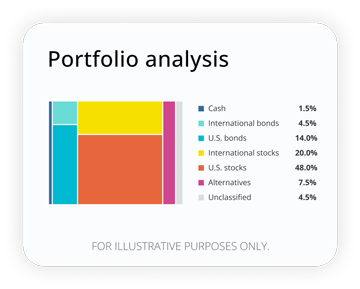
How well are your investments performing?
Analyze your portfolio in minutes and receive a target allocation for your goals.
* Exchange-traded funds (ETFs) are a type of exchange-traded investment product that must register as either an open-end investment company (generally known as “funds”) or a unit investment trust. ETFs are not mutual funds.
Unlike with mutual funds, individual shares of ETFs are not redeemable directly with the issuer. ETF shares are a collection of securities bought and sold at market price, which may be higher or lower than the net asset value. Investment returns will vary based on market conditions and volatility, so an investor’s shares, when redeemed or sold, may be worth more or less than their original cost. ETFs are subject to risks, including those of their underlying securities.
This calculator is for information purposes only and is not intended to provide investment, legal, tax or accounting advice, nor is it intended to indicate the performance, availability or applicability of any product or service.
1 Investment Company Institute, “Release: 529 Plan Program Statistics, December 2025,” March 2026.
2 FINRA, “529 Plans,” accessed April 2026.
3 Library of Congress, “Tax-Preferred College Savings Plans: An Introduction to 529 Plans,” accessed April 2026.
4 IRS, “TG 44: Qualified Tuition Programs – IRC Section 529,” accessed April 2026.
5 IRS, “Frequently asked questions on gift taxes,” accessed April 2026.
RO5480635-0526
 Be current.



The Currency editors
Staff contributors
The CurrencyTM writers and editors cover the latest financial news and insights shaping how we live, work, and play. The team provides accurate, data-driven, and timely content aimed at empowering financial freedom for all.
The content contained in this blog post is intended for general informational purposes only and is not meant to constitute legal, tax, accounting or investment advice. You should consult a qualified legal or tax professional regarding your specific situation. No part of this blog, nor the links contained therein is a solicitation or offer to sell securities. Compensation for freelance contributions not to exceed $1,250. Third-party data is obtained from sources believed to be reliable; however, Empower cannot guarantee the accuracy, timeliness, completeness or fitness of this data for any particular purpose. Third-party links are provided solely as a convenience and do not imply an affiliation, endorsement or approval by Empower of the contents on such third-party websites. This article is based on current events, research, and developments at the time of publication, which may change over time.
Certain sections of this blog may contain forward-looking statements that are based on our reasonable expectations, estimates, projections and assumptions. Past performance is not a guarantee of future return, nor is it indicative of future performance. Investing involves risk. The value of your investment will fluctuate and you may lose money.
Certified Financial Planner Board of Standards Inc. (CFP Board) owns the certification marks CFP®, CERTIFIED FINANCIAL PLANNER™, CFP® (with plaque design), and CFP® (with flame design) in the U.S., which it authorizes use of by individuals who successfully complete CFP Board's initial and ongoing certification requirements.