

Credit card debt can derail money goals: How to get on track
Credit card debt can derail money goals: How to get on track
High-interest credit card debt can crowd out major goals like saving for a home and retirement, but steady payoff strategies can help restore flexibility
Credit card debt can derail money goals: How to get on track
High-interest credit card debt can crowd out major goals like saving for a home and retirement, but steady payoff strategies can help restore flexibility

05.06.2026
Key takeaways:
- Credit card debt hit a record $1.28 trillion at the start of 2026, with many unable to pay in full each month.
- High interest rates can compound balances and delay savings or major purchases.
- Consistent paydown strategies can reduce costs and improve financial flexibility.
Credit card debt can quietly reshape your financial trajectory because of how expensive and persistent it can be for millions of Americans.1
Credit card balances rose by $44 billion in the fourth quarter of 2025 to a record $1.28 trillion, up 5.5% from a year earlier, according to the Federal Reserve Bank of New York.2 An estimated 111 million Americans were unable to pay their credit card bills in full each month at the end of 2025, according to a survey from consumer advocacy groups..3
Interest rates add to the strain, with the average rate on accounts carrying a balance at 21.52% in February 2026, the Federal Reserve Board reported. Unpaid balances at high rates can compound, making it harder to build wealth and reach financial goals like buying a home or saving for retirement.4
The good news is that such impacts are reversible. Paying down balances, even on a small and steady basis, can free up cash flow and improve credit. As you pay off more debt, you could redirect money toward savings, investments, and big purchases.
The hidden costs of carrying a balance
Some costs don’t show up on a monthly statement. About 40% of Americans have delayed or canceled a major purchase due to credit card debt and other financial pressures, while 27% have reduced or paused contributions to savings and emergency funds, Empower research shows.
There are other impacts on longer-term financial goals. About 3 in 5 workers and 3 in 10 retirees say debt is hurting their ability to save for or live comfortably in retirement, according to a 2026 survey from the Employee Benefit Research Institute.5
Card debt can also delay major milestones like homeownership. It can raise debt-to-income ratios and weigh on credit scores, which could make lenders more cautious. Even if approved for a mortgage, large monthly card payments could limit how much of a home loan a borrower can afford.6
There’s also a potential psychological toll: Nearly 2 in 5 Americans say credit card and other debt keeps them up at night, and makes them more cautious about spending or investing. Taking steps in the right direction to reduce and manage debt can make a meaningful difference right way.
Read more: Saving for your first home: 10 things to know
Tackling the card debt problem
The average credit card debt per American in March 2026 was $6,519, according to TransUnion, one of the three major U.S. credit reporting agencies. If interest is growing your balance(s) each month, it may be time to make a plan.7
It’s important to get a clear picture of what you owe, including balances, interest rates and minimum payments. From there, you can review your monthly income and expenses to identify where you might be able to cut discretionary costs and redirect money toward paying down debt.
Having a clear budget in place can make paying down balances and future use of credit cards more deliberate.
While paying only the monthly minimum payment keeps a credit card account current, it allows most of the balance to carry over and accrue interest.
Paying more than the minimum — even modestly — can begin shortening the payoff timeline. Tools like Empower's debt payoff calculator can be useful to help set goals for clearing balances.
Snowball vs. avalanche method
Two common approaches for tackling balances on multiple credit cards are the “debt avalanche” and “debt snowball” methods.
The debt avalanche method focuses on minimizing interest costs. You continue making minimum payments on all debts while directing any extra money toward the balance with the highest interest rate. Once that’s paid off, you move to the next-highest rate. This approach:
- Targets the most expensive debt first.
- Seeks to more quickly reduce total interest paid over time.
The debt snowball method is designed to build momentum. It prioritizes the smallest balance first, even if it doesn’t have the highest rate. When done, you would roll that payment into the next-smallest balance, creating a “snowball” effect. This approach:
- Can deliver quicker wins by eliminating balances faster.
- Can help maintain motivation and consistency.
Read more: How do I pay off credit card debt? Get a Sense Check
Other tools to pay down card debt
There are other financial tools that may help with debt payoff. Balance transfers can provide temporary relief by reducing or eliminating interest, but they also require discipline. If the balance isn’t paid off before the promotional period ends, interest charges can return.8
Other options such as debt consolidation loans or even personal loans have the potential to lower interest rate or simplify payments in some cases, but they work best when paired with new spending habits and a clear plan.
In addition to regular payments, a financial windfall — such as a tax refund, salary raise or bonus — can provide an opportunity to further pay down balances and reduce interest costs, potentially by thousands of dollars.9
Paying down balances can have benefits beyond reducing interest. Lower balances can reduce credit utilization, which can improve credit scores and lead to better borrowing terms for things like auto loans and mortgages.
Once a plan is in place, staying current on payments is critical. Late payments can trigger fees and hurt credit scores, making borrowing more expensive.
Read more: 5 terms to know to use credit cards responsibly
Card debt affects every generation
No matter what your age or immediate financial goals, carrying credit card debt can be a financial strain.
Gen Z is leaning more on credit cards than previous generations did at the same age, often to cover everyday expenses as other costs like rent and car payments take up a larger share of income. That can leave less room to build savings for a home, a family, or a retirement fund.
But the impact isn’t limited to any one generation. A 2025 AARP survey found that 46% of Americans over age 50 carry credit card debt from month to month. Such debt remains most common among adults age 50-64, but has risen for older Americans as well.10
For those nearing retirement, card debt can limit the ability to save more. Retirees living on fixed incomes may face added pressure to keep up with payments, especially when interest costs remain high.11
Regardless of age, the path forward is often similar: review your income and expenses in advance and create a plan to bring down balances and limit interest costs. As balances come down, cash flow can improve, credit profiles can strengthen, and money can be redirected toward goals that build long-term financial stability.
Progress can come in small steps. Whether it’s completely paying off a balance or sticking with a plan for a certain period of time, recognizing your milestones and rewarding yourself can help maintain momentum toward redirecting your money from debt to financial goals.
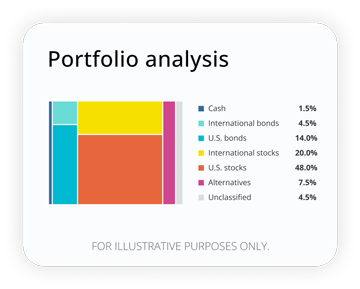
How well are your investments performing?
Analyze your portfolio in minutes and receive a target allocation for your goals.
1 Newsweek, “Credit Card Debt Crisis Deepens as Millions Fall Behind,” March 2026.
2 Federal Reserve Bank of New York, “Household Debt Balances Reach $18.8 Trillion in the Fourth Quarter,” February 2026.
3 MarketWatch, “A record 111 million Americans can’t pay their credit-card bills in full,” March 2026.
4 Federal Reserve Board, “Consumer Credit – G19,” April 2026.
5 EBRI, “2026 Retirement Confidence Survey Finds Americans Less Confident About Retirement as Worries Grow Over Social Security, Medicare and Rising Costs,” April 2026.
6 Experian, “Should You Pay Off Credit Card Debt Before Buying a Home?,” January 2026.
7 Transunion, “Credit Industry Snapshot,” March 2026.
8 CBS News, “5 expert-driven tips for paying off $30,000 in credit card debt,” July 2024.
9 Bloomberg, “Tax Refund Splurge for Many Americans Is Paying Down Debt,” April 2026.
10 AARP, “Credit card debt and adults age 50-plus,” March 2025.
11 AARP, “Credit card debt and adults age 50-plus,” March 2025.
RO5457044-0526
 Get The Currency newsletter


The Currency editors
Staff contributors
The CurrencyTM writers and editors cover the latest financial news and insights shaping how we live, work, and play. The team provides accurate, data-driven, and timely content aimed at empowering financial freedom for all.
The content contained in this blog post is intended for general informational purposes only and is not meant to constitute legal, tax, accounting or investment advice. You should consult a qualified legal or tax professional regarding your specific situation. No part of this blog, nor the links contained therein is a solicitation or offer to sell securities. Compensation for freelance contributions not to exceed $1,250. Third-party data is obtained from sources believed to be reliable; however, Empower cannot guarantee the accuracy, timeliness, completeness or fitness of this data for any particular purpose. Third-party links are provided solely as a convenience and do not imply an affiliation, endorsement or approval by Empower of the contents on such third-party websites. This article is based on current events, research, and developments at the time of publication, which may change over time.
Certain sections of this blog may contain forward-looking statements that are based on our reasonable expectations, estimates, projections and assumptions. Past performance is not a guarantee of future return, nor is it indicative of future performance. Investing involves risk. The value of your investment will fluctuate and you may lose money.
Certified Financial Planner Board of Standards Inc. (CFP Board) owns the certification marks CFP®, CERTIFIED FINANCIAL PLANNER™, CFP® (with plaque design), and CFP® (with flame design) in the U.S., which it authorizes use of by individuals who successfully complete CFP Board's initial and ongoing certification requirements.