

Tax-smart strategies for year-end planning
Tax-smart strategies for year-end planning
These efficient moves may potentially help lower taxes and strengthen long-term finances
Tax-smart strategies for year-end planning
These efficient moves may potentially help lower taxes and strengthen long-term finances

10.27.2025

Listen
·Tax-smart strategies for year-end planning
Key takeaways:
- The end of the year can be an ideal time for people to make smart, tax-efficient moves that can help lower their tax bill and strengthen long-term finances
- Max out 401(k)/403(b) contributions and catch-ups before December 31
- Take RMDs or use QCDs by year-end to avoid penalties and reduce taxable income
- Consider a Roth IRA conversion if future tax rates may be higher
- Fund IRAs and HSAs by Tax Day 2026 to capture 2025 tax benefits
Taxpayers can take steps to help lower their 2025 tax bill and strengthen their overall financial strategy. Strategic year-end moves — such as maximizing retirement contributions, planning required distributions, and exploring charitable or tax-efficient giving — can provide meaningful benefits now and in the years ahead. Additional contributions to IRAs and HSAs can also be made through the filing deadline to tap into some additional potential tax advantages.
The end of the year provides an opportunity to think about smart moves that might help lower tax bills in April — while at the same time, support long-term financial goals. To prepare for tax season, consider these proactive steps to take by year-end as well as those that can wait until Tax Day.
Actions to take by December 31
Max out 401(k) and 403(b) contributions
If cash flow allows, consider increasing 401(k) or 403(b) contributions before December 31. For 2025, employees generally can invest up to $23,500. Older workers may qualify to make additional contributions beyond the annual limits: People age 50 and older can contribute an additional $7,500 catch-up, and those ages 60-63 may qualify for a “super catch-up” of $11,250. Keep in mind, the maximum contribution limit is $70,000, which includes employee deferrals, employer match, and any after-tax contributions combined.
Read more: What are catch-up contributions
Plan RMDs and use QCDs
Starting at age 73, required minimum distributions (RMDs) from certain pre-tax retirement accounts generally must be withdrawn by year-end to avoid penalties. Since RMDs are withdrawn from qualified requirement accounts, some or all of the withdrawal will be considered taxable income — which could push some people into a higher tax bracket.
Qualified Charitable Distributions (QCDs) can potentially reduce taxable income from RMDs. IRA owners can transfer up to $100,000 to charity annually tax-free beginning at age 70½, and once account owners reach age 73, donations to an eligible charitable organization can count towards RMDs as long as the QCD is paid directly from the IRA to the charity.
Read more: Don’t need the RMD? Tax-smart strategies for Required Minimum Distributions
Gift assets other than cash
Philanthropic efforts tend to ramp up during the holiday season, with about 30% of annual giving typically taking place in December — and a well-planned approach to giving can create an opportunity to do well by doing good. Consider this: Non-cash gifts like stock or property can potentially yield greater tax benefits than giving cash. Donating a long-held appreciated stock may eliminate capital gains taxes — and at the same time, may allow for an overall larger gift since qualified charities are exempt from capital gains tax. Donating an investment property can yield similar tax advantages.1
High income donors should keep in mind that 2025 will be the final window to maximize giving under current tax rules, as the One Big Beautiful Bill Act tightens caps beginning in 2026. At the same time, standard deduction filers — roughly 144 million Americans — will be able to claim a $1,000–$2,000 above-the-line deduction for charitable giving in tax year 2026.
Consider a Roth conversion
Conversions from traditional to Roth IRAs can sometimes be a tax-efficient option for those who expect to be in a higher tax bracket in the future and want to take advantage of potential tax-free growth and withdrawals in those later years. Since converted amounts will be treated as taxable income for the year they’re made, planning the timing can be key.
Read more: What are Roth IRA taxes & how do they work?
Review withholding and pay estimated taxes
Changing marital status, switching jobs, starting a side business, or receiving additional income can affect tax status. Be sure to check on withholding amounts to ensure enough taxes are being withheld based on income.
Individuals who receive income such as interest, dividends, alimony, self-employment income, capital gains, prizes, and awards may also have to make estimated tax payments. Paying along the way can potentially reduce their tax burden in April.
Estimated tax payments are generally due on or around:2
April 15 for income earned January 1 to March 31
- June 15 for income earned April 1 to May 31
- September 15 for income earned June 1 to August 31
- January 15 of the following year for income earned September 1 to December 31
Read more: Do you need to make estimated tax payments?
Actions to take by Tax Day
Fund IRAs
Taking advantage of tax-deferred retirement plans can be a tax-efficient move for some. Traditional IRAs can be funded up until Tax Day in April 2026 for the 2025 tax year. Individuals can contribute up to $7,000 (or 100% of earned income, whichever is less). For those age 50 and older, the IRS also allows for an additional catch-up contribution of $1,000.
The same deadline and contribution limits apply to Roth IRAs. Since Roth contributions are made with after-tax dollars, they will not reduce taxable income for the year they’re made. However, withdrawals can be made federal income tax-free if qualifying conditions are met, including meeting the five-year rule, reaching age 59½, having a disability, or making a first-home purchase. Remember that state and local taxes may still apply.
Read more: Roth vs. traditional IRAs: Which should I choose?
Optimize HSAs
Health Savings Accounts (HSAs) offer a unique triple tax advantage — tax-deductible contributions, any tax-deferred earnings are federal tax-free, and federal tax-free withdrawals for qualified medical costs.3 Since there’s no “use-it-or-lose-it” penalty, unused HSA balances can rollover from year to year and be invested. Contribution limits increased in 2025 to $4,300 for individuals and $8,550 for families, plus an extra $1,000 catch-up amount allowed for people age 55 or older — and people have until Tax Day to make them.
Some final thoughts
Taking purposeful steps now can help people position themselves for a more manageable tax bill next April—and pave the way for solid financial footing in the years ahead. Remember to incorporate revisiting asset allocation and rebalancing portfolios as part of a year-end tax planning routine, and consider consulting with a financial or tax professional for guidance.
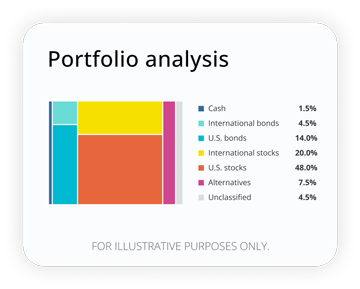
How well are your investments performing?
Analyze your portfolio in minutes and receive a target allocation for your goals.
1 Forbes, “Is It Better To Donate Cash, Stock Or Other Property?” January 24, 2025.
2 Internal Revenue Service, “Pay as you go, so you won't owe: A guide to withholding, estimated taxes and ways to avoid the estimated tax penalty,” May 15, 2025.
3 Contributions, any earnings, and withdrawals are federal income tax-free if used to pay for qualified medical expenses. State income taxes may still apply. HSA funds used for non-qualified medical expenses may be subject to applicable federal and state income taxes and/or penalties.
Asset allocation, diversification, or rebalancing does not ensure a profit or protect against loss.
RO4935436-1025
 Get The Currency newsletter



The Currency editors
Staff contributors
The CurrencyTM writers and editors cover the latest financial news and insights shaping how we live, work, and play. The team provides accurate, data-driven, and timely content aimed at empowering financial freedom for all.
The content contained in this blog post is intended for general informational purposes only and is not meant to constitute legal, tax, accounting or investment advice. You should consult a qualified legal or tax professional regarding your specific situation. No part of this blog, nor the links contained therein is a solicitation or offer to sell securities. Compensation for freelance contributions not to exceed $1,250. Third-party data is obtained from sources believed to be reliable; however, Empower cannot guarantee the accuracy, timeliness, completeness or fitness of this data for any particular purpose. Third-party links are provided solely as a convenience and do not imply an affiliation, endorsement or approval by Empower of the contents on such third-party websites. This article is based on current events, research, and developments at the time of publication, which may change over time.
Certain sections of this blog may contain forward-looking statements that are based on our reasonable expectations, estimates, projections and assumptions. Past performance is not a guarantee of future return, nor is it indicative of future performance. Investing involves risk. The value of your investment will fluctuate and you may lose money.
Certified Financial Planner Board of Standards Inc. (CFP Board) owns the certification marks CFP®, CERTIFIED FINANCIAL PLANNER™, CFP® (with plaque design), and CFP® (with flame design) in the U.S., which it authorizes use of by individuals who successfully complete CFP Board's initial and ongoing certification requirements.