

How to invest in a 529 plan during uncertain times
How to invest in a 529 plan during uncertain times
529 plans offer built-in strategies to help manage risk and preserve value in any market
How to invest in a 529 plan during uncertain times
529 plans offer built-in strategies to help manage risk and preserve value in any market

10.22.2025

Listen
·How to invest in a 529 plan during uncertain times
Key takeaways:
- 529 plans typically offer investment options that are designed to shift risk over time, helping to mitigate short-term market volatility.
- Many 529 plans offer the use of investment options with “glide paths” — age-based investment shifts designed to reduce risk gradually.
- As college draws closer, these plans can adapt to match spending needs more precisely.
529 plans continue to be a powerful tool for college savings, with built-in features that help manage market risk.
Families with 529 plans are facing a different kind of homework this fall: figuring out how to keep their education savings on track while markets shift and college deadlines approach. Whether a 529 account is just getting started or entering its drawdown phase ahead of tuition expenses, market volatility may complicate how families balance growth and protection.
Savers don’t necessarily need to shake up their plans or make reactive moves with their 529 strategy. Understanding how 529 investments are structured, how they’re built for the long-term, and why the time horizon matters can all help keep long-term goals intact, even in volatile markets.
How 529 investments rebalance
Market slides may prompt families to re-evaluate how they invest in a 529.1 529 accounts typically offer several time-targeted funds owners can choose from, typically tied to the year that the student will enter college (or a trade program, according to new rules).2
This design can help make 529 plans resilient against short-term market fluctuations.3 Time-targeted funds automatically rebalance to reduce risk over time: the further away the maturity date, the more risk-tolerant the investments might be.4 Over time, the fund will typically reallocate to more conservative, risk-averse investments.
Read more: School rules: College savings can help fund your retirement
Time is on the 529’s side
For the long-term investor (often for a young child), withdrawals are a decade away if not longer. For these investors, a market dip may come with concerns about temporary setbacks to their investments or a lack of growth momentum. Although the instinct to stop investing until the markets settle may be understandable, it is often more beneficial to continue funding the account.5
Early savers have the advantage of time. Each contribution helps build resilience through market corrections and compounding . A temporary drop in share prices can become an advantage if markets rebound.6
Account owners with college- or trade school-bound students are likely more concerned with drawing down their 529.7 Capital preservation (protecting the investment value as much as possible) becomes a main goal.8 Many 529s investment options begin with more aggressive holdings (stocks, index funds) and become more conservative over time.9 This is known as a glide path, and is common for investors who chose the corresponding maturity year to their education goals. This glide path is designed to reduce investment risk as the account gets closer to withdrawals for qualifying education expenses.10
Riding out volatility with a 529 account
Volatility may present the opportunity to gain value for long-term savers — be it in a 529, or through investments in mutual funds, exchange-traded funds (ETFs), or stocks in other account types. This is due to dollar-cost averaging: the practice of investing a set amount on a schedule, regardless of whether prices are up or down. For example:
- An account owner commits a fixed amount of money to invest at regular intervals.
- When share prices are low, this fixed contribution can purchase a larger number of shares.
- When share prices are high, the fixed contribution may purchase fewer shares.
- Consistent buying behaviors smooth out the average cost per share over the full life of the account.
529 owners can help maintain stability through dollar-cost averaging and a steady investing hand. Investing in bull and bear markets helps to average out the cost of investing over time, which helps steady the account’s value accumulation.
Why age matters with a 529
Many states offering 529 accounts also provide a selection of age-based investment portfolios.11 With an age-based fund, account owners may not need to monitor their investments constantly. Rather, the accounts are rebalanced over time to gradually reduce risk as the account reaches maturity.12
Here is how the typical glide path works:13
- Early years: When the beneficiary is young, the portfolio tilts toward higher growth by holding more stocks. This more aggressive stance seeks to take advantage of the long-time horizon on the account, which allows funds to grow and can help reduce the impact of short-term fluctuations.
- Later years: The glide path comes into effect. As the beneficiary gets closer to drawing down the account balance, the portfolio mix shifts toward more conservative investments.14 For example, stock holdings could be substituted for bonds and cash alternative investments. This transition can help preserve the accumulated balance before funds come out for tuition or other qualified expenses.15
It’s important to determine if the 529 is set up for automatic allocation or kept static by choice.16 With the latter, the asset mix does not change on its own and is up to the individual to manage. Those who want to control what investments they make may make two investment changes per year per account, according to IRS rules on 529s.17
Read more: What to do if you have an overfunded 529 plan
529 withdrawal strategies for the home stretch
Volatility may pose the greatest challenge for account owners preparing to make withdrawals. Here are several strategies that can help preserve the account balance.
Use flexible timing to manage withdrawals
Account owners don’t need to make 529 withdrawals at the exact moment a tuition bill is due. 529 withdrawals can happen any time within the same calendar year as the qualified education expense.18 This could help smooth volatility impacts and offer greater flexibility when the money is withdrawn. For example, an account holder can use their own liquid assets (like cash) to pay the bill while waiting for markets to improve before year-end, making the 529 withdrawal at their discretion during the calendar year.19
Expand the use of 529 withdrawals
Recent federal updates have expanded how 529 plans can be used, allowing account owners to use up to $20,000 annually per student for K–12 tuition. This change may influence withdrawal timelines, especially for families with private school costs. This added flexibility may prompt earlier drawdowns of 529 funds and could make age-based investment strategies even more important. Glide paths that shift to more conservative holdings during high school years may help preserve value for families that plan to use funds before college.
Spread out withdrawals
Instead of liquidating a large sum from the 529 to pay for qualifying expenses, it may be beneficial to make smaller, staggered withdrawals throughout the semester or year.20 This approach may help average out the withdrawal cost and stops the account from potentially locking in losses during low points in the market.
529 101: Staying the course
529 plans typically offer investments that are structured to adjust over time as the contributors’ goals evolve. Although volatility can complicate the picture, it does not necessarily have to derail the plan. From age-based glide paths to flexible withdrawal timing, today's 529 accounts offer tools that help investors stay steady, even as markets shift. For families focused on education, this stability can be its own investment.
FAQ
1. What is a 529 plan?
A 529 plan is a tax-advantaged account designed to help families save for education expenses, including college and trade programs.21
2. How do 529 glide paths work?
Glide paths gradually shift investments from higher-risk assets like stocks to more conservative ones such as bonds and cash alternatives as the beneficiary nears college age.22
3. Should families stop contributing during market downturns?
Continuing contributions can lower the average cost per share and capture growth potential when markets rebound.23
4. How does dollar-cost averaging apply to a 529 plan?
Investing fixed amounts on a schedule helps smooth out fluctuations in market prices over time.24
5. Can 529 withdrawals be timed strategically?
Yes. Withdrawals can occur anytime in the same calendar year as the qualified expense, providing flexibility to wait out temporary market dips.25
6. Are 529 plans only for college?
No. Under current federal rules, 529 funds may also cover K–12 tuition and certain trade programs.26
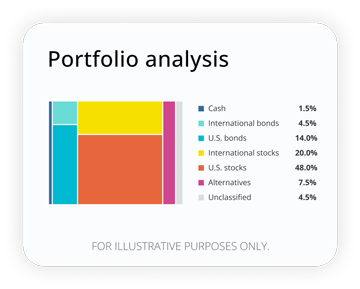
How well are your investments performing?
Analyze your portfolio in minutes and receive a target allocation for your goals.
1 New York Times, “How Should You Invest for College During Market Swings?” April 2025
2 My529, “Investment Options,” Accessed October 2025
3 CNBC, “How college savers can manage 529 plans in a turbulent market,” May 2025
4 CNBC, “What college savers need to know about their 529 accounts as market roils,” April 2025
5 NYSaves 529, “Avoid the top 529 plan mistakes,” Accessed May 2025
6 WA 529 Invest, “Start early to make the most of your savings,” Accessed October 2025
7 New York Times, “How Should You Invest for College During Market Swings?” April 2025
8 Ibid
9 Morningstar, “529 Plans: What’s Changed and What’s the Same?,” June 2023
10 Investor.gov, “Saving for education – 529 plans,” Accessed October 2025
11 CNBC, “These states offer free money when you open a 529 college savings plan for your child,” September 2025
12 Forbes, “After The Market Drop: How To Protect Your 529 College Savings,” March 2025
13 Corporate Finance Institute, “Glide Path,” Accessed October 2025
14 Morningstar, “What Bad Returns at the Wrong Time Can Mean for College,” Accessed October 2025
15 Ibid.
16 U.S. News, “529 Plans: Should You Choose Static or Age-Based?,” September 2025
17 Internal Revenue Service, “Exempt Organizations Technical Guide,” February 2024
18 Internal Revenue Service, “529 Plans: Questions and answers,” Accessed October 2025
19 Ibid.
20 CNBC, “With college tuition bills coming due, here’s what to know before you tap your 529 plan,” May 2025
21 Internal Revenue Service, “529 Plans: Questions and answers,” Accessed October 2025
22 Morningstar, “529 Plans: What’s Changed and What’s the Same?,” June 2023
23 CNBC, “With college tuition bills coming due, here’s what to know before you tap your 529 plan,” May 2025
24 New York Times, “How Should You Invest for College During Market Swings?” April 2025
25 Morningstar, “What Bad Returns at the Wrong Time Can Mean for College,” Accessed October 2025
26 Internal Revenue Service, “529 Plans: Questions and answers,” Accessed October 2025
Investing involves risk, including possible loss of principal.
Asset allocation, diversification, dollar-cost averaging or rebalancing does not ensure a profit or protect against loss.
RO 4911082-1025
 Get The Currency newsletter



The Currency editors
Staff contributors
The CurrencyTM writers and editors cover the latest financial news and insights shaping how we live, work, and play. The team provides accurate, data-driven, and timely content aimed at empowering financial freedom for all.
The content contained in this blog post is intended for general informational purposes only and is not meant to constitute legal, tax, accounting or investment advice. You should consult a qualified legal or tax professional regarding your specific situation. No part of this blog, nor the links contained therein is a solicitation or offer to sell securities. Compensation for freelance contributions not to exceed $1,250. Third-party data is obtained from sources believed to be reliable; however, Empower cannot guarantee the accuracy, timeliness, completeness or fitness of this data for any particular purpose. Third-party links are provided solely as a convenience and do not imply an affiliation, endorsement or approval by Empower of the contents on such third-party websites. This article is based on current events, research, and developments at the time of publication, which may change over time.
Certain sections of this blog may contain forward-looking statements that are based on our reasonable expectations, estimates, projections and assumptions. Past performance is not a guarantee of future return, nor is it indicative of future performance. Investing involves risk. The value of your investment will fluctuate and you may lose money.
Certified Financial Planner Board of Standards Inc. (CFP Board) owns the certification marks CFP®, CERTIFIED FINANCIAL PLANNER™, CFP® (with plaque design), and CFP® (with flame design) in the U.S., which it authorizes use of by individuals who successfully complete CFP Board's initial and ongoing certification requirements.