

Getting out what’s put into retirement plans
Getting out what’s put into retirement plans
What savers need to know about the rules around how and when money comes out of a 401(k)
Getting out what’s put into retirement plans
What savers need to know about the rules around how and when money comes out of a 401(k)

09.29.2025

Listen
·Getting out what’s put into retirement plans
Key takeaways
- Some 401(k) plans require funds to be distributed in a fixed order, which can reshape portfolio risk.
- Required minimum distributions (RMDs) and withdrawal rules are evolving, often with more exceptions and flexibility than in the past.
- Loans and hardship withdrawals can help meet short-term needs, but may carry long-term tradeoffs as well
Withdrawal settings and tax rules may affect how long 401(k) savings last, and how much of it remains in the participant’s account.
People may be familiar with the requirements around withdrawing money from a 401(k) account, whether it’s for retirement expenses or keeping up with required minimum distribution (RMD) rules. Fewer may realize their plans could restrict how that money comes out. Plan withdrawal rules can determine which investments types get sold first.
This structure has the potential to shift a 401(k)'s risk profile. Withdrawal hierarchies can create changes that can go without notice, but may end up altering the overall structure of a portfolio in a person’s retirement years.
What withdrawal hierarchy rules mean
Some retirement plans allow account holders to choose which funds to draw from. Others require withdrawals to be made on a “pro-rata” basis, which means withdrawals happen across all the account’s investments at any risk level.1 This can help keep the same amount of risk, even as people draw down from their retirement account.
Hierarchy-based withdrawals operate differently. These plans pull from a ranked list of investments, and may draw down more conservative holdings (such as cash or conservative bond funds), and then working their way up in terms of risk. This means the highest-risk investments could be the ones left in the account the longest.2
Although this may provide a longer investment period for higher-yield potential assets, it may also leave a portfolio with higher risk when low- to moderate-risk 401(k) strategies are preferred. In other words, these plans may gradually increase volatility exposure rather than decrease it, all while retirees may want to preserve their account balance against market trends.
Account holders may not know whether their plan is pro-rata or hierarchy-based.3 Plan summaries may not always include specifics on redemption rules. The recordkeeper, who executes on day-to-day operations, has access to information on what investments come out first.
Read more: 401(k) withdrawal rules: How to avoid penalties
Why the withdrawal order matters
The asset allocation in a 401(k) can shift with every withdrawal. Pulling cash, bonds, or low-risk liquid investments may reshape the portfolio by having in medium- to high-risk holdings.4 Over time, what started as a balanced 50/50 portfolio could quietly shift to 60/40 — with more money in riskier investments than originally planned.
This drift may seem minor at first, but it may add up over time. Retirees tend to draw down during volatile markets, rather than neutral or bullish periods.5 If hierarchy withdrawals pull conservative assets first, the 401(k) balance may be more exposed to market swings.6
Withdrawal mechanics may not always be easy to find
Retirement plan documents may tend to focus on contribution rules, fees, and eligibility.7 Withdrawal mechanics may not be as visible, even though they’re important.
Some plans follow pro-rata rules to meet IRS distribution requirements. But in this case, “pro rata” may only refer to how tax obligations are sourced, rather than which investments are sold and when.8 Participants may assume withdrawals are spread evenly across holdings, even though their plan actually uses a hierarchy system.9
Read more: 401(k) vs. 403(b): What's the difference?
What retirees can do about 401(k) withdrawals
Pro-rata and hierarchical drawdowns are about how the mechanics of a plan works, rather than trying to time the market. There are several things retirees should consider if they are curious about their plans’ draw-down method:
- Ask about their plan’s withdrawal protocol: Find out whether the plan uses a hierarchy or pro-rata format, and if holdings can be selected for sale.
- Request information: Account owners in hierarchical plans may want to request a copy of plan documents describing the order of execution for accounts, which may serve as a blueprint for what assets are sold and when.
- Consider rebalancing before withdrawing:* Adjusting assets to match risk tolerance may help offset the chance of high-risk investments dominating one’s account after low-risk investments are sold.
- Watch for allocation drift: Small withdrawals may also tilt the portfolio mix. Staying on top of withdrawals can help preserve the asset allocation, which can be particularly important for keeping a sustainable 401(k) balance.
Keeping it in balance
One of the biggest potential retirement risks may not take the form of volatile markets or funding missteps. It may come from gradual, potentially unnoticed changes within a portfolio.
Withdrawals processed automatically may shift the account’s balance without much notice. Not all plans sell off lower-risk investments first: it’s also possible that the plan could sell higher-risk stock investments and sell more conservative mutual funds and exchange-traded funds (ETFs) later on.10 The order, method, and mix all influence how a portfolio performs in different market conditions. Retirees may not see it happen unless they know where to look. But when they do, they may be able to help keep their balance while pulling out the funds they need.
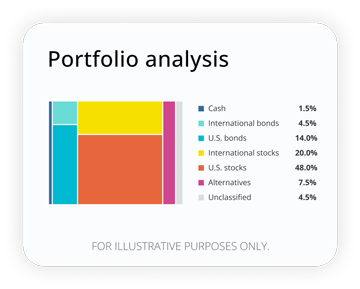
How well are your investments performing?
Analyze your portfolio in minutes and receive a target allocation for your goals.
*Rebalancing does not ensure a profit or protect against loss.
1 PlanSponsor, “What Pro-Rata Rules Mean When Taking Plan Distributions,” June 2024
2 CNBC, “There’s a ‘danger zone’ for retirees when the stock market dips. How to shield your portfolio,” March 2025
3 Wall Street Journal, “I Got Burned by the 401(k) ‘Hierarchy Trap’,” June 2025
4 Cornell University, “A Stochastic Control Approach to Defined Contribution Plan Decumulation: "The Nastiest, Hardest Problem in Finance.” August 2020
5 Morningstar, “A Down-Market Survival Guide for Retirees,” April 2025
6 The Wharton School, University of Pennsylvania, “Defaulting 401(k) Assets into Payout Annuities For “Pretty Good” Lifetime Incomes,” June 2025
7 Internal Revenue Service, “Plan disclosure documents - Understanding your employer’s retirement plan,” Accessed September 2025
8 PlanSponsor, “What Pro-Rata Rules Mean When Taking Plan Distributions,” June 2024
9 Wall Street Journal, “I Got Burned by the 401(k) ‘Hierarchy Trap’,” June 2025
10 Cornell University, “A Stochastic Control Approach to Defined Contribution Plan Decumulation: "The Nastiest, Hardest Problem in Finance.” August 2020
RO4858985-0925
 Get The Currency newsletter



The Currency editors
Staff contributors
The CurrencyTM writers and editors cover the latest financial news and insights shaping how we live, work, and play. The team provides accurate, data-driven, and timely content aimed at empowering financial freedom for all.
The content contained in this blog post is intended for general informational purposes only and is not meant to constitute legal, tax, accounting or investment advice. You should consult a qualified legal or tax professional regarding your specific situation. No part of this blog, nor the links contained therein is a solicitation or offer to sell securities. Compensation for freelance contributions not to exceed $1,250. Third-party data is obtained from sources believed to be reliable; however, Empower cannot guarantee the accuracy, timeliness, completeness or fitness of this data for any particular purpose. Third-party links are provided solely as a convenience and do not imply an affiliation, endorsement or approval by Empower of the contents on such third-party websites. This article is based on current events, research, and developments at the time of publication, which may change over time.
Certain sections of this blog may contain forward-looking statements that are based on our reasonable expectations, estimates, projections and assumptions. Past performance is not a guarantee of future return, nor is it indicative of future performance. Investing involves risk. The value of your investment will fluctuate and you may lose money.
Certified Financial Planner Board of Standards Inc. (CFP Board) owns the certification marks CFP®, CERTIFIED FINANCIAL PLANNER™, CFP® (with plaque design), and CFP® (with flame design) in the U.S., which it authorizes use of by individuals who successfully complete CFP Board's initial and ongoing certification requirements.