

The rise of health savings accounts with Gen Z and Millennials
The rise of health savings accounts with Gen Z and Millennials
Rising limits and growing adoption are turning HSAs into a long-term tool for younger workers
The rise of health savings accounts with Gen Z and Millennials
Rising limits and growing adoption are turning HSAs into a long-term tool for younger workers

08.26.2025

Listen
·The rise of health savings accounts with Gen Z and Millennials
Key takeaways
- 2025 contribution limits for health savings accounts (HSA) have increased, giving workers more room to save and invest for future healthcare needs.
- Younger account holders may benefit from investing in an HSA early and letting them grow over time.
- HSAs can be used for medical expenses now or as a flexible way to save for future needs.
HSAs may present Gen Z and Millennials with tax advantages, investing potential, and flexibility — making them a potentially compelling way to build future healthcare savings.
Health savings accounts (HSAs) are gaining momentum in the world of savings. For Gen Z and Millennials, the long investing runway ahead may make them especially powerful. Contribution caps are rising, more employers are offering Consumer-directed Healthcare (CDH) plans to employees alongside HSAs, and a growing number of account holders are investing their balances in mutual funds, exchange-traded funds (ETFs), or other options offered within their HSA.1 Even though these accounts are designed to cover healthcare expenses, their saver-friendly terms can also make them ways to invest long-term for future medical costs.
For younger workers, an HSA could provide another way to save for future medical needs tax-free while also serving as an investment account that may help them see returns over time.
Saving now, spending later
A number of people treat their HSAs like a checking account for medical bills, which is their intended purpose.2 But an increasing number of young workers are shifting to an investment mindset with their accounts. In 2011, only 2% of accounts were invested. By 2023, that figure grew to 15%.3
Invested accounts are also more likely to hold larger balances. As of mid-2024, total invested HSA assets rose 38% year-over-year, due in part to strong market performance.4 That’s the benefit of compounding — investors earn returns on their contributions, and those returns generate earnings of their own.
Over time, this cycle could make the growth curve steepen quickly. This may benefit younger HSA investors: the earlier money is invested, the more likely it is to grow substantially over time. Shifting savings to investments may not be right for everyone, however. But for those who can keep the money stashed away for the long-term, it may create a much larger reserve for future healthcare needs.
Read more: Drugmakers expand direct prescription sales. Here’s what to know
How HSAs work
HSAs are available to people enrolled in High-Deductible Health (HDH) plans and CDH plans. Contributions go in pre-tax and can be deducted from the account owner’s income, much like 401(k)s and other employer-sponsored healthcare plans.5 Earnings also grow tax-free for the life of the investment, and withdrawals to pay for qualifying medical expenses are also tax-free.6
The maximum HSA contribution for 2025 is $4,300 for self-only coverage, or $8,550 for family coverage. There is an additional $1,000 in catch-up payments for people 55 or older. To qualify for an HSA, an HDH or CDH plan must have a $1,650 deductible at minimum for individuals, or a $3,300 deductible for family coverage.7 Out-of-pocket maximums must be no higher than $8,300 or $16,600 respectively.8
The benefits of an HSA account are designed to help account holders pay for immediate expenses, but also for expenses years down the line. Unlike Flexible Spending Accounts (FSAs), which are tied to employers, HSAs stay with the account owner throughout the lifetime of the account.9 There is no requirement to spend down the balance every year, nor to drain the funds after leaving a job.
HSAs gain traction in the workplace
HSA-qualified plans are becoming more common. As of 2024:10
- 21% of covered workers are enrolled in an HSA-qualified HDHP
- 25% of firms offer HSA-qualified high-deductible plans through their employer
- Roughly 1 in 5 people provided with these plans are enrolled
- Employers contribute an average of $705 for self-only coverage and $1,297 for family plans
For many Gen Z and Millennials, healthcare costs may be relatively low compared to what they may experience later in life. This could make the higher deductibles of an HSA-qualified healthcare plan more predictable: fewer healthcare expenses at this life stage make deductibles easier to manage, while lower premium payments help keep payments in line with care. The money saved can go into an HSA, where it may compound for decades before it’s needed for medical care.
Read more: The Benefits Blueprint: Benefits to build financially resilient workforces
The benefits of HSAs for Gen Z and Millennials
Healthcare spending rises with age. Today’s youngest adults account for 44% of the U.S. population, but only about 21% of total health spending.11 That’s compared to adults 55 and older, who make up 41% of the population yet account for 56% of its spending.12 There is an advantage for younger workers with lower average yearly healthcare spending: Any additional savings could be invested, turning the account into a source of compounding interest rather than a healthcare-specific checking account.
For example, a 25-year-old who contributes $200 a month to an invested HSA that keeps pace with the S&P 500®’s performance — an average rate of return of 6.47% — could potentially build a balance of about $33,000 over 10 years. This is based on a hypothetical 6.47% return in line with S&P 500® averages.13 The account could accumulate around $453,000 by age 65, depending on investment performance and risk tolerance.
How HSAs grow with younger workers
An HSA plays several roles over time: they can be a tax-free investment vehicle earlier in life, a method of paying for increasing healthcare costs for families, and become a source of cash when paying for higher expenses later in life — all tax-free for qualifying expenses. This means younger workers who get in early may use their account balances for a range of purposes for every life stage.
For younger workers with time on their side, an HSA isn’t just another benefits checkbox. It can be the type of quiet, long-term financial move that plays the long game.
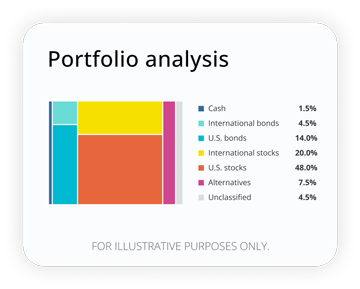
How well are your investments performing?
Analyze your portfolio in minutes and receive a target allocation for your goals.
The S&P 500® index and associated data are a product of S&P Dow Jones Indices LLC, its affiliates and/or their licensors and has been licensed for use by Empower Retirement, LLC. © 2025 S&P Dow Jones Indices LLC, its affiliates and/or their licensors. All rights reserved. Redistribution or reproduction in whole or in part are prohibited without written permission of S&P Dow Jones Indices LLC. For more information on any of S&P Dow Jones Indices LLC’s indices please visit www.spdji.com. S&P® is a registered trademark of Standard & Poor’s Financial Services LLC (“SPFS”) and Dow Jones® is a registered trademark of Dow Jones Trademark Holdings LLC (“Dow Jones”). Neither S&P Dow Jones Indices LLC, SPFS, Dow Jones, their affiliates nor their licensors (“S&P DJI”) make any representation or warranty, express or implied, as to the ability of any index to accurately represent the asset class or market sector that it purports to represent and S&P DJI shall have no liability for any errors, omissions, or interruptions of any index or the data included therein.
1 Internal Revenue Service, “26 CFR 601.602: Tax forms and instructions,” Accessed August 2025
2 Healthcare.gov, “Health Savings Account (HSA),” Accessed August 2025
3 EBRI, “Trends in Health Savings Account Balances, Contributions, Distributions, and Investments, 2011–2023,” June 2025
4 ABA Banking Journal, “Report: Total health savings account assets grew in 2024,” April 2025
5 Internal Revenue Service, “HSA Contributions,” Accessed August 2025
6 Internal Revenue Service, “Publication 969 (2024), Health Savings Accounts and Other Tax-Favored Health Plans,” Accessed August 2025
7 Thomson Reuters, “IRS Announces 2026 HSA and EBHRA Contribution Limits, HDHP Minimum Deductibles, and HDHP Out-of-Pocket Maximums,” May 2025
8 Ibid.
9 Healthcare.gov, “People with coverage through a job,” Accessed August 2025
10 Kaiser Family Foundation, “2024 Employer Health Benefits Survey,” October 2024
11 Kaiser Family Foundation, “Health Care Costs and Affordability,” May 2024
12 Ibid.
13 S&P Global, “S&P 500®,” Accessed August 2025
RO4758795-0825
 Get The Currency newsletter
News and know-how for whatever money decision comes next.
*If you’re already registered with Empower, please use the same email address as your existing account.
Recent Articles
Zero-based budgeting: What it is and how it works
Money
Theme Slug
category--money
Pathauto Slug
money
Learn how zero-based budgeting works, how to give every dollar a job, and how to build a monthly plan with categories, steps, and a practical example.
Inherited a retirement account? Understanding your options
Money
Theme Slug
category--money
Pathauto Slug
money
Learn what to do after inheriting a retirement account, including how to contact the administrator, gather documents, and navigate tax and withdrawal rules.
Could a scammer convince you to empty your retirement account?
Money
Theme Slug
category--money
Pathauto Slug
money
How to recognize the warning signs of common financial scams and help protect your retirement savings.

The Currency editors
Staff contributors
The CurrencyTM writers and editors cover the latest financial news and insights shaping how we live, work, and play. The team provides accurate, data-driven, and timely content aimed at empowering financial freedom for all.
The content contained in this blog post is intended for general informational purposes only and is not meant to constitute legal, tax, accounting or investment advice. You should consult a qualified legal or tax professional regarding your specific situation. No part of this blog, nor the links contained therein is a solicitation or offer to sell securities. Compensation for freelance contributions not to exceed $1,250. Third-party data is obtained from sources believed to be reliable; however, Empower cannot guarantee the accuracy, timeliness, completeness or fitness of this data for any particular purpose. Third-party links are provided solely as a convenience and do not imply an affiliation, endorsement or approval by Empower of the contents on such third-party websites. This article is based on current events, research, and developments at the time of publication, which may change over time.
Certain sections of this blog may contain forward-looking statements that are based on our reasonable expectations, estimates, projections and assumptions. Past performance is not a guarantee of future return, nor is it indicative of future performance. Investing involves risk. The value of your investment will fluctuate and you may lose money.
Certified Financial Planner Board of Standards Inc. (CFP Board) owns the certification marks CFP®, CERTIFIED FINANCIAL PLANNER™, CFP® (with plaque design), and CFP® (with flame design) in the U.S., which it authorizes use of by individuals who successfully complete CFP Board's initial and ongoing certification requirements.