

Retirement savings goals 2025: 20-somethings have double the recommended balance
Retirement savings goals 2025: 20-somethings have double the recommended balance
New Empower data shows younger workers outpacing early retirement savings benchmarks, with older cohorts balancing priorities as they enter retirement
Retirement savings goals 2025: 20-somethings have double the recommended balance
New Empower data shows younger workers outpacing early retirement savings benchmarks, with older cohorts balancing priorities as they enter retirement

08.21.2025
Key takeaways
- 20-somethings are outpacing early retirement savings goals: Average 401(k) balances are about $100,800, roughly 202% of the 1× salary benchmark.
- Savers in their 30s average $199,600 (103% of the 3× target), while those in their 50s average $617,300 (112% of the 8× target).
- The 60s cohort is navigating the retirement transition: Average balances of $573,100 are around 88% of the 10× benchmark ($649,572), as some begin withdrawals and others continue working toward their goals.
How close are Americans to hitting the savings milestones some experts recommend? Empower Personal DashboardTM data from July, paired with income benchmarks from BLS and Census data, shows where each age group stands.
What are retirement savings benchmarks by age?
Retirement savings benchmarks are target account balances that include contributions, employer matches, and long-term growth. A common rule of thumb is to tie your savings goals to multiples of your salary — for example:
- By age 30: 1× your salary
- By age 40: 3× your salary
- By age 50: 6× your salary
- By age 60: 8× your salary
- By retirement (around age 67): 10× your salary
These multiples are milestones to aim for by the end of each age bracket. They offer a useful starting point, but they don’t reflect every saver’s unique circumstances. How much you’ll actually need depends on lifestyle expectations, time horizon, life span, and market performance. According to Empower research, most Americans don’t believe in hard deadlines when it comes to financial milestones — yet nearly half say they didn’t prepare soon enough.
Read more: Average retirement savings by age
Retirement savings goals vs reality
Americans in their 20s are starting strong, with balances well above early retirement savings benchmarks, while those in their 60s are transitioning into retirement with savings close to long-term targets. Empower data on average 401(k) balances as of July is set against widely used retirement benchmarks — such as having saved one times salary by age 30 and 10 times by retirement age — with the targets scaled to income using Bureau of Labor Statistics earnings and U.S. Census population data.1,2
The data reveals a decade-by-decade picture of how Americans are progressing toward retirement readiness.
Average 401(k) balances vs. savings goals
Age group | Weighted avg. income | Target (× salary) | Target $ | Avg 401(k) balance | Progress toward goal |
20s (20-29) | $49,954 | 1× | $49,954 | $100,763 | 202% |
30s (30-39) | $64,644 | 3× | $193,931 | $199,600 | 103% |
40s (40-49) | $70,524 | 6× | $423,145 | $401,838 | 95% |
50s (50-59) | $69,113 | 8× | $552,906 | $617,259 | 112% |
60s (60-69) | $64,957 | 10× | $649,572 | $573,081 | 88% |
Anonymized data from Empower Personal DashboardTM as of July, 2025.
These figures include 401(k) balance data from people who use Empower’s online financial dashboard and may include balances from both current and former employer-sponsored plans. Investors who use online financial tools tend to be particularly engaged in saving for retirement and other financial best practices. Note: Sample sizes vary by age cohort.
From 20s to 60s: What the data shows
With 42% citing retirement planning as their top wealth-building opportunity, these decade-based benchmarks reveal how average balances compare with the flexible milestones many Americans consider — even if they don’t see them as strict deadlines.
20s: Building strong early momentum
Americans in their 20s average about twice the recommended 1× salary benchmark ($100,763 vs. $49,954). This could reflect the impact of automatic enrollment, employer matches, and early adoption of target-date funds.
Still, it’s worth remembering that those who utilize financial tools may be more in tune with financial best practices; according to Empower research only 47% of Gen Z contribute to a retirement plan — for those who do, starting early is already paying off.
30s: Staying on pace with benchmarks
Average 401(k) balances for those in their 30s line up almost exactly with 3× target. Empower research shows that Millennials lead the way when it comes to financial curiosity: 52% say they place high importance on financial insights and news, while the group as a whole spends nearly five hours a day thinking about money matters. With average balances coming in at almost $200,000, Millennials show how financial planning, steady contributions, and compounding can pay off.
40s: Balancing priorities mid-career
At this stage, the average balance is $401,838 against a 6× benchmark of $423,145. For many households, the 40s are a financially demanding decade, with mortgages, childcare, and tuition competing for dollars. Even so, balances remain within striking distance of the benchmark, showing that many workers continue contributing despite heavier financial obligations.
50s: Catch-up and peak earnings power
In their 50s, savers average $617,259 — ahead of the 8× benchmark of $552,906. These are often peak earning years, with many households experiencing lower expenses as children leave home. Catch-up contributions also become available at age 50, giving workers an extra boost to accelerate retirement savings: Eligible savers can contribute an additional $7,500 a year in 2025.3
Read more: What are catch up contributions?
60s: Preparing for the retirement transition
By the 60s, average balances reach $573,081, compared with the 10× benchmark of $649,572 — about 88% of the target. At this point, some savers may already be drawing down their accounts, reflecting the natural shift from accumulation to withdrawal. For others still working, balances remain close to the goal, offering a measure of readiness as retirement approaches. Those looking for a last-minute balance boost pre-retirement can now take advantage of increased catch-up contribution limits: As of 2025, workers aged 60-63 can contribute an extra $11,250 to their 401(k) each year through a new increased catch-up provision.
What this means for retirement readiness
The picture that emerges is one of progress — with younger savers showing early momentum, mid-career Americans balancing priorities, and older cohorts preparing for retirement transitions. The retirement savings benchmarks aren’t one-size-fits-all, but they offer a useful reference point to understand how saving currently looks across generations.
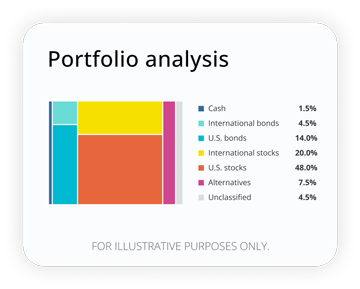
How well are your investments performing?
Analyze your portfolio in minutes and receive a target allocation for your goals.
Methodology: Average 401(k) balances are based on Empower Personal Dashboard data as of July 2025. Benchmark incomes were estimated using U.S. Census population counts by single year of age (Vintage 2024) and BLS median weekly earnings by age bracket (Q2 2025). To align with decade-based age groups (20s, 30s, etc.), each decade’s income was calculated as a population-weighted average across the relevant BLS brackets (for example, ages 30–34 from the 25–34 bracket and ages 35–39 from the 35–44 bracket). For the 60s group, we included both the 55–64 and 65+ BLS brackets to capture earnings across ages 60–69. Weekly earnings were annualized, and the weighted averages were then used to set savings benchmarks (e.g., 1× salary by 30, 3× by 40, 6× by 50, 8× by 60, and 10× by retirement). This approach ensures benchmarks reflect both current income levels and the actual demographic distribution of U.S. workers, rather than relying on a single midpoint value.
1 U.S. Census Bureau, “National Population by Characteristics: 2020–2024, Single-Year-of-Age Data (Vintage 2024),” June 2025.
2 U.S. Bureau of Labor Statistics, “Usual Weekly Earnings of Wage and Salary Workers, Q2 2025, Table 3,” July 2025.
3 IRS, “401(k) limit increases to $23,500 for 2025, IRA limit remains $7,000,” November 2024.
RO4763600-0825
 Get The Currency newsletter



The Currency editors
Staff contributors
The CurrencyTM writers and editors cover the latest financial news and insights shaping how we live, work, and play. The team provides accurate, data-driven, and timely content aimed at empowering financial freedom for all.
The content contained in this blog post is intended for general informational purposes only and is not meant to constitute legal, tax, accounting or investment advice. You should consult a qualified legal or tax professional regarding your specific situation. No part of this blog, nor the links contained therein is a solicitation or offer to sell securities. Compensation for freelance contributions not to exceed $1,250. Third-party data is obtained from sources believed to be reliable; however, Empower cannot guarantee the accuracy, timeliness, completeness or fitness of this data for any particular purpose. Third-party links are provided solely as a convenience and do not imply an affiliation, endorsement or approval by Empower of the contents on such third-party websites. This article is based on current events, research, and developments at the time of publication, which may change over time.
Certain sections of this blog may contain forward-looking statements that are based on our reasonable expectations, estimates, projections and assumptions. Past performance is not a guarantee of future return, nor is it indicative of future performance. Investing involves risk. The value of your investment will fluctuate and you may lose money.
Certified Financial Planner Board of Standards Inc. (CFP Board) owns the certification marks CFP®, CERTIFIED FINANCIAL PLANNER™, CFP® (with plaque design), and CFP® (with flame design) in the U.S., which it authorizes use of by individuals who successfully complete CFP Board's initial and ongoing certification requirements.