

From credit scores to cash flows: How fintech is reshaping small-business lending
From credit scores to cash flows: How fintech is reshaping small business lending
Fintech platforms and online lenders are using real-time data to approve loans in hours, expanding access to capital for millions of entrepreneurs
From credit scores to cash flows: How fintech is reshaping small business lending
Fintech platforms and online lenders are using real-time data to approve loans in hours, expanding access to capital for millions of entrepreneurs

11.06.2025

Listen
·From credit scores to cash flows: How fintech is reshaping small business lending
Small businesses are finding new funding pathways beyond traditional loans, with some lenders approving financing in hours by analyzing payment flows instead of credit scores.
Key takeaways
- Small businesses are looking beyond traditional bank lending to online and fintech solutions.
- Embedded finance uses AI and real-time data to tailor lending that adjusts with a company’s performance.
- U.S. tariffs have ushered in a wave of business for lending startups, with one firm reporting credit-line applications up 730% year-over-year in August.
Small-business lending is being rebuilt for America’s 36 million plus entrepreneurs — and it’s happening inside the platforms they already use.1 Companies like Square, PayPal, and Uber (in partnership with Pipe) are turning the tools that small businesses rely on every day into sources of capital, using real-time sales data to offer faster, more accessible funding.2 At the same time, a new generation of fintech lenders — including Wayflyer, Clearco, and Slope — is leveraging transaction and e-commerce data to deliver loans in hours instead of weeks.
The shift is redefining how companies manage growth and cash flow, providing a modern alternative to traditional bank lending. The broader trend, known as embedded finance, is already proving how digital infrastructure can deliver capital faster when small businesses face disruption. Demand for short-term loans surged in August as import-heavy companies faced new tariffs on Chinese goods and growing uncertainty about supply costs. Slope reported that applications for its credit lines surged 730% year-over-year.3
Read more: How mega-retailers are turning tariffs into opportunity
Fintech moves faster
Industry estimates suggest fintech companies now generate 10–15% of small business loan volume — a small share of dollars but nearly double the number of borrowers served by traditional banks.4
Small businesses often need access to capital to grow and scale, but the criteria and processes traditional lenders use to determine creditworthiness sometimes prevents them from qualifying. Traditional lenders generally look at credit scores, years in business, and minimum monthly or annual revenue, which can favor companies with long track records and steady cash flow. Plus, securing funding through a bank often still requires in-person applications and manual document reviews, with approval processes that can take weeks because of conservative risk assessments and regulatory checks.5
Inside the new lending ecosystem
Instead of relying on credit scores and collateral, fintech lenders now track real-time sales data and how a business performs day-to-day. They can see a café’s morning surge in card swipes or an online retailer’s weekend sales spike and adjust credit offers automatically.6
With AI-driven data integration and real-time analytics, capital is becoming more responsive to how businesses operate, helping small-to-medium sized businesses (SMBs) find the capital solutions they need. The Federal Reserve Banks’ Small Business Credit Survey shows that while large and small banks remain the dominant financers, 24% of small businesses surveyed sought financing through an online lender in 2024. Expected odds of success, quick service, lack of collateral requirements, and denial by other lenders most commonly drove firms to apply at online lenders.7
Read more: 42% of Americans are willing to pay more when shopping local to support small businesses
From dashboards to deposits
Uber, in partnership with Pipe, now provides capital offers directly in its Uber Eats Manager app based on the restaurant’s sales history. Loans can be approved instantly, with funds arriving in the business bank account within 24 hours.8 Square provides custom loan offers ranging from $100-$350K based on business performance and deposits the cash the next business day after approval.9 Earlier this year, PayPal announced it had passed $30 billion in global loan originations for small businesses since launching its first merchant lending solution in 2013.10
Filling a critical gap for small businesses
Small businesses are considered the “backbone” of the U.S. economy and “the heart” of their communities.11,12 They create jobs, stimulate local economies, add character to the neighborhood, and often provide financial support for local groups and organizations.
These firms make up more than 43% of the U.S. gross domestic product (GDP) and nearly 40% of private sector payroll.13 Between 2021 and 2024, businesses with under 250 employees accounted for nearly 53% of net job gains, according to the U.S. Bureau of Labor Statistics (BLS).14
Despite their impact, access to capital continues to be a critical challenge. Only 44% of SMBs currently have access to any form of external financing — whether through bank loans, lines of credit, or alternative lending.15
Of those SMBs who do have access to capital, 37% report they are highly interested in switching to providers that offer embedded lending options, highlighting how demand for faster, more flexible credit is reshaping the small business finance market.16
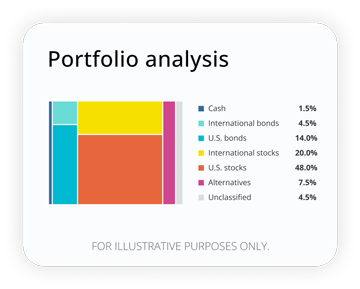
How well are your investments performing?
Analyze your portfolio in minutes and receive a target allocation for your goals.
1 U.S. Small Business Administration Office of Advocacy, “New Advocacy Report Shows the Number of Small Businesses in the U.S. Exceeds 36 million,” June 2025.
2 Forbes, “How Uber And Fintechs Are Changing Small Business Lending,” September 2025.
3 Bloomberg, “Small Businesses Turn to Lending Startups as Tariff Costs Mount,” September 2025.
4 Future Nexus, “Are We About to Make a Quantum Leap in Small Business Lending?” September 2025.
5 Stripe, “Fintech lending 101: The benefits and challenges of this new lending model,” August 2024.
6 Forbes, “How Uber And Fintechs Are Changing Small Business Lending,” September 2025.
7 Federal Reserve Banks, ““2025 Report on Employer Firms: Findings from the 2024 Small Business Credit Survey,” March 2025.
8 Forbes, “How Uber And Fintechs Are Changing Small Business Lending,” September 2025.
9 Square, “Square Loans,” November 2025.
10 PayPal, “PayPal Surpasses $30B in Global Small Business Lending,” May 2025.
11 Office of the United States Trade Representative, “Small Business,” November 2025.
12 NFIB Research Center, “2024 Small Business Contribution to the Community,” November 2024.
13 U.S. Small Business Administration Office of Advocacy, “Frequently Asked Questions About Small Business,” July 2024.
14 U.S. Bureau of Labor Statistics, “Small businesses continue to outpace large businesses in job creation,” May 2025.
15 PYMNTS, “B2B FinTechs Target SMBs With Expanded Offerings,” April 2025.
16 Ibid.
RO4967890-1125
 Get The Currency newsletter



The Currency editors
Staff contributors
The CurrencyTM writers and editors cover the latest financial news and insights shaping how we live, work, and play. The team provides accurate, data-driven, and timely content aimed at empowering financial freedom for all.
The content contained in this blog post is intended for general informational purposes only and is not meant to constitute legal, tax, accounting or investment advice. You should consult a qualified legal or tax professional regarding your specific situation. No part of this blog, nor the links contained therein is a solicitation or offer to sell securities. Compensation for freelance contributions not to exceed $1,250. Third-party data is obtained from sources believed to be reliable; however, Empower cannot guarantee the accuracy, timeliness, completeness or fitness of this data for any particular purpose. Third-party links are provided solely as a convenience and do not imply an affiliation, endorsement or approval by Empower of the contents on such third-party websites. This article is based on current events, research, and developments at the time of publication, which may change over time.
Certain sections of this blog may contain forward-looking statements that are based on our reasonable expectations, estimates, projections and assumptions. Past performance is not a guarantee of future return, nor is it indicative of future performance. Investing involves risk. The value of your investment will fluctuate and you may lose money.
Certified Financial Planner Board of Standards Inc. (CFP Board) owns the certification marks CFP®, CERTIFIED FINANCIAL PLANNER™, CFP® (with plaque design), and CFP® (with flame design) in the U.S., which it authorizes use of by individuals who successfully complete CFP Board's initial and ongoing certification requirements.