

Taxes on an inherited 401(k): What beneficiaries need to know
Taxes on an inherited 401(k): What beneficiaries need to know
Learn when taxes may apply, how distributions and the 10-year rule can affect taxation, and what to consider before withdrawing
Taxes on an inherited 401(k): What beneficiaries need to know
Learn when taxes may apply, how distributions and the 10-year rule can affect taxation, and what to consider before withdrawing

11.04.2026
Key takeaways
- Inheriting a 401(k) doesn't automatically mean you'll owe taxes — taxes generally apply when you withdraw money.
- Different tax rules apply to inherited pre-tax and Roth 401(k) accounts, and your withdrawal timing can affect how much you owe.
- Understanding your options and planning withdrawals around required deadlines may help you manage your tax bill.
Inheriting a 401(k) can come with some important financial decisions, including one big question: Will you owe taxes on the money?
The good news is that inheriting a 401(k) doesn't automatically trigger a federal income tax bill. Instead, taxes generally apply when you withdraw money from the account. How much you'll owe depends on several factors, including whether you've inherited pre-tax and/or Roth 401(k) accounts, your relationship to the original account owner, and when you take withdrawals.
Understanding the rules can help you avoid unexpected taxes and make informed decisions about your inheritance.
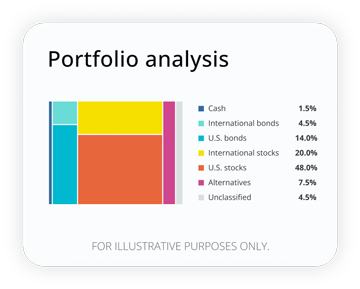
How well are your investments performing?
Analyze your portfolio in minutes and receive a target allocation for your goals.
Do you pay taxes on an inherited 401(k)?
Income taxes on inherited 401(k) withdrawals are different from estate or inheritance taxes. There is no single inherited 401(k) tax rate. The amount you ultimately owe depends on your total taxable income, filing status, deductions, credits, and applicable federal and state tax laws.
As you consider when to make withdrawals, keep in mind individuals who inherit 401(k)s and other qualified retirement plans are typically subject to required minimum distribution (RMD) rules.1
The plan's rules determine which distribution options are available to meet the requirements. Surviving spouses typically have more options than non-spouse beneficiaries. The plan administrator can explain which options are available and help beneficiaries understand the applicable distribution requirements.
Read more: Taxes on inheritances and how to avoid them
How pre-tax, Roth, and after-tax 401(k) money is taxed after inheritance
Not all inherited 401(k) funds receive the same tax treatment. Before making a withdrawal, it's important to understand what type of money is in the account.
Pre-tax 401(k) accounts
If you inherit a pre-tax 401(k) account, funds you withdraw are generally taxed as ordinary income at the federal level.2 That means the taxable portion of your withdrawal is added to your other income for the year and taxed at your applicable income tax rates.
For example, if you inherit a $100,000 pre-tax 401(k) account and withdraw $20,000, you generally pay federal income tax on the $20,000 distribution, assuming the money was entirely pre-tax. You wouldn't automatically owe income tax on the remaining $80,000 simply because you inherited it. Remember, making a larger withdrawal could increase your taxable income for the year enough to move some of it into a higher tax bracket.
Some states may also tax retirement plan distributions as income, while others offer exemptions or don't impose individual income taxes. State rules vary, so check with your state tax agency to determine whether and how your inherited 401(k) withdrawals may be taxed.3
Roth 401(k) accounts
If you inherited a Roth 401(k) account, it may receive more favorable tax treatment. Because Roth contributions are made with after-tax dollars, those contributions generally aren't taxed again when withdrawn.4*
Investment earnings may also be tax-free if the distribution meets the IRS requirements for a qualified distribution. For designated Roth accounts, this generally includes satisfying the five-taxable-year holding period and meeting a qualifying condition, such as the original account owner's death.5 If the five-year requirement hasn't been met, part of a distribution attributable to earnings may be taxable.
Read more: Inherited a retirement account? Understanding your options
How inherited 401(k) options can affect tax timing
One of the most important decisions you'll make is what to do with the inherited account. Your options depend on your beneficiary status and what the 401(k) plan allows. Not every plan offers every distribution option. Here’s how some of the common choices compare:
Option | Potential immediate tax impact | Key consideration |
Leave money in the plan | Keeps money tax-advantaged with generally no immediate tax on funds left in the account | Plan rules and distribution deadlines apply |
Direct transfer to an inherited IRA | Generally preserves tax deferral if properly executed | Inherited IRA distribution rules apply |
Surviving spouse rollover to own account | Generally avoids immediate tax on eligible rollover amounts | Future withdrawals follow applicable owner rules |
Partial or lump-sum withdrawal | Pre-tax amounts generally taxable in the year received | Could increase your taxable income |
Read more: Inherited IRA beneficiary options & withdrawal rules
How the 10-year rule and RMDs affect taxable income
Many non-spouse beneficiaries must withdraw an inherited 401(k) in full by the end of the 10th year after the original account owner's death.6 For example, if the owner died in 2026, the deadline would generally be December 31, 2036.
However, some beneficiaries, including surviving spouses, may qualify for different rules. Annual RMDs may also apply during the 10-year period if the original owner had reached their required beginning date.7 Any outstanding RMD for the year of death generally must still be taken. Withdrawals of pre-tax funds are generally taxable in the year received, so timing can affect your tax bill.8
How withholding and the 10% additional tax work
When you withdraw money from an inherited 401(k), you may encounter two additional tax-related rules as well.
Federal income tax withholding
Depending on the type of distribution you take, your plan may automatically withhold some of the funds and send to the IRS.9 Certain eligible rollover distributions paid directly to beneficiaries generally require 20% withholding, but that doesn't mean your final tax rate is 20%. This isn't an additional tax — it’s a prepayment toward the income taxes you owe on the withdrawal. For example, if you withdraw $10,000 and $2,000 is withheld, you'll receive $8,000, with the remaining $2,000 credited toward your federal tax bill.
10% early-withdrawal additional tax
Normally, withdrawing retirement funds before age 59½ may trigger an additional 10% tax. However, inherited 401(k) distributions are generally exempt from this additional tax, regardless of your age.10 Different rules may apply if a surviving spouse rolls the money into their own retirement account.
Tax reporting
Your plan will generally report distributions on IRS Form 1099-R, which shows the amount withdrawn and any federal income tax withheld.11
How to manage taxes on an inherited 401(k)
While you generally can't avoid income taxes on inherited pre-tax funds, a little planning may help you manage your tax bill. Here are a few steps to consider before making a withdrawal from an inherited 401(k):
- Know your options. Check with the plan administrator about available withdrawal and transfer options, RMDs, and deadlines. Rules may differ depending on your beneficiary status.
- Understand what you're inheriting. Find out what the account contains pre-tax, Roth, and/or after-tax funds, as each may have different tax implications.
- Consider spreading out withdrawals. When allowed, taking smaller distributions over several years may help manage your taxable income. For example, withdrawing $20,000 annually from a $100,000 inherited 401(k) over five years may have a different tax impact than taking the full amount at once.
- Explore a direct transfer. Rolling over eligible funds directly to an inherited IRA may allow you to defer taxes until you withdraw the money on your own timeline, subject to distribution deadlines.12 **
- Plan for taxes. Consider how withdrawals may affect your income, including potential federal and state taxes. A tax professional can help you estimate what you may owe and how much should be withheld.
Also, be sure to keep important records, including your distribution confirmations and Form 1099-R.
**Carefully consider all options, including leaving your money in your existing retirement plan, and compare benefits, tax consequences, fees, and expenses before moving your money.
Read more: What to do when a loved one dies: A financial checklist
The bottom line
Inheriting a 401(k) doesn't necessarily trigger an immediate tax bill, but your withdrawal decisions can affect how much you owe. Understanding the account's tax treatment, distribution deadlines, and available options can help you make the most of your inheritance.
Frequently asked questions
How much tax do you pay if you inherit a pre-tax 401(k) account valued at $100,000?
There's no fixed tax rate. If you withdraw $100,000 from a fully pre-tax inherited 401(k) account, the amount generally counts as ordinary income. Your tax bill will depend on your other income, filing status, deductions, and applicable tax laws.
Do state taxes apply to inherited 401(k) distributions?
They can. State income tax treatment varies, and some states also impose separate estate or inheritance taxes.
What is the best way to handle an inherited 401(k)?
It depends on your financial needs, beneficiary status, and tax situation. Compare lump-sum withdrawals, eligible transfers, and other available options, and consider consulting with a professional before making a decision.
1 Internal Revenue Service, “Retirement topics – Beneficiary,” August 1, 2026.
2 Internal Revenue Service, “Retirement topics - Tax on normal distributions,” February 26, 2026.
3 Internal Revenue Service, “State government websites,” October 11, 2026.
4 Internal Revenue Service, “Retirement plans FAQs on designated Roth accounts,” August 2, 2026.
5 Ibid.
6 Internal Revenue Service, “Retirement topics – Beneficiary,” August 1, 2026.
7 Internal Revenue Service, “Required minimum distributions for IRA beneficiaries,” November 16, 2026.
8 Internal Revenue Service, “Retirement topics - Required minimum distributions (RMDs),” April 8, 2026.
9 Internal Revenue Service, “Rollovers of retirement plan and IRA distributions,” May 31, 2026.
10 Internal Revenue Service, “Retirement topics - Exceptions to tax on early distributions,” December 11, 2025.
11 Internal Revenue Service, “About Form 1099-R, Distributions From Pensions, Annuities, Retirement or Profit-Sharing Plans, IRAs, Insurance Contracts, etc.,” October 16, 2026.
12 Internal Revenue Service, “Rollovers of retirement plan and IRA distributions,” May 31, 2026.
*Roth withdrawals are federally tax-free if they are qualified distributions as defined by the IRS. For a distribution to be qualified, the account must have been open for at least five years, and the withdrawal must occur after age 59½, death, or disability. Earnings withdrawn before those conditions are met may be subject to taxes and penalties. Tax laws are subject to change. State and local taxes may still apply.
RO6065521-1026
 Get The Currency newsletter



The content contained in this blog post is intended for general informational purposes only and is not meant to constitute legal, tax, accounting or investment advice. You should consult a qualified legal or tax professional regarding your specific situation. No part of this blog, nor the links contained therein is a solicitation or offer to sell securities. Compensation for freelance contributions not to exceed $1,250. Third-party data is obtained from sources believed to be reliable; however, Empower cannot guarantee the accuracy, timeliness, completeness or fitness of this data for any particular purpose. Third-party links are provided solely as a convenience and do not imply an affiliation, endorsement or approval by Empower of the contents on such third-party websites. This article is based on current events, research, and developments at the time of publication, which may change over time.
Certain sections of this blog may contain forward-looking statements that are based on our reasonable expectations, estimates, projections and assumptions. Past performance is not a guarantee of future return, nor is it indicative of future performance. Investing involves risk. The value of your investment will fluctuate and you may lose money.
Certified Financial Planner Board of Standards Inc. (CFP Board) owns the certification marks CFP®, CERTIFIED FINANCIAL PLANNER™, CFP® (with plaque design), and CFP® (with flame design) in the U.S., which it authorizes use of by individuals who successfully complete CFP Board's initial and ongoing certification requirements.